
AI Governance Policy GCC: Trusted SME Guide
AI Governance Policy GCC: Trusted SME Guide
AI Governance Policy GCC: Trusted SME Guide
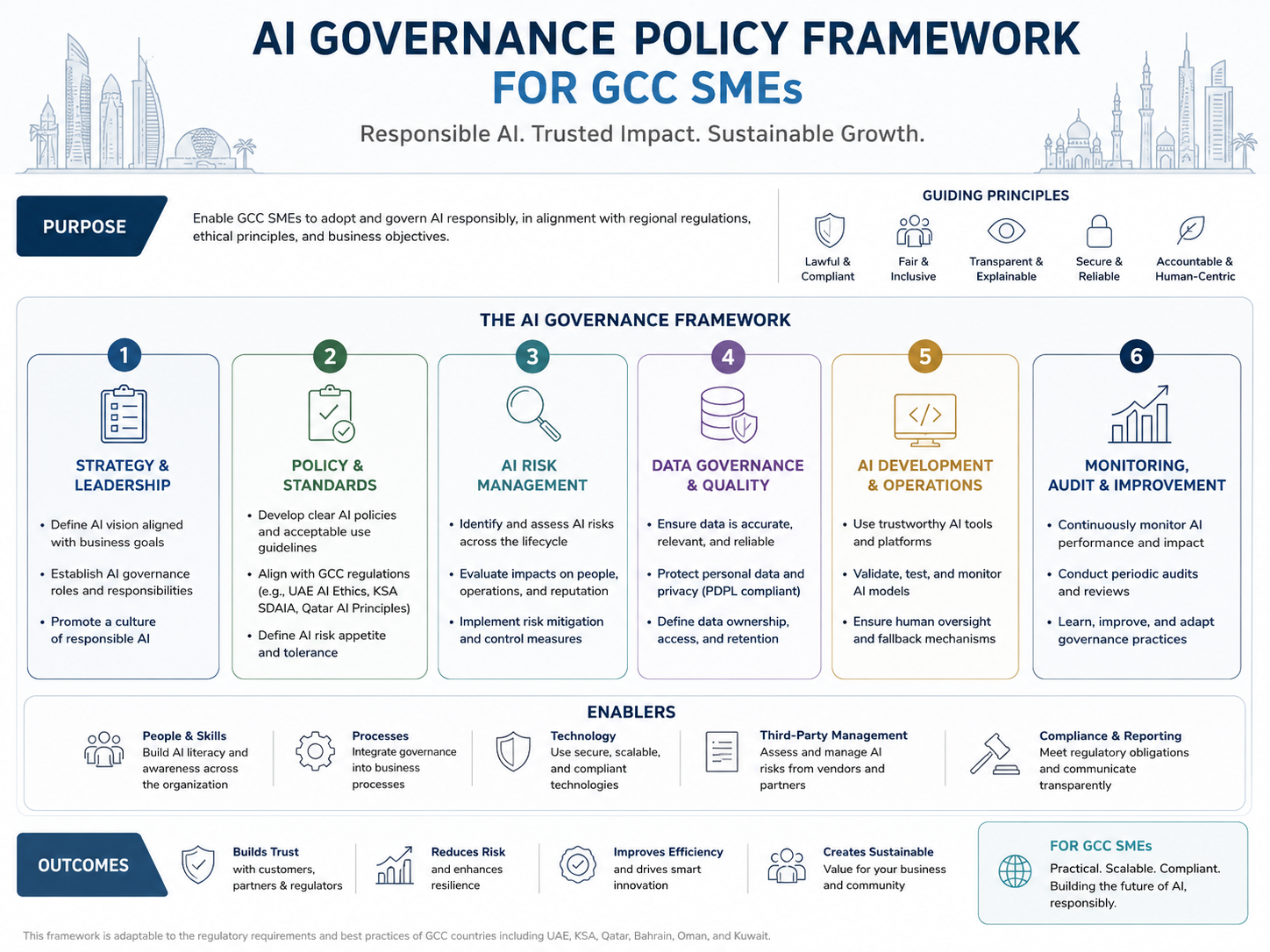
An AI Governance Policy GCC helps SMEs in Saudi Arabia, the UAE, and Qatar use AI tools safely, responsibly, and without unnecessary enterprise complexity. It gives founders clear rules for approved tools, sensitive data, vendor checks, risk levels, human review, Arabic-language quality, and customer transparency.
For SMEs, the goal is simple: use AI to move faster without exposing customer data, creating unfair decisions, or losing trust.
Introduction
AI is already inside many GCC businesses, even when there is no official policy. A Riyadh fintech team may use AI for customer screening. A Dubai e-commerce brand may use chatbots for Arabic support. A Doha SME may use AI analytics to forecast sales or automate reports.
That speed is useful. But without clear controls, small mistakes can become legal, financial, or reputational problems.
An AI Governance Policy GCC gives SMEs a practical way to manage AI before things get messy. It helps your team decide which tools are safe, what data should never be entered, when human review is required, and how vendors should be checked before launch.
For Arabic-speaking customers, it also supports better user experience. AI responses should be accurate, culturally respectful, transparent, and easy to escalate to a real person when needed.
What Is an AI Governance Policy for GCC SMEs?
AI Governance Policy Meaning in Simple Business Terms
An AI governance policy is a business rulebook for how your company uses AI.
It explains.
Which AI tools are approved
What data employees can and cannot enter
Who approves risky AI use cases
When a human must review AI output
How vendors, logs, access, and incidents are managed
How often the policy should be updated
For GCC SMEs, this is not just a technical document. It connects AI use with customer trust, cybersecurity, data governance, Arabic UX, and local compliance expectations.
Why SMEs in Saudi, UAE, and Qatar Need AI Rules
Many SMEs in Riyadh, Jeddah, Dubai, Abu Dhabi, and Doha start using AI before creating proper controls. That can lead to employees uploading customer data into public tools, vendors using unclear models, or AI influencing decisions in HR, finance, or customer service without proper review.
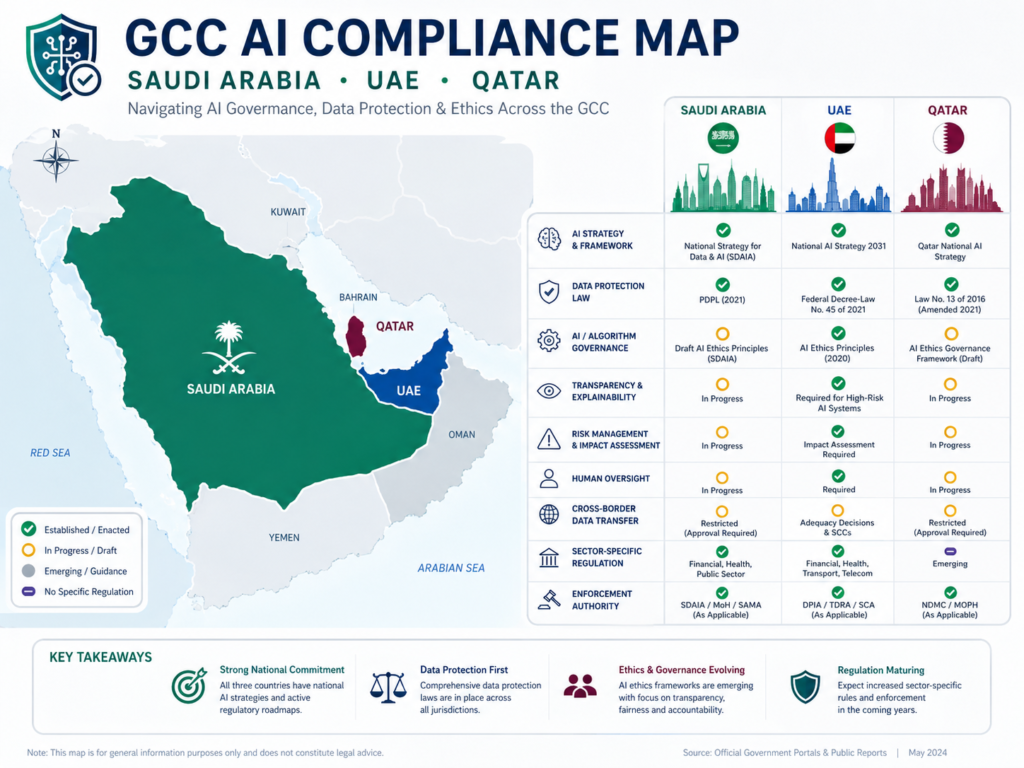
Saudi Arabia’s SDAIA AI Ethics Principles make responsible AI an important topic for organizations operating in the Kingdom. In the UAE, fast AI adoption across digital services shows how seriously the market is moving toward AI-enabled transformation. In Qatar, fintech and financial service businesses should treat AI risk as part of wider operational governance.
A practical AI Governance Policy GCC helps SMEs stay organized while still moving quickly.
What a Practical SME AI Policy Should Cover
A useful SME AI policy does not need to be a long corporate manual. It should be clear enough for employees, managers, vendors, and founders to follow.
At minimum, it should cover.
Approved AI tools
Prohibited data
Risk levels by use case
Vendor review requirements
Model monitoring
Arabic-language quality checks
Human review rules
Incident response
Policy review dates
The best policy is the one your team actually uses.
Core AI Governance Policy Templates SMEs Should Use
AI Use Case Register Template
An AI use case register lists every AI tool and workflow used across the company. This gives management visibility before AI spreads informally across teams.
A simple register can include.
| Field | What to Record |
|---|---|
| Tool name | Chatbot, AI CRM, analytics tool, code assistant, etc. |
| Department | Sales, HR, finance, customer support, IT |
| Purpose | What the tool is used for |
| Data used | Customer data, public data, internal documents, payment data |
| Business owner | Person responsible for the tool |
| Risk level | Low, medium, or high |
| Approval status | Approved, pending, restricted, or rejected |
| Human review | Required or not required |
For example, a Dubai retailer using AI for product recommendations should record whether customer behavior data is used, where the system is hosted, and who reviews performance.
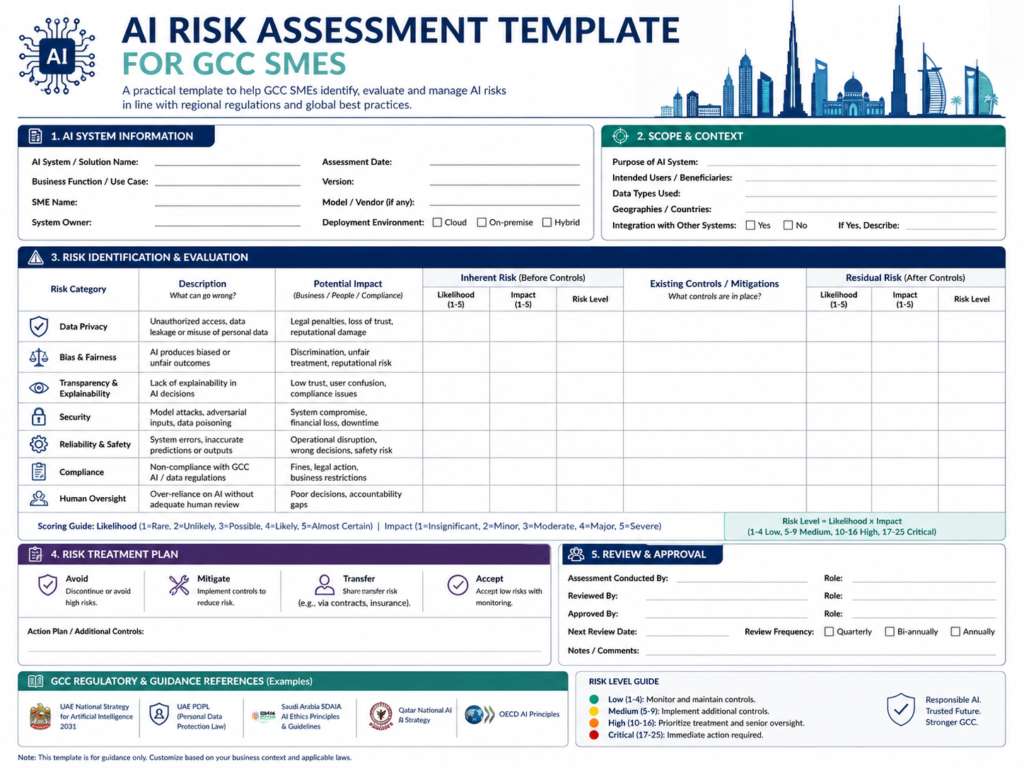
AI Risk Assessment Template
An AI risk assessment separates low-risk AI tasks from sensitive decisions.
Drafting internal emails or summarizing public content may be low risk. Credit scoring, hiring recommendations, medical triage, fraud detection, payment monitoring, and customer eligibility decisions are much higher risk.
A strong AI compliance policy should review risk across.
Privacy
Bias or unfair treatment
Cybersecurity
Financial harm
Customer impact
Regulatory exposure
Reputation risk
High-risk use cases should require approval, testing, legal or compliance review, cybersecurity checks, and human oversight.
AI Vendor Review Checklist
AI vendor governance is essential when SMEs buy SaaS platforms, APIs, chatbots, analytics tools, AI-enabled CRMs, or customer support automation.
Before signing a contract, ask:
Where is the data stored?
Are prompts or inputs used to train the vendor’s model?
Can logs be accessed, exported, or deleted?
Who can access company or customer data?
Is human override available?
What happens during a security incident?
Does the tool support Arabic properly?
Are customer disclosures required?
Can the vendor meet sector-specific expectations?
Teams building customer-facing products can also connect vendor review with secure delivery through mobile app development services or scalable front-end development services.
GCC Compliance Considerations for AI Governance
Saudi Arabia.
In Saudi Arabia, SMEs should align AI governance with responsible AI principles, data classification expectations, and financial sector requirements when relevant.
A Riyadh fintech startup, for example, should avoid using AI for customer eligibility decisions without documented testing, explain ability, human escalation, and ownership.
SAMA is especially relevant for fintech, banking, payments, fraud monitoring, and customer data workflows. Your AI Governance Policy GCC should define who approves AI in regulated processes and how decisions are reviewed.
UAE.
In the UAE, AI governance should reflect the country’s strong digital direction while still protecting customers and business data.
Dubai and Abu Dhabi startups should pay special attention to AI used in fintech, legal workflows, investor communication, customer support, and personal data processing.
A Dubai SaaS company using an AI chatbot should document.
Chatbot behavior
Customer disclosures
Escalation paths
Arabic-English response quality
Vendor access
Data storage and logging
Fast AI adoption is not a reason to skip governance. It is a reason to make governance practical.
Qatar.
For Qatar SMEs, QCB is especially important when AI touches fintech or financial services.
A Doha startup using AI for payments, lending, onboarding, customer analytics, or fraud detection should document the use case, classify the risk, keep audit logs, test outputs, and assign a responsible owner.
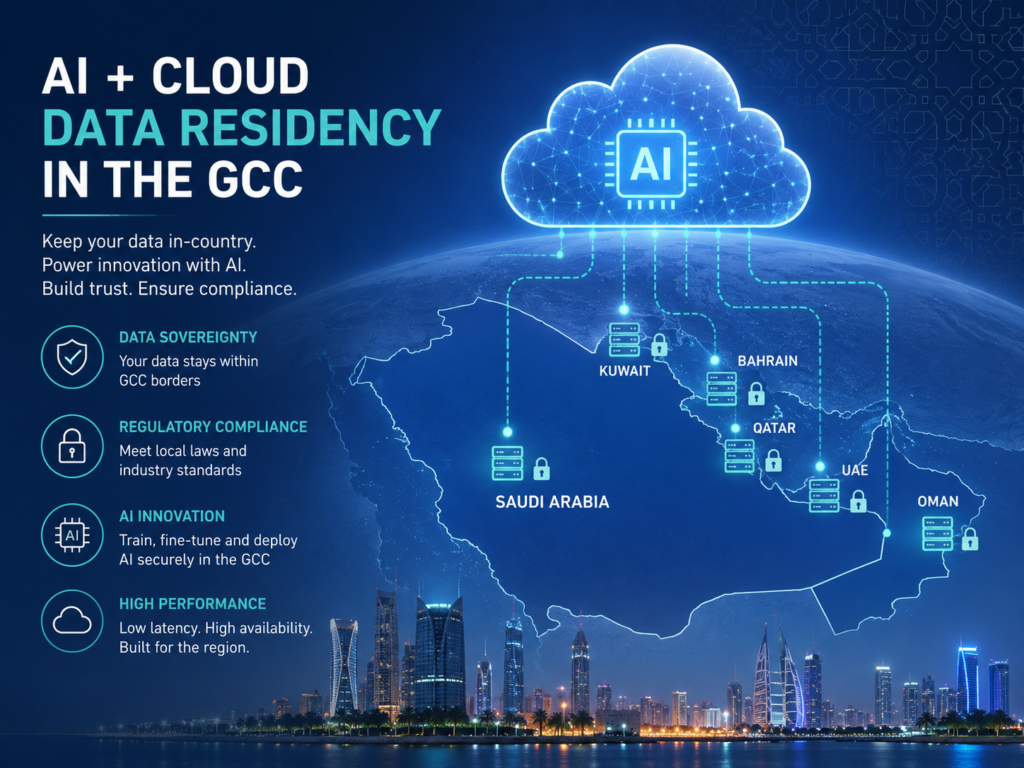
A Qatar business using GCP Doha or other regional cloud options should connect AI data governance with data residency, access controls, and audit logs.
How to Build an AI Governance Policy GCC Step by Step
Map AI Tools, Data, and Business Owners
Start by listing every AI tool used by staff, vendors, and systems.
Include:
Chat GPT-style tools
AI design platforms
Analytics engines
CRM automation
Code assistants
Customer service bots
AI tools inside existing SaaS platforms
Assign each tool to a business owner, not only IT. This creates accountability and avoids “shadow AI” spreading across the company without control.
Classify AI Risk by Use Case
Classify each use case as low, medium, or high risk.
Low-risk tools can move faster. High-risk tools should require approval, testing, cybersecurity checks, legal or compliance input, and human review.
For secure software workflows, SMEs can also review AI vulnerability detection guidance to connect AI adoption with DevSecOps.
Approve, Monitor, and Review AI Usage
Create a simple governance cycle.
Request the AI use case
Assess the risk
Approve, restrict, or reject it
Monitor performance and incidents
Review the policy regularly
Update the policy quarterly or whenever a major tool, vendor, regulation, or data flow changes.
Local AI Governance Use Cases in the GCC
Fintech and Payments in Riyadh, Dubai, and Doha
A Riyadh fintech following SAMA expectations should review AI used in fraud detection, onboarding, payment monitoring, and customer scoring.
A Dubai fintech in DIFC or ADGM should check vendor transparency, auditability, and customer disclosures.
A Doha fintech should align AI controls with QCB-related risk expectations, especially when decisions affect financial access or customer onboarding.
Retail, E-commerce, and Arabic Customer Support
A Dubai e-commerce brand using AI chatbots should test Arabic dialect handling, refund responses, religious and cultural sensitivity, and escalation to human agents.
Strong UX can be supported through web designing services and SEO services.
In practice, Arabic chatbot governance should not only check grammar. It should check tone, accuracy, refund policy handling, customer frustration, and when the bot should stop answering and hand over to support.
Logistics, Government Suppliers, and Data Residency
A logistics SME serving government clients in Abu Dhabi, Riyadh, or Doha should document routing algorithms, vendor access, data sharing, and cloud locations.
This matters during procurement reviews. Clients may want to know where data goes, who can access it, and whether automated decisions are reviewed by people.

Data, Cloud, and Arabic UX Requirements
Data Residency Across Saudi, UAE, and Qatar
Cloud choice matters. GCC SMEs may consider regional options such as AWS Bahrain, Azure UAE Central, and GCP Doha depending on data residency, latency, sector expectations, and customer contracts.
Your responsible AI framework should state where sensitive data can and cannot go.
Sensitive data may include.
Identity documents
Payment information
Health information
Government-related data
Customer complaints
Employee records
Confidential contracts
Before sending this data into any AI tool, review the vendor terms, storage location, access controls, and deletion process.
Arabic UX, Bias, and Customer Transparency
Arabic-speaking customers deserve clear AI disclosures. If a chatbot is AI-powered, say so.
If an answer affects refunds, eligibility, access, complaints, or service quality, offer human review. Customers should not feel trapped inside an automated system.
Bias also matters. AI outputs should be checked for unfair treatment based on nationality, language, gender, location, age, or financial status.
Human Review for Sensitive AI Decisions
Human review should be mandatory for finance, HR, healthcare, public-sector services, legal workflows, complaints, and customer eligibility.
AI can assist. People should own sensitive decisions.
A simple rule works well: if the AI output can affect someone’s money, job, health, rights, access, or reputation, a qualified person should review it before action is taken.
Choosing the Right AI Governance Template for Your SME
Free Template vs. Custom AI Governance Policy
A free template is useful for early structure. It can help founders start quickly and identify obvious gaps.
A custom AI Governance Policy GCC is better when your SME handles regulated data, customer-facing AI, fintech workflows, employee evaluation, government contracts, or cross-border data processing.
What Founders Should Ask Before Using AI Tools
Before adopting a new AI tool, founders should ask.
What data goes into the tool?
Is the data stored?
Can the vendor use it to train models?
Who accesses logs?
Can we delete data?
Is Arabic output tested?
Can a human override the AI?
What happens if the AI gives a harmful answer?
Who owns the risk inside the company?
These questions are simple, but they prevent many expensive problems.
When to Involve Legal, Compliance, or Cybersecurity Teams
Bring experts in when AI touches personal data, payments, customer eligibility, employee evaluation, health data, legal documents, or cross-border processing.
SMEs can explore broader support through Mak It Solutions services, GCC IT support guidance, or direct consultation via contact.
Final Take
A strong AI Governance Policy GCC helps SMEs in Saudi Arabia, the UAE, and Qatar use AI with more confidence, control, and customer trust. By setting clear rules for approved tools, sensitive data, vendor checks, Arabic UX, and human review, businesses can reduce risk without slowing innovation.
For founders, the goal is not to create a complex corporate document. It is to build a practical policy your team can actually follow. With the right governance in place, GCC SMEs can adopt AI responsibly, protect customer data, and stay ready for future compliance needs.
Need a practical AI Governance Policy GCC for your SME in Saudi Arabia, the UAE, or Qatar?
Contact Mak It Solutions to review your AI tools, data flows, vendor risks, compliance gaps, and Arabic customer experience. We can help you create a custom GCC strategy that is clear, responsible, and easy for your team to follow.
FAQs
Q : Do Saudi SMEs need an AI governance policy before using Chat GPT or AI tools?
A : Saudi SMEs should create at least a basic AI governance policy before using Chat GPT or similar tools for customer, employee, financial, or operational data. A simple policy should define approved tools, banned data, human review, vendor checks, and escalation steps.
Q : What should UAE startups include in an AI vendor review checklist?
A : UAE startups should check data storage, prompt retention, model training rights, cybersecurity controls, access logs, incident response, Arabic-language quality, and customer disclosure. Vendor review should happen before contracts are signed, not after launch.
Q : How can Qatar SMEs manage AI risks under QCB fintech expectations?
A : Qatar SMEs in fintech should document AI use cases, classify risk, keep audit logs, test outputs, and ensure human review for sensitive financial decisions. This is especially important for onboarding, fraud detection, credit review, and payment monitoring.
Q : Can GCC SMEs store AI-related customer data outside the region?
A : Sometimes they can, but it depends on the data type, sector, contract terms, cloud region, and applicable data transfer expectations. Sensitive financial, health, government, identity, or employee data needs extra care.
Q : How often should a Dubai or Riyadh SME review its AI governance policy?
A : A Dubai or Riyadh SME should review its AI governance policy at least every quarter and immediately after adding a major AI tool, changing vendors, handling new data types, or entering regulated workflows. AI tools change quickly, so a policy written once and forgotten becomes risky.