


Future-Proof SaaS Pricing Strategy for AI Agents
Future-Proof SaaS Pricing Strategy for AI Agents
Future-Proof SaaS Pricing Strategy for AI Agents
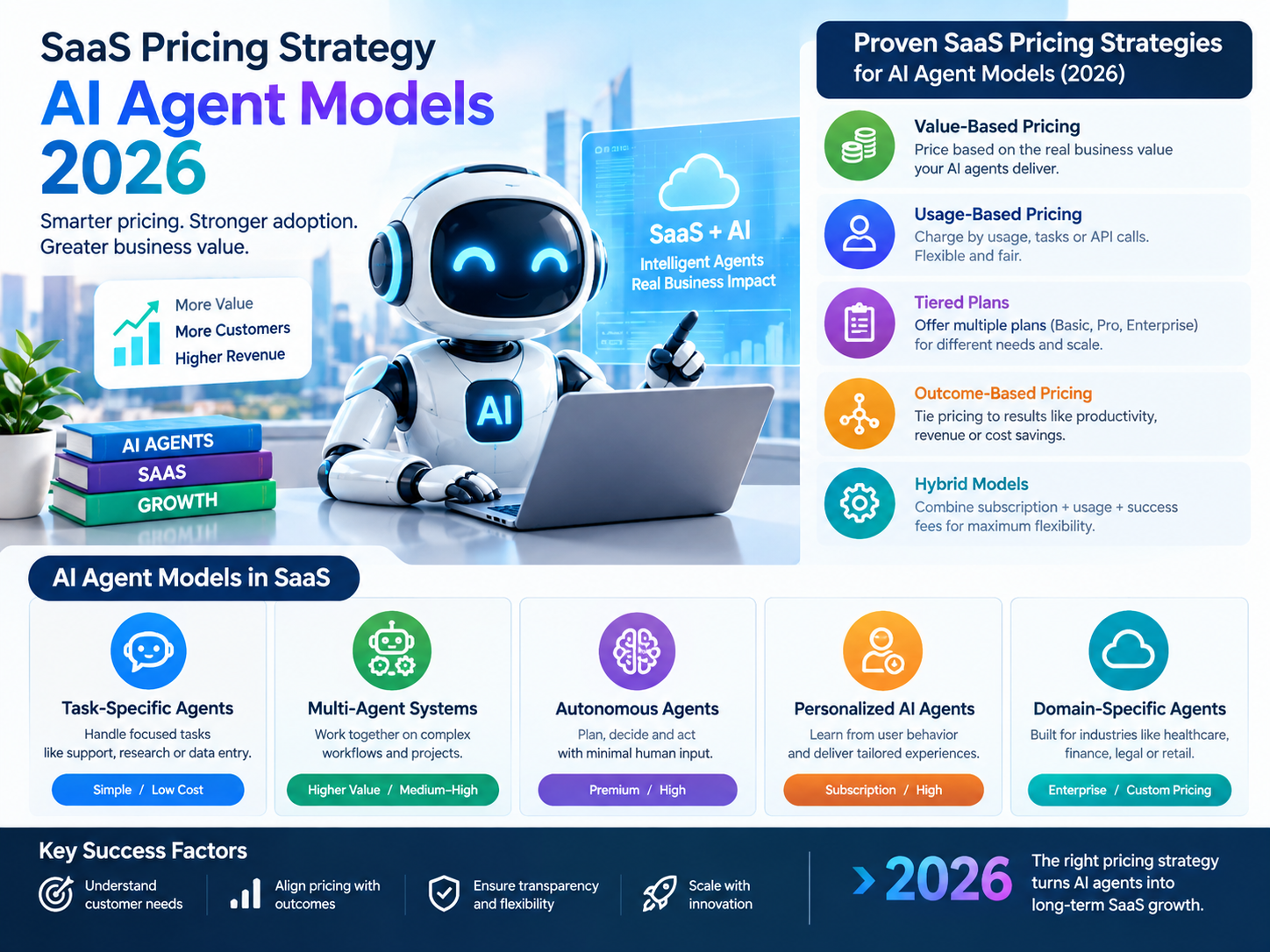
AI agents are changing what customers consume, what vendors pay for, and what a modern SaaS pricing strategy needs to measure. When software can research, resolve tickets, update records, process transactions, and run workflows without adding another human user, charging only by seat starts to lose its connection with value.
For many AI SaaS businesses, the strongest starting point is a predictable platform subscription combined with usage, credits, actions, or clearly defined outcomes. That structure gives buyers more control over spend while helping vendors recover variable inference and automation costs.
Why SaaS Pricing Strategy Must Change for AI Agents
Traditional per-seat pricing assumes that customer value rises roughly with the number of people using a product. AI agents weaken that relationship: one employee may supervise automation doing work that previously required several users, while every automated task can create inference, API, orchestration, storage, retrieval, and monitoring costs.
The shift is already happening against a backdrop of rapid AI adoption. Stanford’s 2025 AI Index reports that 78% of surveyed organizations used AI in 2024, up from 55% in 2023.
Mak It Solutions explores the broader economics of this transition in its agentic arbitrage and SaaS economics guide.
Why Per-Seat Pricing Is Losing Its Value Signal
Per-seat pricing still makes sense when collaboration, administration, or individual access directly drives customer value. It becomes less useful when digital workers perform thousands of tasks without requiring thousands of employee licenses.
Per-agent pricing can act as a bridge. It keeps licensing relatively simple, but the definition of an “agent” needs to be clear especially when two agents can consume dramatically different amounts of compute or deliver very different business outcomes.
Mak It Solutions’ AI Agents vs SaaS pricing analysis looks more closely at how autonomous workflows can compress seat counts without reducing dependence on the underlying SaaS platform.
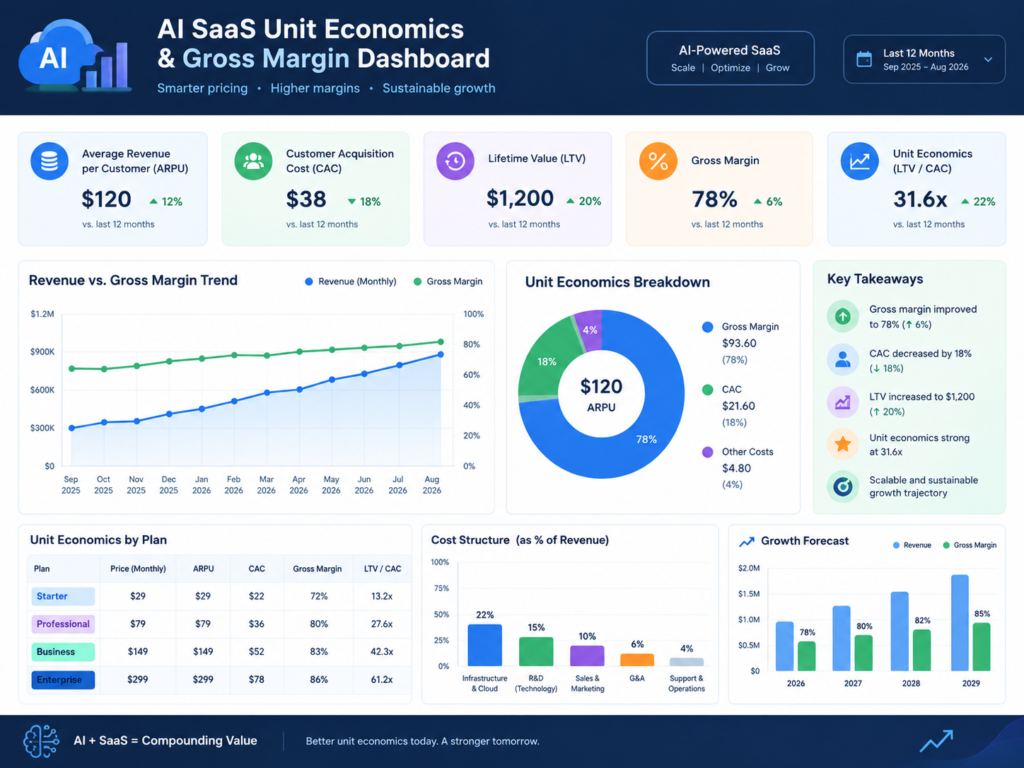
How AI Inference Costs Change SaaS Unit Economics
AI SaaS unit economics need to account for model inference, retrieval, API calls, tool execution, retries, storage, observability, and any required human review as part of cost-to-serve.
That matters because rapid product adoption does not automatically mean healthy growth. If agent activity and AI COGS rise faster than recurring revenue, a product can appear successful while gross margin deteriorates.
The wider SaaS market remains substantial: Gartner reported worldwide enterprise application SaaS revenue of about $218.5 billion in 2024, representing 16.7% year-over-year growth.
The New Goal.
A strong pricing architecture has to balance customer value, willingness to pay, cost-to-serve, predictable invoices, expansion potential, and operational simplicity.
Customers want to know what next month’s bill might look like. Vendors need revenue to expand when AI consumption expands. Pricing that solves only one side of that equation rarely works well for long.
SaaS Pricing Strategy.
There is no universal pricing model for every AI SaaS product. In practice, hybrid pricing is often the most flexible starting architecture because a recurring platform fee creates predictability while usage, credits, actions, or outcomes allow revenue to scale with AI activity.
Seat and Per-Agent Pricing.
Seat-based pricing remains easy to explain, approve, and forecast. Per-agent pricing offers similar simplicity when each deployed digital worker has a clearly defined role.
The weakness appears when workload varies significantly. One agent may perform a few lightweight tasks each day, while another executes compute-heavy workflows continuously. In that situation, license count alone says little about value delivered or cost incurred.
Usage and Credit-Based Pricing.
Usage-based SaaS pricing connects revenue more directly with consumption. Pricing SaaS reported in its Q1 2024 benchmark that more than half of the companies studied included at least one usage-based pricing component, while pure pay-as-you-go pricing appeared in about 12%.
Useful pricing meters include.
Per action: Effective when customers easily understand the billable activity.
Credits: Useful when different AI workloads carry different cost or value weights.
Tokens: Technically transparent, but often too disconnected from business value for non-technical buyers.
API calls: Well suited to infrastructure, platform, and developer-focused products.
The same benchmark found that 24.7% of studied companies were explicitly charging for AI functionality at the time, showing that AI monetization was still developing rather than following one dominant model.
Hybrid and Outcome-Based Pricing
Hybrid structures such as subscription plus usage, platform fee plus credits, or minimum commitment plus overages protect baseline recurring revenue while preserving expansion potential.
Outcome-based pricing goes further by charging for measurable results: qualified leads, resolved tickets, processed invoices, completed workflows, or other business events. It can align strongly with customer value, but only when the outcome is auditable, attributable, measurable, and clearly defined in the contract.
For a deeper look at those trade-offs, see Mak It Solutions’ outcome-based SaaS pricing guide.
How to Choose the Right SaaS Value Metric
A useful SaaS value metric should rise when customer value rises, remain measurable at scale, and maintain a defensible relationship with cost-to-serve.
The key is to test willingness to pay and AI unit economics together. Choosing a metric simply because engineering can meter it is rarely enough.
Separate Technical Consumption From Customer Value
A million tokens might matter internally to the finance and engineering teams, but it usually means little to a CFO buying business software.
“1,000 invoices reconciled” or “500 support tickets resolved” is easier to connect with an operational result. Good value-based pricing gives buyers a clear answer to one question: Why did paying more mean we received more value?
Model Inference Cost, Margin, and Expansion Revenue
A useful economic chain is.
Revenue per unit → AI COGS per unit → Gross margin → Expansion potential
Then test what happens to ARR, NRR, margin, and expansion revenue as usage grows.
Mak It Solutions’ FinOps for AI guide provides additional context for connecting AI consumption with financial accountability.
Stress-Test Low and High Usage
Before launch, model light users, typical accounts, power users, and large enterprise customers. Test both profitability and invoice volatility.
A pricing model can look excellent in an internal spreadsheet and still fail commercially if customers cannot forecast what they will owe.
Build an AI SaaS Pricing and Packaging Architecture
Packaging and billing meters should solve different problems. Packages define capabilities, integrations, security, support, service levels, and governance; the pricing meter determines how charges scale.
A base fee with included consumption and transparent overages often creates a practical balance.
Set Base Fees, Included Usage, and Overage Rules
Start with a minimum platform fee, include enough consumption for normal product use, and clearly explain what happens when customers exceed the allowance.
Depending on the product, useful controls may include prepaid commitments, rollover rules, spend caps, enterprise discounts, and automatic credit replenishment. Avoid allowances designed primarily to create surprise overage revenue.
Use Tiers to Reflect Real Customer Differences
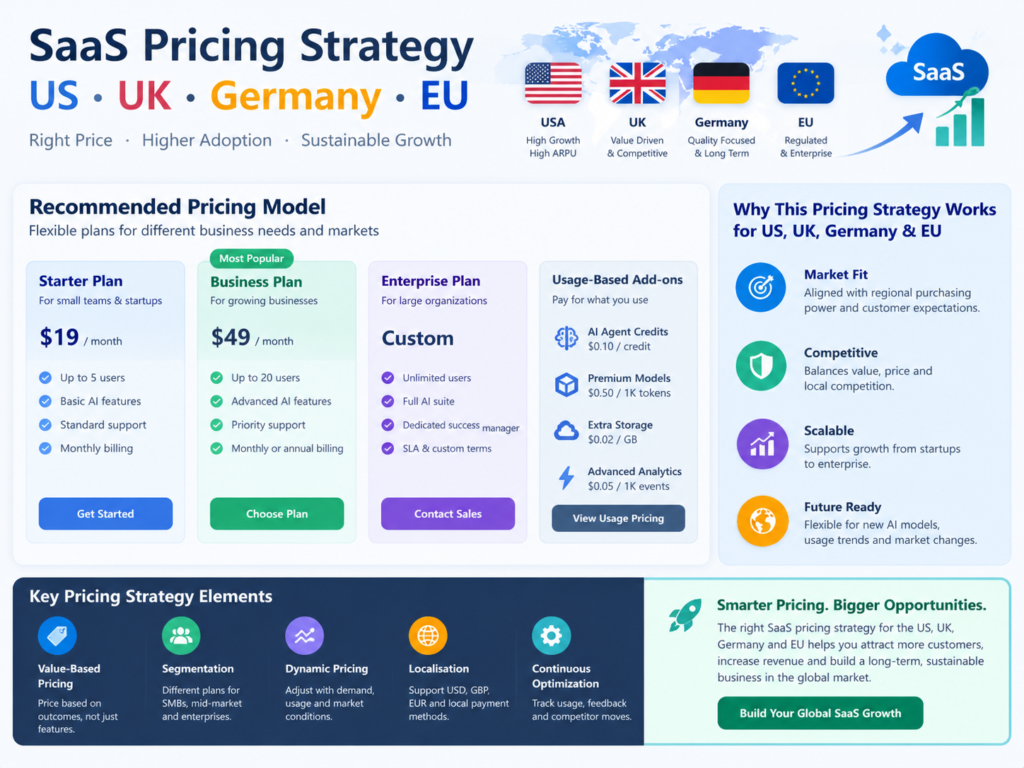
Separate SMB, mid-market, and enterprise packages around meaningful differences such as automation volume, integrations, workflow limits, analytics, security, support, data retention, and SLAs.
An SMB plan might focus on easy self-service adoption. An enterprise contract may add SSO, audit controls, custom integrations, procurement support, regional requirements, and negotiated usage commitments.
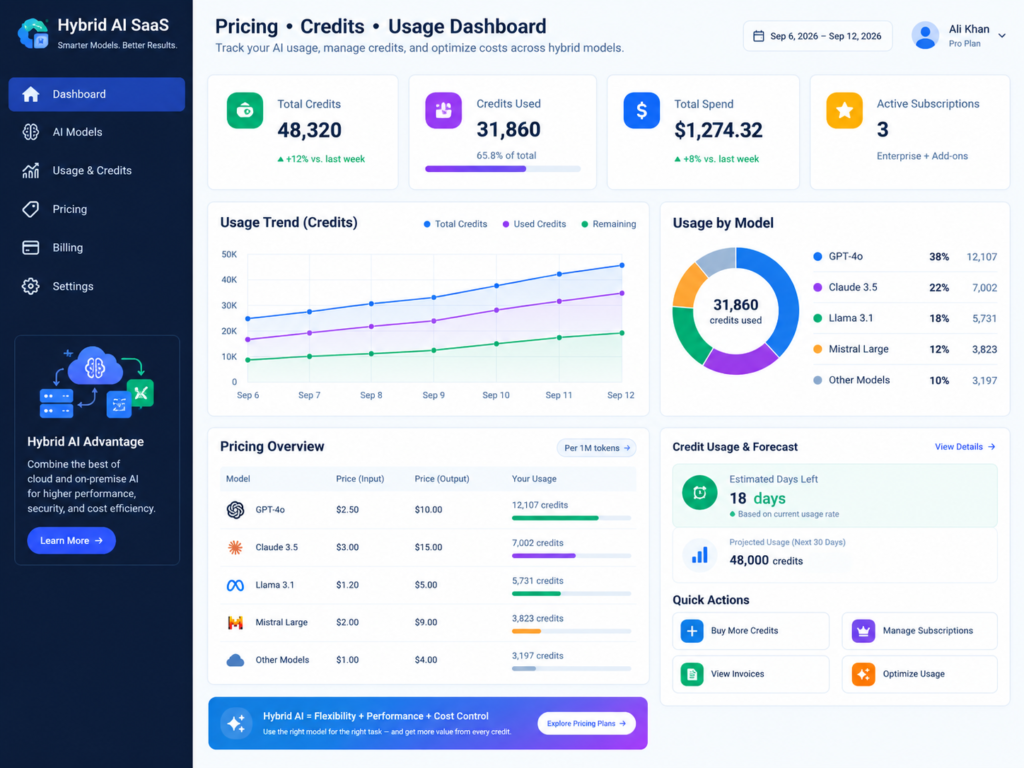
Make Usage Visible Before It Becomes a Problem
Customers should be able to see current consumption, remaining credits, projected spend, and billable events without opening a support ticket.
Alerts at 50%, 80%, and 100% of an allowance can reduce anxiety around consumption-based pricing. Spend caps and forecasts make the model easier to trust.
Mak It Solutions’ Business Intelligence Services can support reporting for usage, margins, NRR, and customer-value metrics.
Localize SaaS Pricing for the USA, UK, Germany, and EU
International pricing requires more than converting a USD figure into GBP or EUR. Tax treatment, privacy obligations, invoicing, procurement, data residency, security requirements, and willingness to pay can all affect packaging.
USA.
Enterprise buyers in US technology and business hubs commonly ask vendors for stronger security documentation and controls, with SOC 2 frequently appearing in procurement discussions.
If a SaaS environment stores, processes, or transmits payment-card data, PCI DSS may also be relevant. PCI SSC continues to list PCI DSS v4.0.1 as the currently published standard.
Healthcare SaaS requires additional care. HHS guidance explains that cloud providers creating, receiving, maintaining, or transmitting ePHI on behalf of HIPAA-covered entities or business associates can themselves have HIPAA business-associate obligations.
UK.
UK customers may prefer GBP contracts, clear VAT treatment, predictable commitments, and procurement documentation written for local buyers.
Data protection remains an important consideration for AI SaaS handling personal information. The ICO continues to provide AI and data-protection guidance, while noting that parts of its guidance are being reviewed following changes introduced by the Data (Use and Access) Act.
Germany and the EU.
German and wider EU customers may expect EUR pricing, GDPR/DSGVO controls, transparent sub processors, regional hosting choices, and clear documentation around AI governance.
The EU AI Act entered into force on August 1, 2024 and became generally applicable on August 2, 2026, with requirements continuing to phase in. Certain high-risk AI obligations now have later application dates: December 2, 2027 for specified Annex III systems and August 2, 2028 for high-risk systems embedded in regulated products.
Germany’s B2B e-invoicing rules also began changing on January 1, 2025. Domestic businesses must be able to receive compliant e-invoices, while transitional rules continue to govern when issuers must move away from other invoice formats.
For implementation planning, Mak It Solutions’ enterprise AI adoption roadmap and API-first architecture guide provide complementary technical guidance.
A Practical SaaS Pricing Strategy Framework for Founders
Choosing between seat-based, usage-based, hybrid, and outcome pricing becomes easier when the team evaluates each model against the same commercial criteria.
| Pricing Model | Value Alignment | Cost Alignment | Buyer Predictability | Metering Complexity | Expansion Potential |
|---|---|---|---|---|---|
| Seat | Medium | Low | High | Low | Medium |
| Per agent | Medium | Medium | High | Low | Medium |
| Per action | High | High | Medium | Medium | High |
| Usage | Medium | High | Low–Medium | Medium | High |
| Credits | High | High | Medium | Medium–High | High |
| Hybrid | High | High | High | Medium–High | High |
| Outcome | Very High | Medium–High | Medium | High | Very High |
Pilot Before Migrating the Entire Customer Base
Interview customers, test willingness to pay, run pricing cohorts, and use shadow billing before changing existing contracts.
Track NRR, gross margin, adoption, expansion revenue, support complaints, and the gap between forecasted and actual invoices. Existing customers may also need grandfathering, temporary credits, spend protections, or renewal-based migration.
When Expert Support Becomes Useful
Pricing becomes harder when metering architecture, model costs, packaging, billing infrastructure, international requirements, and analytics all start affecting one another.
Mak It Solutions’ technology services portfolio can help connect product architecture, AI integration, analytics, and monetization requirements.
Final Words
AI agents do not make SaaS pricing simpler. They make choosing the right value metric more important.
Start with the customer outcome, determine what reliably represents that value, model the AI cost behind every billable unit, and then choose a pricing architecture buyers can understand and forecast. For many products, that will mean a hybrid model rather than abandoning subscriptions altogether.
If AI consumption is growing faster than your current SaaS pricing strategy can handle, Mak It Solutions can help map value metrics, packaging, metering architecture, analytics, and regional requirements into a practical monetization plan.
Contact Mak It Solutions for a scoped SaaS and AI assessment and begin with one product, customer segment, or pricing experiment instead of forcing a full migration at once.
Key Takeaways
AI agents weaken the traditional relationship between employee count, seat count, and SaaS value.
Hybrid subscription plus usage is often a strong starting model because it combines predictability with expansion.
Credits and business actions usually communicate value more clearly than raw tokens.
AI COGS and gross margin should be modeled across light, typical, power-user, and enterprise consumption.
US, UK, German, and EU pricing should account for regional tax, privacy, procurement, security, and billing requirements.
The best SaaS pricing strategy is measurable, predictable, margin-aware, and simple enough for customers to explain internally.
FAQs
Q : How many pricing tiers should an AI SaaS company offer?
A : A practical starting point is three commercial tiers—for example, SMB, growth or mid-market, and enterprise—with a custom option only when needed. Each tier should represent genuine differences in value, usage, security, integrations, support, or service levels rather than minor feature changes.
Q : Should AI credits expire or roll over?
A : Either structure can work. Expiring credits make capacity and revenue planning simpler, while rollover can reassure customers whose activity changes from month to month.
If rollover is offered, define the expiration period or cap clearly and display it in the usage dashboard.
Q : How can SaaS companies change pricing without upsetting customers?
A : Test the new model first and show customers how their historical usage would have been billed. Grandfathering, temporary credits, renewal-based migration, and spend caps can soften the transition.
Most importantly, explain the value metric behind the change rather than framing it as a simple price increase.
Q : What usage limits should an AI SaaS free trial include?
A : Provide enough usage for prospects to experience the core customer outcome without leaving expensive inference or autonomous workflows completely uncontrolled.
Premium models, high-volume automation, or costly integrations can have tighter limits. The trial should also show usage clearly so buyers understand how the paid model works.
Q : How often should an AI SaaS company review pricing?
A : Review performance metrics at least quarterly and consider a deeper pricing and packaging review roughly every six to twelve months.
AI model costs, customer behavior, product capability, and competitive offers can shift quickly. A meaningful change in gross margin, expansion, usage distribution, customer complaints, or forecast accuracy may justify reviewing pricing sooner.
[…] What Is API Monetization for AI Agents? […]