


Zero Trust for AI Agents: Secure Architecture 2026
Zero Trust for AI Agents: Secure Architecture 2026
Zero Trust for AI Agents: Secure Architecture 2026
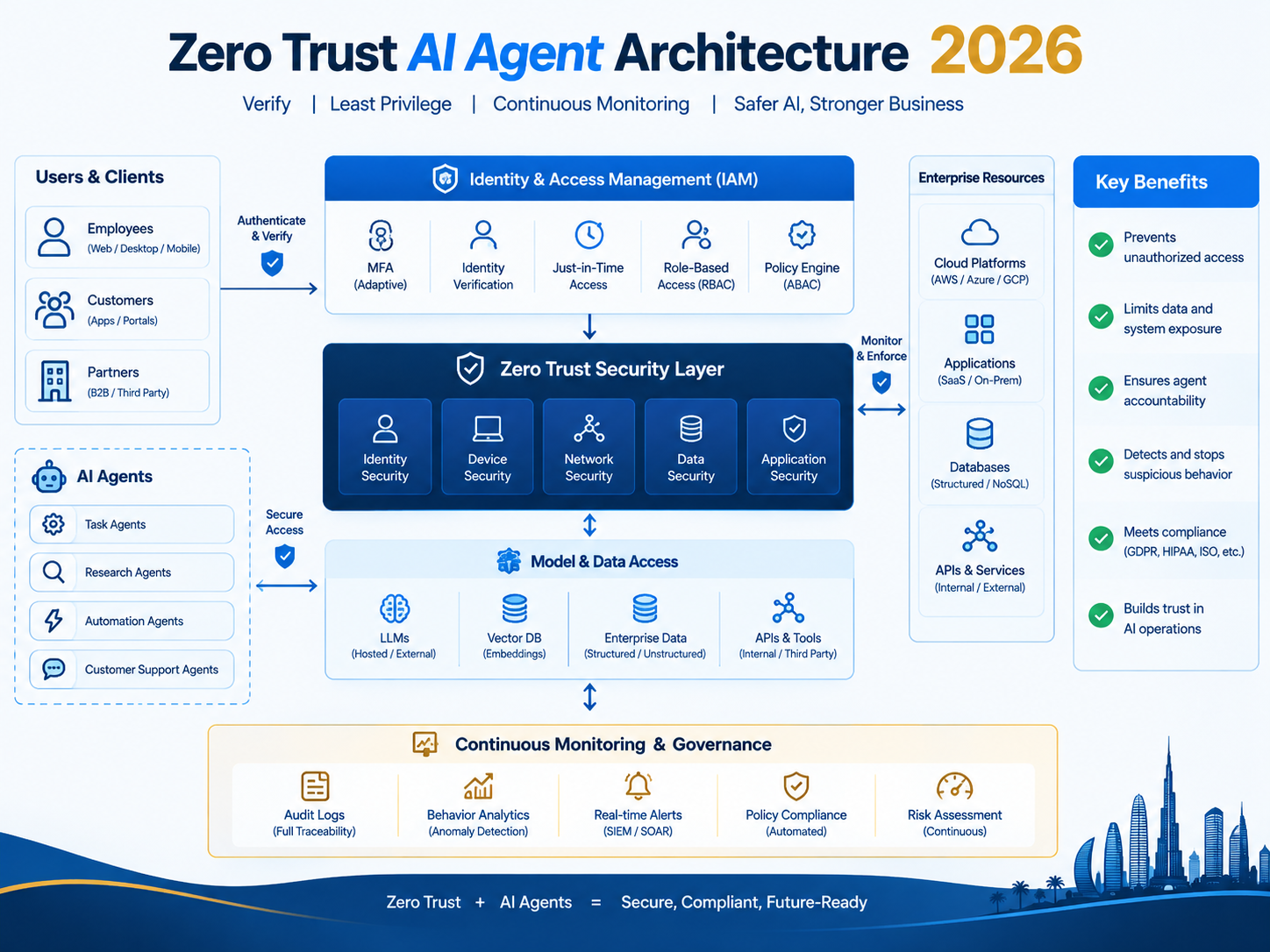
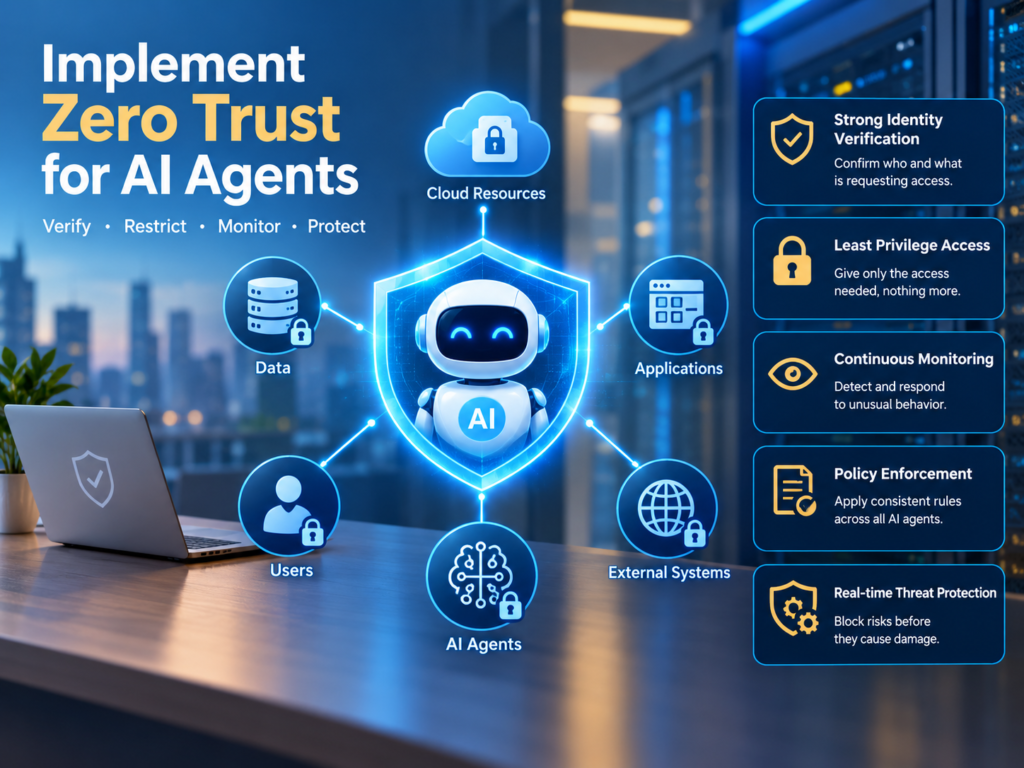
Zero Trust for AI agents means an autonomous agent is never permanently trusted just because it authenticated successfully. Enterprises should verify agent identity, authorize sensitive actions individually, restrict MCP tools and data access, monitor runtime behavior, require human approval where risk justifies it, and maintain auditable records.
For production environments, the practical security chain is.
Identity → authentication → per-action authorization → tool/MCP controls → data boundaries → runtime monitoring → human approval → auditability → incident response
Why AI Agents Break Traditional Trust Models
Zero Trust for AI agents becomes important when software can do much more than generate an answer.
Modern AI agents may query databases, call APIs, invoke MCP tools, update CRM records, interact with other agents, execute workflows, and access sensitive enterprise data. Once an agent can take actions rather than simply suggest them, traditional session-based trust becomes a weak security boundary.
An authenticated agent should not automatically receive broad trust for the rest of its session.
For enterprises operating across the US, UK, Germany, and the wider EU, agentic AI security therefore needs to become part of identity and access architecture not something added after agents reach production.
What Is Zero Trust for AI Agents?
Zero Trust for AI agents applies “never trust, always verify” principles to autonomous software identities. Identity, context, requested resources, tools, permissions, and risk should be evaluated whenever an agent attempts a sensitive action.
From Zero Trust Architecture to Agentic AI Security
Traditional Zero Trust Architecture already rejects implicit trust based on network location. NIST SP 800-207 focuses security on resources, users, assets, and workflows rather than assuming something inside a network boundary can automatically be trusted.
Agentic systems extend that principle.
An autonomous agent can dynamically decide what action to take next. Policy enforcement therefore needs to follow the agent throughout its workflow instead of ending after authentication.
That makes continuous verification and contextual authorization central to agentic AI security.
Treat AI Agents as Non-Human Identities
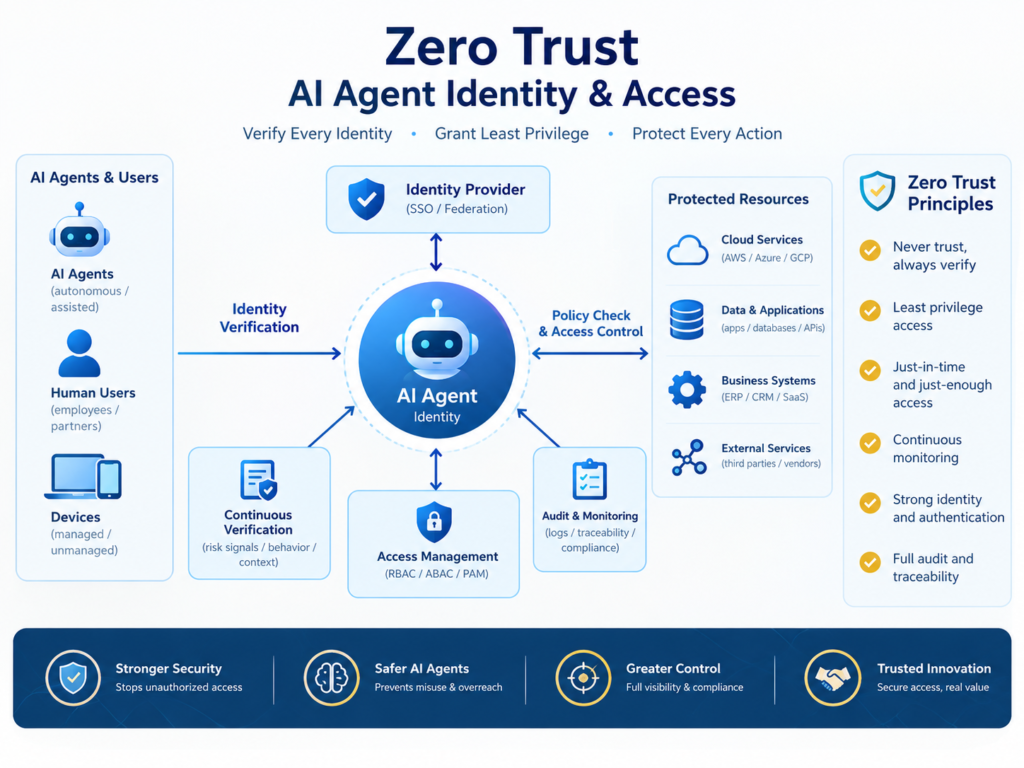
Production agents should generally be managed as non-human identities (NHIs) or workload identities, with unique credentials, accountable owners, defined permissions, and explicit lifecycle controls.
Using one shared API key across several agents makes attribution, rotation, and revocation unnecessarily difficult.
For every production identity, security teams should be able to answer.
Who owns this agent?
Which systems can it access?
Which tools can it call?
What data can it read or modify?
Which actions require additional approval?
When should its access expire or be revoked?
This extends the broader Zero Trust strategy for AI-era security into controls designed specifically for autonomous agents.
Why Session-Based Trust Is Not Enough
Traditional Zero Trust controls users, devices, and workloads, but autonomous agents introduce dynamic decision-making and tool execution.
Authorization therefore needs to reach individual actions rather than stopping at initial authentication.
An agent legitimately authorized to read customer records, for example, should not automatically be allowed to export those records, delete them, email them externally, or transfer them to another agent.
Zero Trust AI Agent Security Architecture
A practical Zero Trust for AI agents architecture gives each production agent a unique identity, uses tightly scoped credentials, evaluates sensitive actions against policy, restricts tools and data, and monitors execution continuously.
High-risk operations can add another control: human approval before execution.
Identity, Authentication, and Short-Lived Credentials
Start with a unique workload identity.
OAuth/OIDC, mTLS, cloud workload identities, and frameworks such as SPIFFE/SPIRE can help authenticate software workloads without relying entirely on persistent shared secrets.
Where the environment supports them, short-lived credentials reduce exposure because compromised credentials expire sooner. Secrets should also be scoped, centrally managed, rotated, and revocable.
Organizations building API-driven platforms can apply these controls alongside an API-first application architecture.
Policy Decision and Policy Enforcement Points
A Policy Decision Point (PDP) determines whether an action should be allowed. A Policy Enforcement Point (PEP) makes sure that decision is enforced.
Policy engines such as OPA can evaluate several signals together, including.
Agent identity
Initiating user or workflow
Requested resource
Requested action
Tool or API
Environment
Data sensitivity
Time and session context
Runtime risk signals
Instead of asking only, “Is this agent authenticated?”, the architecture asks:
“Should this authenticated agent perform this specific action under these specific conditions?”
That is a much stronger security boundary.
Micro segmentation and Data Boundaries
Agents should not receive flat access to enterprise environments.
API gateways, segmented services, workload boundaries, network controls, and data classifications can limit what an agent can reach and reduce lateral movement if something goes wrong.
The same principle applies to agent-to-agent (A2A) communication. Trust in one agent should not automatically transfer its privileges to another.
Organizations handling sensitive analytics can combine these controls with governed business intelligence and data workflows.
How to Secure AI Agent Identity and Access
Least privilege for AI agents means granting only the permissions required for a particular task, resource, environment, and duration. Agent-specific identity, tool-specific permissions, and contextual authorization can reduce the impact of compromised prompts, agents, or credentials.
Apply Least Privilege to Every Agent
Avoid giving an agent broad permissions such as database administrator access when it only needs to read a limited set of tables.
Access should be constrained by.
Task
Resource
Action
Tool
Environment
Data sensitivity
Duration
A customer-support agent, for example, might be allowed to read customer history while requiring additional authorization before issuing a large refund.
Replace Shared API Keys With Agent-Specific Identity
Shared API keys weaken ownership, selective revocation, rotation, and forensic traceability.
Agent-specific identities allow security teams to revoke one compromised workload without unnecessarily disrupting unrelated services. They also improve audit trails because activity can be tied to a particular agent and accountable owner.
Where legacy systems still require API keys, gateways or credential brokers can provide an additional enforcement layer.
Authorize the Action, Not Just the Agent
Per-action authorization comes down to one question:
Can this agent perform this specific action on this specific resource through this particular tool, under the current conditions, right now?
That question should sit at the center of Zero Trust for autonomous AI agents.
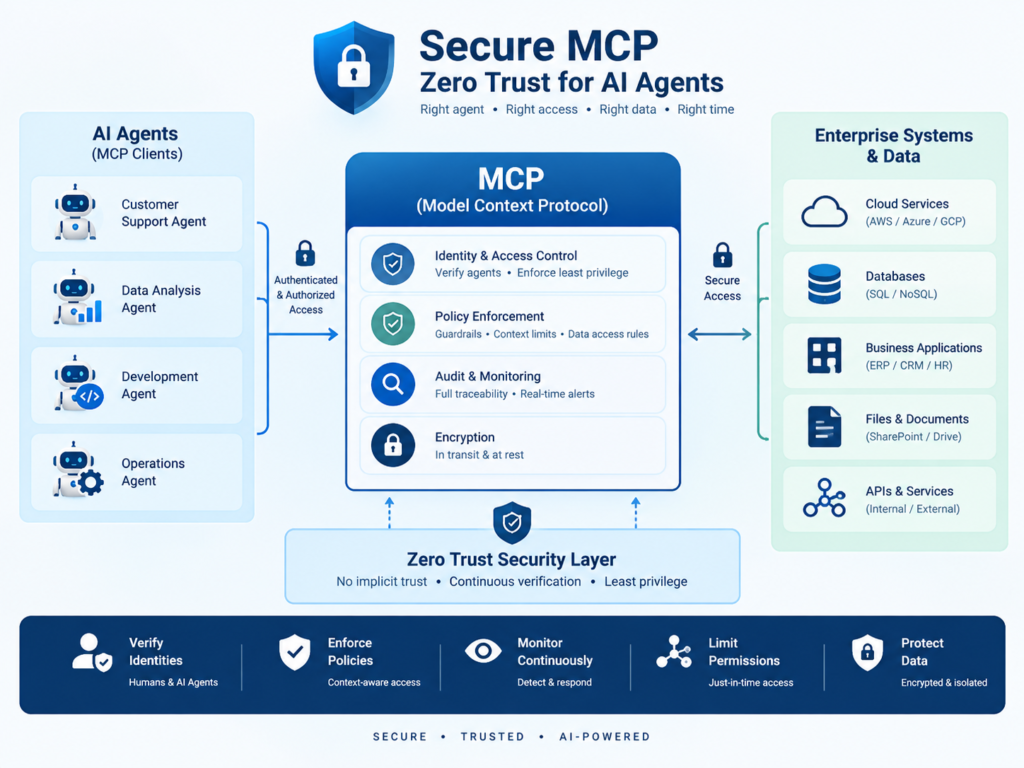
Secure MCP, Tools, and Agent Runtime Actions
Authentication alone cannot secure AI agent tool access.
Every MCP or API request should be evaluated against the agent identity, requested action, target resource, user or workflow context, tool permissions, and relevant runtime risk before execution.
Put MCP and Tool Calls Behind Enforcement Controls
MCP servers and external tools increase what an AI agent can do. They also increase its attack surface.
Useful controls include.
Approved MCP server allow lists
MCP or API gateways
Scoped tool permissions
Policy enforcement points
Rate limits
Explicit schemas for permitted operations
Additional approval for privileged actions
These controls become increasingly important as agents consume commercial and internal APIs, a model explored in Mak It Solutions’ AI-agent API monetization guide.
Defend Against Prompt Injection and Tool Poisoning
Indirect prompt injection can place malicious instructions inside webpages, documents, emails, or retrieved content. Tool poisoning can manipulate tool descriptions, interfaces, or other information an agent relies on when deciding what to execute.
Retrieved content and third-party MCP servers should therefore be treated as untrusted input.
Separate instructions from data, validate tool parameters, constrain execution privileges, and require additional authorization before consequential actions.
The goal is not to assume the model will always recognize malicious instructions. The surrounding architecture should limit what an attacker can accomplish even when the agent behaves unexpectedly.
Continuously Monitor Agent Behavior
Runtime monitoring can look for unusual or high-risk behavior such as.
Unexpected tool sequences
Abnormal data access
Unusual transaction sizes
Privilege escalation attempts
Excessive API activity
Unexpected agent-to-agent communication
Access outside normal workflow boundaries
Depending on the risk, the response might include additional verification, blocking the request, requiring human approval, isolating the workload, or revoking credentials.
Governance, Auditability, and Human Accountability
Every production agent should be identifiable, attributable, and auditable.
Organizations need to know who owns an agent, what authority it has, which systems and tools it can access, what actions it performed, and how that authority can be suspended during an incident.
Create an Inventory of Agents and Accountable Owners
Maintain an inventory covering.
Production agents
Accountable owners
Business purposes
Credentials and identities
MCP servers and external tools
APIs
Datasets
Downstream agents
Deployment environments
Permission scopes
This becomes especially important in private and regulated deployments, including architectures similar to those discussed in Mak It Solutions’ private AI infrastructure guide.
Log Decisions, Tool Calls, and Security-Relevant Actions
Audit logging should capture enough context to reconstruct significant security events.
Depending on the system, useful records can include authentication events, authorization decisions, credential issuance, policy changes, tool calls, security-relevant input/output metadata, A2A activity, approval decisions, execution results, and revocations.
Logs should be protected against unauthorized alteration and retained according to applicable operational, security, contractual, and regulatory requirements.
Define Human Approval and Incident Response Boundaries
Human approval is most useful when an action creates meaningful financial, privacy, safety, contractual, security, or operational consequences.
A procurement agent, for example, might research vendors autonomously but require approval before signing an agreement or triggering a high-value purchase. Similar governance patterns appear in AI agents in procurement.
Incident-response plans should also include a practical agent kill switch. Security teams should be able to.
Disable the agent identity
Revoke credentials and tokens
Terminate active sessions
Block MCP and API access
Isolate affected workloads
Stop relevant downstream activity
Preserve logs for investigation
Designing these controls before an incident is far easier than improvising them during one.
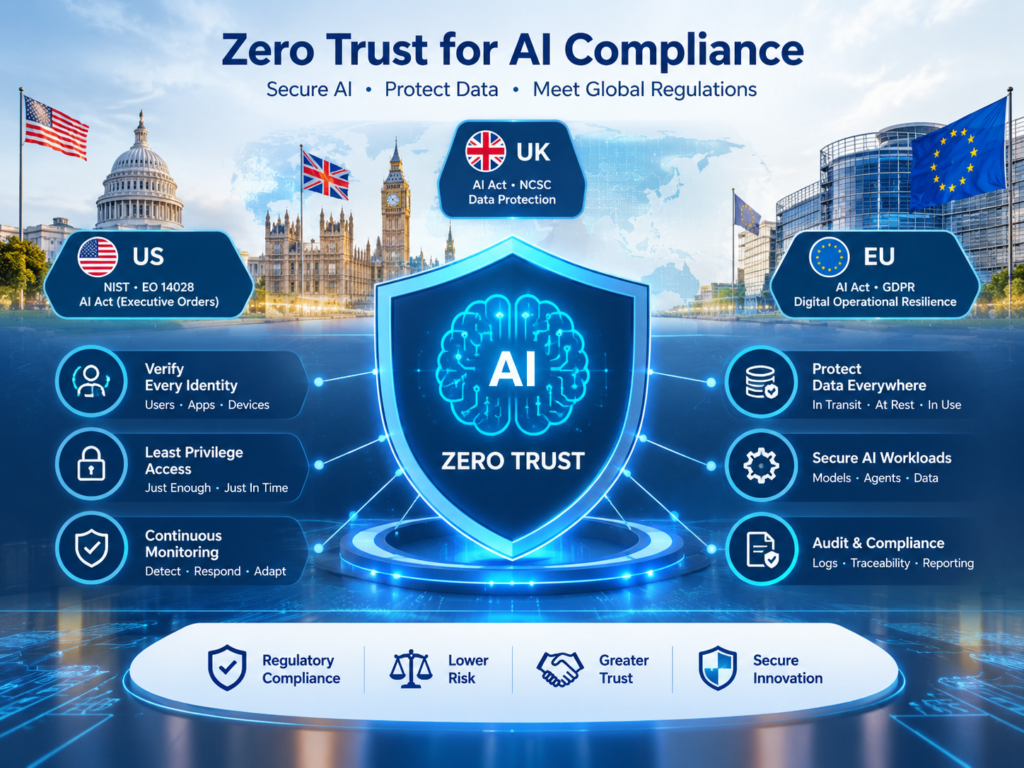
Zero Trust AI Compliance in the US, UK, and EU
The core security architecture can remain broadly consistent across regions: identity, least privilege, policy enforcement, monitoring, auditability, and accountable governance.
The legal and regulatory obligations around that architecture, however, vary by jurisdiction and sector.
United States.
NIST SP 800-207 provides a widely used architectural foundation for Zero Trust deployments in the United States.
Depending on the organization and data involved, enterprises may also need to consider requirements or commitments related to CISA guidance, SOC 2, PCI DSS, or the HIPAA Security Rule.
A healthcare platform using agents to access electronic protected health information, for example, has different regulatory obligations from a general SaaS provider. Both may use Zero Trust principles, but their compliance requirements are not interchangeable.
United Kingdom.
UK organizations should align agent access and data handling with applicable UK GDPR requirements and relevant ICO guidance on security measures.
The UK’s NCSC Zero Trust guidance emphasizes areas such as identity, policy-based authorization, monitoring, and appropriate authentication and authorization throughout access flows.
For a financial-services business in London or a SaaS company in Manchester, agent inventories, least privilege, auditability, and controlled data access can therefore become part of the wider security and privacy program.
Germany and the EU.
Organizations operating in Germany and the wider European Union may need to consider GDPR/DSGVO, the EU AI Act, NIS2, and, for applicable regulated financial entities, DORA.
German organizations may also encounter BSI or BaFin requirements and expectations depending on their sector and activities.
The EU AI Act entered into force on August 1, 2024, establishing a risk-based regulatory framework for AI.
For organizations operating across Berlin, Munich, Frankfurt, Dublin, Amsterdam, Paris, and other European markets, Zero Trust controls can support technical governance, but they do not automatically establish regulatory compliance.
Data residency, lawful processing, AI-system classification, documentation, risk management, and sector-specific requirements still need to be assessed separately.
How to Implement Zero Trust for AI Agents
Implementing Zero Trust for AI agents does not require replacing the entire security architecture at once.
A practical approach is to discover existing agents and access paths first, introduce stronger workload identity and per-action policies next, and then continuously monitor and test the environment.
The objective is the progressive removal of implicit trust.
Discover Agents, Identities, Tools, and Data Paths
Inventory production agents, MCP servers, APIs, datasets, credentials, downstream agents, deployment environments, and accountable owners.
Pay particular attention to agents capable of privileged, externally visible, financially significant, or irreversible actions.
Existing web and application architectures should also be reviewed for API boundaries, excessive privileges, and legacy shared credentials.
Enforce Identity, Least Privilege, and Runtime Policies
Replace persistent shared secrets with workload identities and short-lived credentials where practical.
Introduce PDP/PEP controls, contextual authorization, segmented data access, tool allow lists, approval gates, and explicit enforcement around privileged operations.
Policies should reflect what an agent actually needs to accomplish—not what is easiest to grant.
Monitor, Audit, Test, and Continuously Reduce Trust
Monitor agent behavior and authorization outcomes.
Test realistic agent security scenarios, including prompt injection, malicious MCP servers, tool poisoning, credential theft, privilege escalation, and abnormal A2A behavior.
Use the findings to tighten permissions, refine policies, and improve incident-response procedures.
A practical starting point is straightforward: inventory your agents, map privileged actions, locate persistent credentials and shared API keys, and identify the highest-risk agent-to-tool and agent-to-data boundaries.
Wrap It Up
As AI agents move from prototypes into production, Zero Trust for AI agents becomes a practical architecture requirement rather than a theoretical security principle.
Start by mapping identities, credentials, MCP servers, tools, sensitive data, and privileged actions. Then focus on the trust boundaries where a compromised or misdirected agent could create the greatest impact.
Mak It Solutions can help assess the surrounding application, API, analytics, and security architecture and turn those findings into a scoped implementation roadmap.
Request a scoped architecture consultation to identify and prioritize high-risk agent trust boundaries.
Key Takeaways
Zero Trust for AI agents extends identity security beyond initial authentication to individual autonomous actions.
Give production agents distinct non-human or workload identities where appropriate.
Use short-lived, least-privilege credentials wherever the architecture supports them.
Put MCP servers, APIs, sensitive datasets, and A2A interactions behind explicit policy enforcement.
Treat retrieved content and third-party tools as potentially untrusted.
Monitor runtime behavior and maintain auditable records of authentication, authorization, tool execution, approvals, and revocations.
Use human approval when actions carry significant financial, operational, legal, privacy, security, or safety consequences.
Apply consistent Zero Trust principles globally while separately assessing applicable US, UK, German, and EU regulatory obligations.
FAQs
Q : Should every AI agent have its own identity?
A : Production agents should generally have distinct identities when they access enterprise resources or perform consequential actions. Unique identities improve authorization, ownership, logging, credential rotation, and selective revocation.
Depending on the environment, implementation options may include cloud workload identities, OAuth/OIDC, mTLS, SPIFFE/SPIRE, or another appropriate identity mechanism.
Q : Are shared API keys safe for autonomous AI agents?
A : Shared, long-lived API keys create additional risk because they make attribution and selective revocation difficult. If one shared credential is compromised, multiple workloads may be affected.
A stronger architecture uses agent-specific identity, scoped permissions, secure credential storage, rotation, and short-lived credentials where practical.
Q : What should enterprises log when AI agents call external tools?
A : Organizations should capture enough information to reconstruct important security decisions without unnecessarily retaining sensitive content.
Relevant records can include the agent identity, initiating user or workflow, authorization result, requested tool and action, target resource, timestamp, credential events, policy version, approval events, execution result, and relevant agent-to-agent activity.
Q : When should an AI agent require human approval?
A : Human approval is appropriate when an action could create substantial financial, legal, privacy, security, safety, contractual, or operational consequences.
Examples include significant payments, deleting production data, modifying privileged accounts, transmitting sensitive information externally, approving unusual contracts, or performing irreversible infrastructure changes.
Q : How can organizations revoke a compromised AI agent’s access quickly?
A : Revocation should be designed before deployment.
Security teams should be able to disable the agent identity, revoke active credentials or tokens, terminate sessions, block MCP or API access, isolate workloads, and stop relevant downstream activity.
Centralized identity management and short-lived credentials can make containment more effective. Audit records should also be preserved so teams can determine which resources, tools, and downstream systems were accessed before revocation.