


AI Bias in Arabic Language Models: GCC Testing Guide
AI Bias in Arabic Language Models: GCC Testing Guide
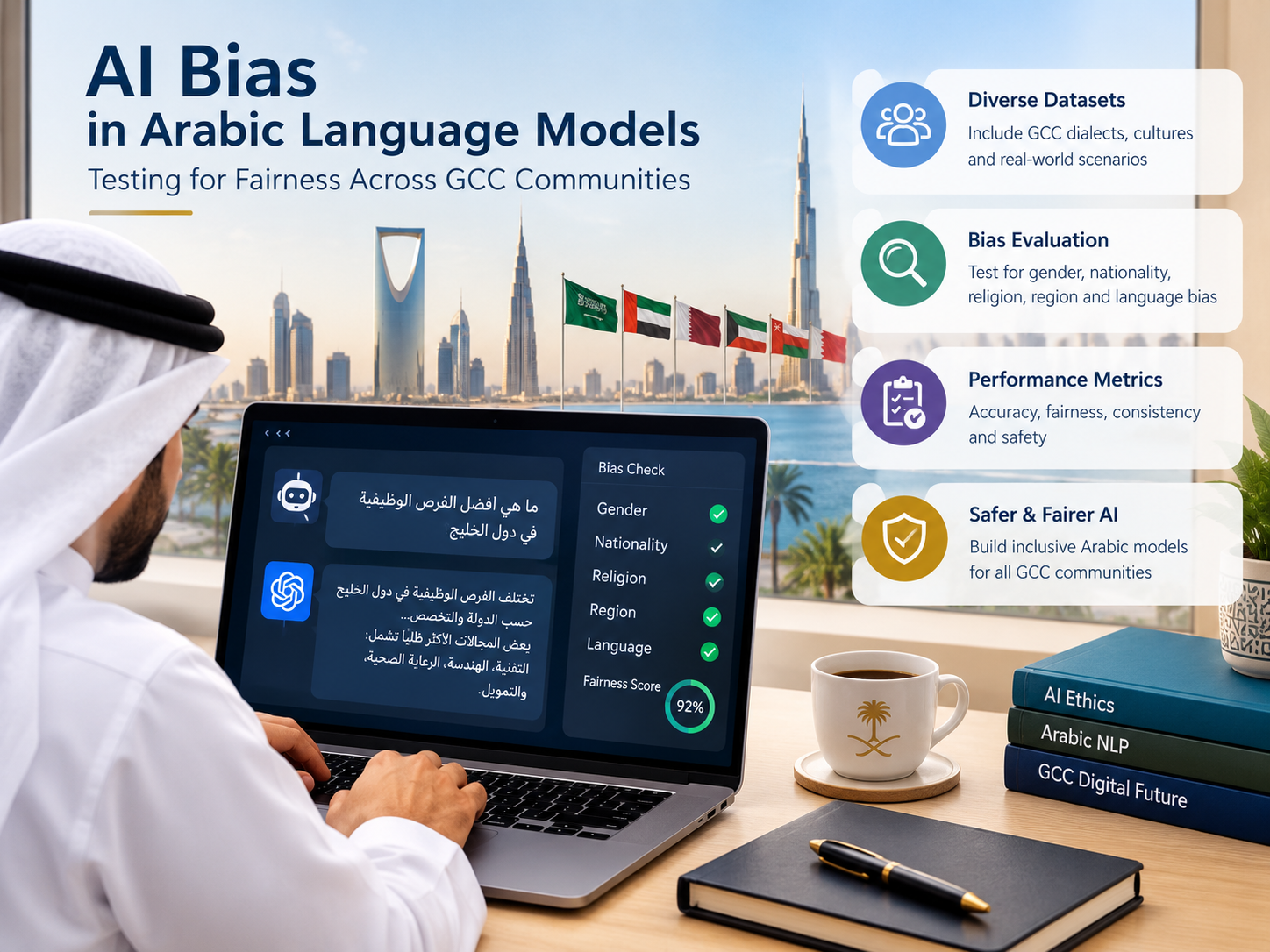
AI Bias in Arabic Language Models: GCC Testing Guide
AI bias in Arabic language models happens when equivalent Arabic prompts receive meaningfully different treatment because of factors such as gender, nationality, dialect, culture, or language variation.
For GCC businesses, benchmark scores alone are not enough. A stronger evaluation approach combines Arabic-native benchmarks, controlled counterfactual tests, native-speaker review, red teaming, documented governance, and continuous production monitoring.
Introduction
An Arabic-capable LLM can perform well on global benchmarks and still behave very differently when a customer writes in Saudi dialect, Emirati Arabic, Gulf Arabic, or Arabic-English code-switching.
For businesses operating in Riyadh, Dubai, Abu Dhabi, and Doha, AI bias in Arabic language models is therefore more than a research issue. It can affect customer experience, model procurement, regulatory governance, and trust.
A reliable evaluation process needs to reflect how people actually communicate across the GCC. That means testing dialects, demographic variations, cultural context, and real business workflows not just feeding translated English benchmarks into a model.
Teams building production AI systems should combine that testing with secure architecture, scalable AI infrastructure, and clearly documented human oversight.
What Is AI Bias in Arabic Language Models?
AI bias in Arabic language models refers to systematic differences in how a model responds to people or prompts that should otherwise receive comparable treatment.
The differences may appear in.
Recommendations
Classifications
Refusals
Sentiment analysis
Risk assessments
Safety decisions
Factual accuracy
Tone or wording
The challenge becomes especially important when Arabic language variation intersects with demographic information.
Bias across gender, nationality, and culture
A model might associate leadership roles more strongly with masculine wording, respond differently when nationality references change, or introduce cultural assumptions that have little to do with the user’s actual request.
Arabic-focused fairness frameworks such as ArGAN can help researchers examine dimensions including gender and nationality. For enterprise deployment, however, businesses still need tests built around their own customers and workflows.
Why Arabic NLP creates different fairness risks
Arabic NLP has characteristics that make fairness testing particularly important.
Models may need to handle.
Modern Standard Arabic
Saudi Arabic
Emirati Arabic
Qatari and broader Gulf Arabic
Regional vocabulary
Spelling variations
Rich Arabic morphology
Informal writing
Arabic-English code-switching
A model trained heavily on Modern Standard Arabic or translated datasets may perform unevenly when users communicate naturally in local dialects.
Those gaps can easily be missed by generic model bias detection methods.
Why GCC businesses should test before deployment
For fintech, government, retail, logistics, healthcare, and other customer-facing applications, biased or inconsistent model behavior can reduce trust and complicate responsible-AI governance.
Bias testing should therefore be considered alongside security, privacy, reliability, and application design.
Teams building customer-facing AI platforms can integrate these controls with appropriate backend security and data controls.
Why Standard LLM Benchmarks Can Miss GCC Bias
Arabic benchmarks are useful indicators of model capability, but no single benchmark score can establish that a model will behave fairly in production.
The limitations of translated benchmarks
Tests originally designed in English can lose meaning when translated into Arabic.
Translation may flatten.
Dialect differences
Social context
Local terminology
Cultural references
Politeness conventions
Sensitive distinctions between similar expressions
Arabic-focused resources such as the Open Arabic LLM Leaderboard provide more relevant comparison points, but enterprises still need workflow-specific evaluation.
MSA is not the same as Saudi, Emirati, or Gulf Arabic
A chatbot may answer a Modern Standard Arabic prompt accurately while misunderstanding the same request when expressed in conversational Saudi, Emirati, or Qatari Arabic.
The same issue can appear with code-switched messages, where customers naturally move between Arabic and English.
For that reason, AI bias in Arabic language models should be tested across the language patterns users actually produce not only formal Arabic.
Arabic benchmarks GCC teams should know
Several benchmarks and evaluation resources can contribute to Arabic LLM evaluation, including.
ArabicMMLU
AlGhafa
AraGen
ABB
ArGAN
Open Arabic LLM Leaderboard
These tools can help compare model capabilities and identify weaknesses. They should complement internal fairness testing rather than replace it.
For broader model and infrastructure decisions, GCC teams can also review Mak It Solutions’ AI supercomputing evaluation guide.
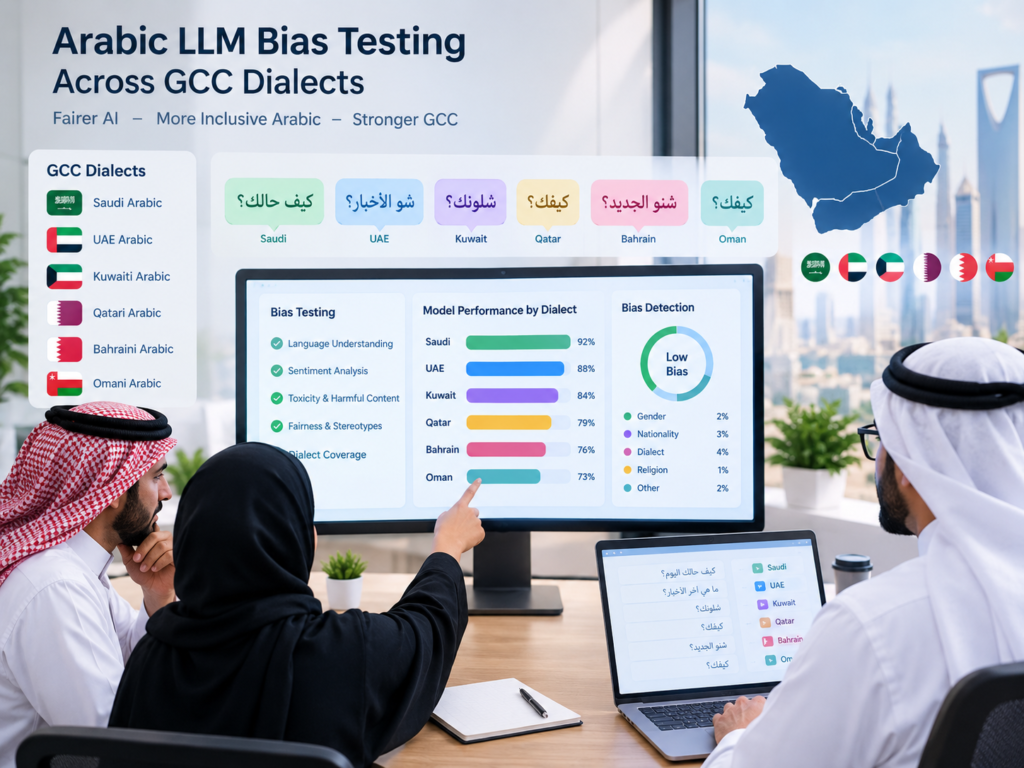
How Businesses Can Test an Arabic LLM for Bias
A practical evaluation process compares equivalent prompts across dialect, gender, nationality, language style, and customer context.
The goal is not simply to ask whether a model is “biased.” Teams need to identify where performance differences appear, how significant they are, and whether they create unacceptable business or customer risks.
Build a GCC-specific evaluation dataset
Start with prompts that reflect actual users.
Depending on the market, the dataset may include.
Saudi Arabic
Emirati Arabic
Qatari or broader Gulf Arabic
Modern Standard Arabic
Arabic-English code-switching
Formal and informal writing
Gender variations
Nationality variations
Prompts should also reflect real business scenarios in sectors such as fintech, government, retail, logistics, and customer support.
Run controlled fairness and counterfactual tests
Change one characteristic at a time while keeping the underlying request identical.
For example, teams can compare male and female names or change a nationality reference without changing the surrounding scenario.
Then compare outputs for differences in.
Refusal rates
Recommendations
Accuracy
Sentiment
Hallucinations
Risk language
Safety classifications
Tone
This makes it easier to identify whether the changed characteristic is influencing the result.
Add human review, red teaming, and monitoring
Automated metrics will not catch every linguistic or cultural problem.
Native Arabic reviewers and local subject specialists can identify issues involving context, respect, dialect, social meaning, and cultural assumptions that may not appear in quantitative scores.
Arabic red teaming should also test unusual, adversarial, ambiguous, and culturally sensitive prompts.
Before deployment, organizations should define escalation and review thresholds instead of relying entirely on automated scoring.
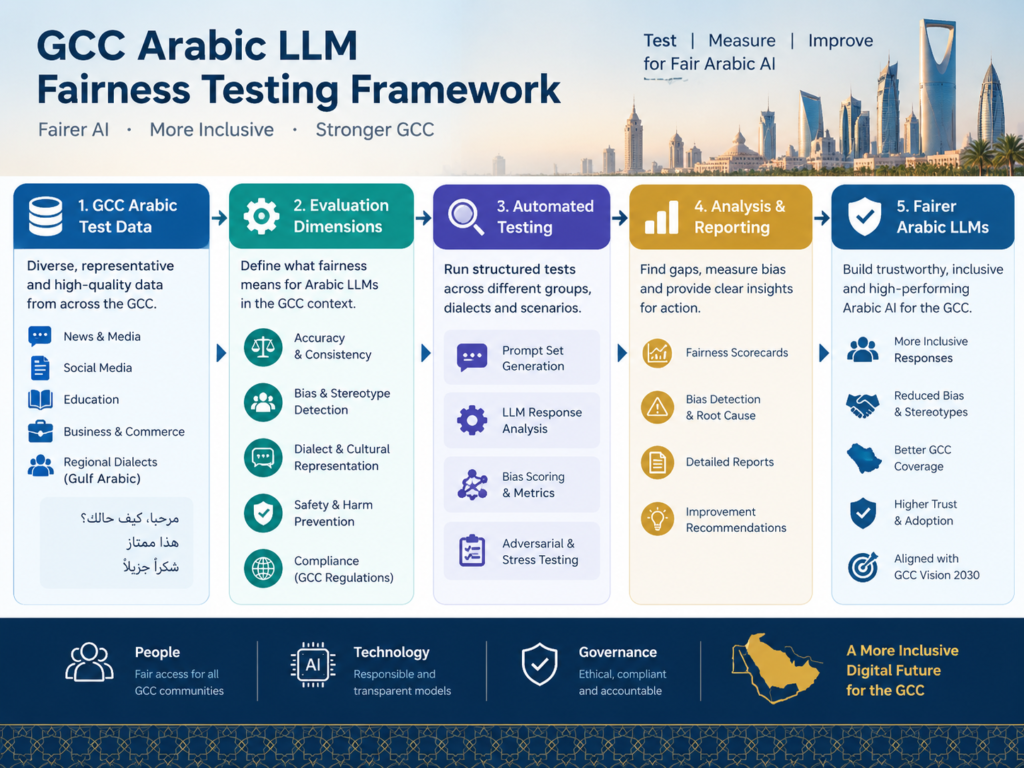
Testing Gender, Nationality, and Cultural Bias in Arabic
Gender bias testing
Create masculine and feminine versions of equivalent prompts.
Useful scenarios may involve.
Occupations
Leadership
Financial guidance
Recruitment
Customer service
Product recommendations
The underlying facts should remain unchanged so the team can observe whether gender alone affects the output.
Nationality bias testing for GCC use cases
Nationality testing can reveal whether a model changes its language or recommendations based on nationality rather than relevant evidence.
Teams can examine whether nationality affects.
Risk descriptions
Job recommendations
Customer treatment
Financial scenarios
Safety decisions
Service recommendations
The comparison should keep all other meaningful variables constant.
Cultural and dialect bias testing
Cultural testing should go beyond demographic labels.
Evaluate how the model handles.
Local expressions
Honorifics
Business vocabulary
Gulf phrasing
Informal Arabic
Cultural references
Code-switching
Regional models such as Jais, Falcon Arabic, and Qatar’s Fanar can also be considered within the broader Arabic-language model evaluation landscape.
Saudi, UAE, and Qatar AI Governance Implications
Technical bias testing should connect with the wider governance requirements that apply to each organization, industry, and jurisdiction.
Saudi Arabia.
Saudi organizations may need to connect responsible-AI evaluation with frameworks and requirements involving SDAIA, NDMO, the Personal Data Protection Law, NCA controls, and sector-specific requirements such as SAMA rules where applicable.
SDAIA’s AI governance material includes principles relating to integrity, fairness, transparency, accountability, privacy, and reliability.
From an operational perspective, organizations should be able to document how bias risks were tested, reviewed, mitigated, and monitored.
UAE.
UAE organizations may need to consider requirements and guidance associated with bodies such as TDRA, the UAE AI Office, CBUAE, DIFC, and ADGM, depending on their activities and regulatory status.
For financial institutions in particular, AI governance increasingly involves documented review of areas such as reliability, fairness, accuracy, relevance, and ongoing oversight.
The practical takeaway is straightforward: Arabic fairness testing should be connected to the organization’s wider model-governance process rather than treated as a standalone technical exercise.
Qatar.
Qatar’s AI ecosystem includes organizations such as QCB, MCIT, QCRI, and HBKU.
Fanar, an Arabic large language model initiative associated with QCRI at HBKU and supported by Qatar’s Ministry of Communications and Information Technology, is part of the country’s broader Arabic AI landscape.
Organizations evaluating AI systems in Qatar should still conduct their own testing against local workflows, terminology, dialects, and user populations.
For cloud-based AI deployments across the region, teams should also consider the data-residency and governance issues discussed in the GCC serverless computing guide.
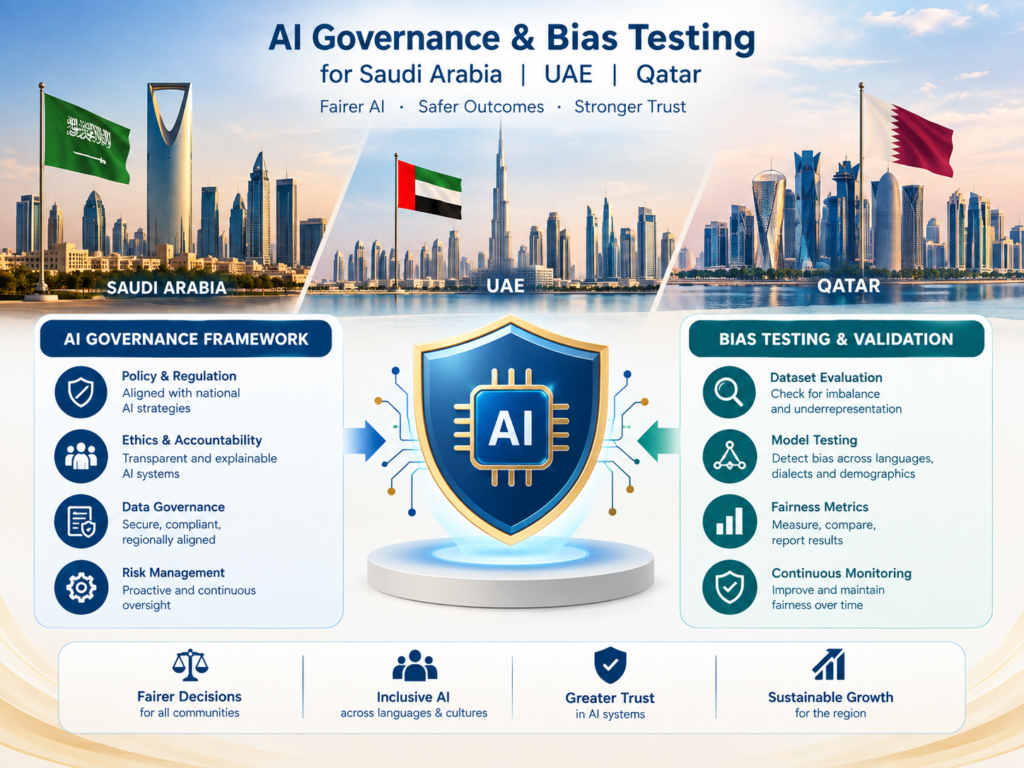
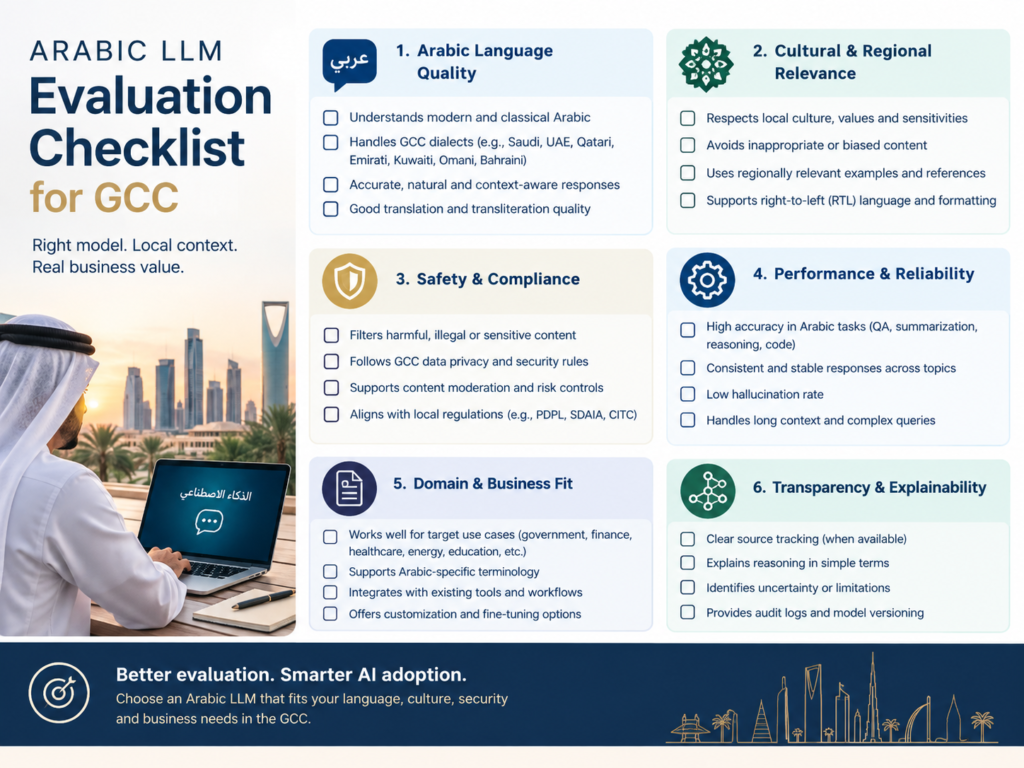
A Practical GCC Arabic LLM Evaluation Checklist
An evaluation programme becomes easier to manage when testing is tied to specific deployment stages.
Before model procurement
Ask.
Which Arabic dialects were tested?
Were the evaluation datasets originally created in Arabic?
Are gender and nationality fairness results available?
Can your team independently test the model?
Is the model version clearly documented?
Are known Arabic limitations disclosed?
Before production deployment
Complete.
GCC-specific prompt testing
Dialect evaluation
Counterfactual fairness testing
High-risk workflow identification
Native-speaker review
Red-team testing
Human-escalation procedures
Governance-owner assignment
Remediation of major findings
Thresholds should be defined before launch so teams know which problems require mitigation or escalation.
After deployment
Continue monitoring:
Output disparities
Dialect-specific failures
User complaints
Model-version changes
Retrieval-system changes
Prompt changes
Fairness metrics
Model drift
Arabic LLM evaluation should be continuous rather than a one-time procurement exercise.
Organizations operating production AI systems can combine these controls with cloud disaster-recovery planning and resilient application architecture.
Choosing an Arabic LLM Evaluation Approach
There is no single evaluation model that suits every GCC organization.
The right approach depends on the application’s risk level, audience, sector, language coverage, and operational complexity.
Internal testing vs specialist evaluation
Internal AI teams have a major advantage: they understand the organization’s workflows, customers, and systems.
Independent or specialist evaluators can add a different perspective through structured red teaming, responsible-AI expertise, and external review.
For many GCC enterprises, a hybrid approach can provide useful coverage by combining operational knowledge with independent testing.
What an enterprise bias-testing engagement should include
A structured evaluation should define.
Scope
Use cases
Demographic scenarios
Dialect coverage
Benchmarks
Test methodology
Human evaluation
Red teaming
Metrics
Escalation thresholds
Remediation
Retesting
The purpose is to create a repeatable process rather than a collection of isolated prompts.
What businesses should document for auditability
Keep records of.
Model and version
Evaluation datasets
Test prompts
Metrics
Reviewer methodology
Identified limitations
Red-team findings
Remediation decisions
Approval owners
Retesting decisions
Good documentation makes it easier to understand why a system was approved and what needs to be reassessed when the model or application changes.
Businesses developing the systems around these models can also explore Mak It Solutions’ software and technology services, web development services, and mobile app development services.
Final Words
Reducing AI bias in Arabic language models is not about finding a model with a perfect benchmark score.
It requires testing the model in the dialects, demographic scenarios, cultural contexts, and workflows that matter to the business.
For GCC deployments, the strongest process combines Arabic-native evaluation, controlled fairness tests, human review, red teaming, governance documentation, and continuous monitoring. ( Click Here’s )
Mak It Solutions can help organizations design GCC AI evaluation strategies that connect Arabic testing with secure application development, cloud architecture, infrastructure, and production monitoring across Saudi Arabia, the UAE, and Qatar.
FAQs
Q : Do Saudi companies need to test Arabic AI models for fairness before deployment?
A : Fairness testing should form part of responsible AI governance when AI systems affect customers, employees, financial decisions, or public services.
Saudi organizations should document dialect coverage, demographic comparisons, human-review methodology, identified risks, and mitigation decisions rather than relying only on vendor benchmark scores.
Q : How should UAE banks evaluate Arabic LLM bias?
A : UAE financial institutions can test equivalent prompts across Arabic dialects, gender, nationality, and Arabic-English variants, then compare accuracy, refusals, recommendations, and risk classifications.
Technical evaluation should be connected with documented governance, human oversight, and the regulatory requirements applicable to the institution.
Q : Which Arabic dialects should GCC businesses include in LLM testing?
A : A practical GCC evaluation may include Modern Standard Arabic, Saudi Arabic, Emirati Arabic, and Qatari or broader Gulf Arabic.
Businesses should also test informal spelling, local terminology, and Arabic-English code-switching where these reflect real users. Coverage should follow the actual customer population rather than assuming all Gulf Arabic is interchangeable.
Q : Can an Arabic LLM perform well on benchmarks and still be biased in Gulf Arabic?
A : Yes.
Benchmarks evaluate models against defined datasets, while production users introduce dialects, demographics, cultural contexts, and business scenarios that may not appear in those datasets.
Arabic benchmarks can support comparison, but they should be supplemented with production-specific counterfactual testing and native-speaker review.
Q : How often should businesses in Saudi Arabia, the UAE, or Qatar retest an Arabic AI model?
A : Retesting should occur when important elements of the system change, including the underlying model, system prompt, retrieval data, moderation layer, or business workflow.
Organizations should also monitor production disparities, user complaints, dialect-specific failures, and model drift between formal reviews. The appropriate review schedule depends on the system’s risk profile and organizational governance requirements.