
AI Supercomputing Platforms GCC: Leader Guide
AI Supercomputing Platforms GCC: Leader Guide
AI Supercomputing Platforms GCC: Leader Guide
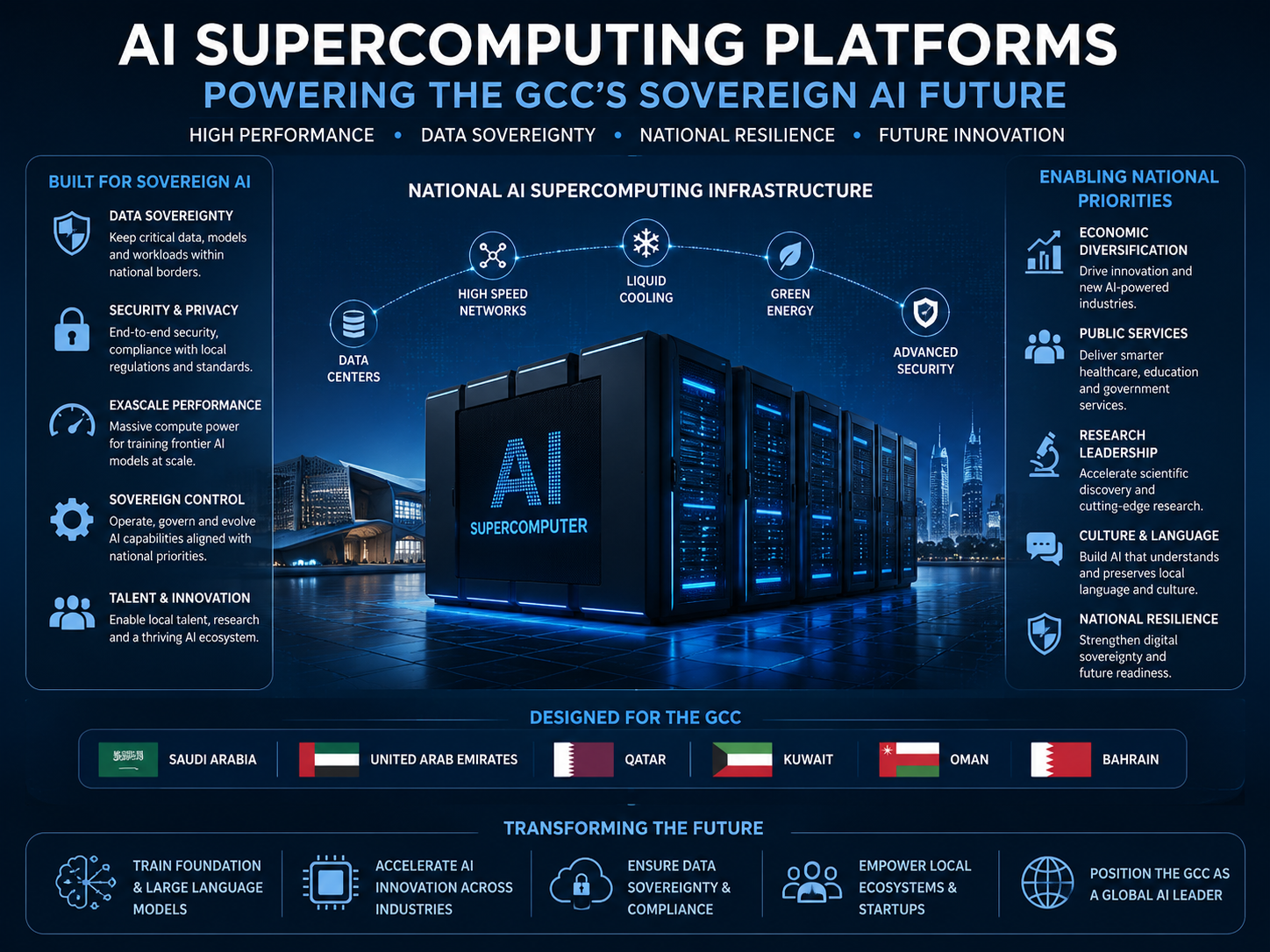
AI supercomputing platforms GCC leaders are evaluating today are not just “bigger cloud servers.” They are high-performance AI environments built for GPU-heavy model training, inference, Arabic LLMs, secure data processing, and regulated enterprise workloads.
For Saudi, UAE, and Qatar organizations, the real value is control: faster AI innovation without losing sight of data residency, compliance, Arabic user experience, cost, and governance.
Why AI Supercomputing Platforms Matter in the GCC
The GCC is moving quickly from AI pilots to national-scale AI infrastructure. Banks want better fraud detection. Governments want Arabic digital services. Retailers want smarter personalization. Energy and logistics companies want forecasting, automation, and optimization.
That shift changes the buying question.
It is no longer only: “Which AI model should we use?”
The better question is: “Where will the model run, who controls the data, and can the infrastructure scale safely?”
That is where AI supercomputing platforms become important. They bring together GPUs, high-speed networking, storage, orchestration, cooling, security, and governance so organizations can train, fine-tune, and run AI systems at serious scale.
What Are AI Supercomputing Platforms GCC Leaders Need?
AI supercomputing platforms GCC enterprises need are purpose-built compute environments for advanced AI workloads. They support.
Model training and fine-tuning
Large-scale inference
Arabic LLM development
Simulation and forecasting
Secure data processing
High-performance AI applications
Traditional cloud is still useful for websites, apps, APIs, databases, and everyday business systems. A Dubai retailer using e-commerce platforms may run its storefront on standard cloud. But real-time AI personalization, recommendation engines, and large product-search models usually need more specialized compute planning.
AI Supercomputing vs. Traditional Cloud
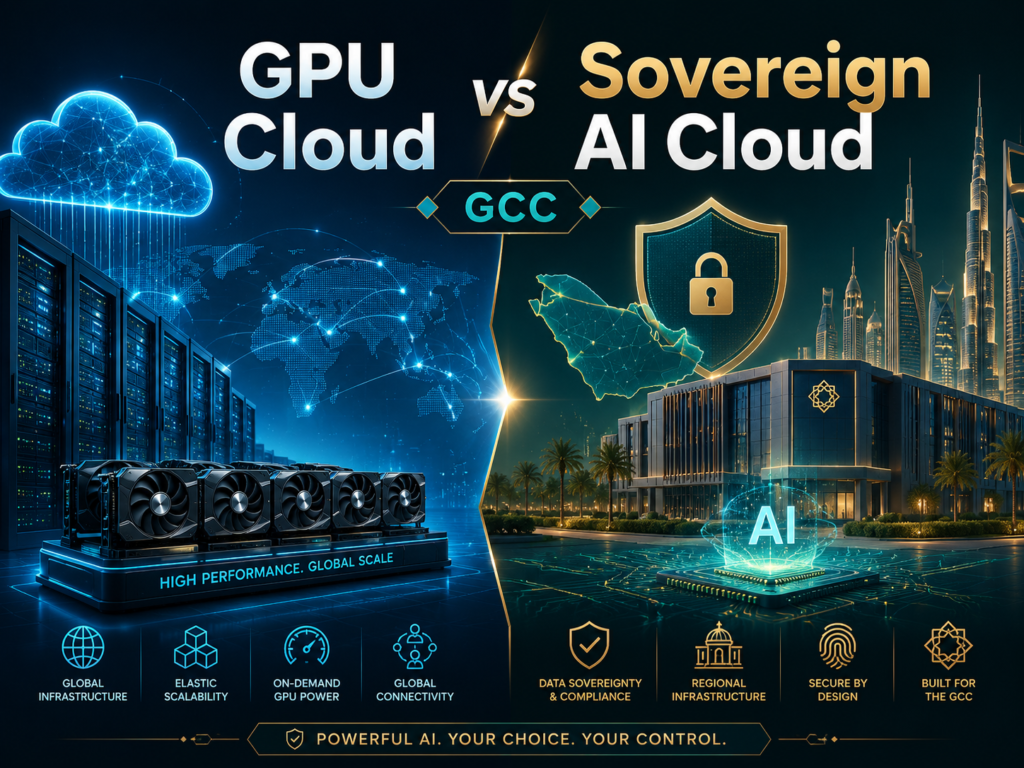
Traditional cloud is optimized for flexibility. AI supercomputing is optimized for performance under heavy AI demand.
Large AI workloads need dense GPU clusters, fast interconnects, low-latency storage, strong workload scheduling, and careful cost control. Without that foundation, teams may spend heavily on GPUs but still get slow training, poor utilization, or unstable inference.
In practice, this means IT, data, compliance, and business teams should evaluate AI infrastructure together—not after the platform is already purchased.
Why GPU Clusters, AI Factories, and HPC Matter
GPU clusters reduce the time needed to train, fine-tune, and serve advanced models. AI factories take that idea further by combining compute, data pipelines, MLOps, observability, governance, and application delivery into a repeatable AI production system.
Saudi Arabia’s HUMAIN is a strong example of this direction. PIF says HUMAIN was launched in May 2025 to build the AI stack across data centers, cloud infrastructure, models, and applications.
For GCC enterprises, the lesson is clear: AI success is not only about buying GPUs. It is about building a full operating model around them.
Why Saudi, UAE, and Qatar Are Investing in Sovereign AI
Sovereign AI is about more than national branding. It means stronger control over compute, data flows, model behavior, cybersecurity, and local language capability.
For GCC decision-makers, sovereign AI matters because many high-value workloads involve sensitive data: banking records, citizen services, healthcare information, energy operations, logistics networks, and customer behavior.
Saudi Arabia.
Saudi Arabia is linking AI infrastructure with economic diversification, digital government, and national competitiveness. For a Riyadh bank, Jeddah logistics operator, or Saudi enterprise group, AI planning should account for Arabic UX, sector regulation, data classification, and local hosting expectations.
HUMAIN’s stated focus on full-stack AI capabilities makes it especially relevant for Saudi organizations that want advanced AI without losing control of infrastructure and governance.
UAE.
The UAE is also building major AI infrastructure capacity. G42 says Stargate UAE is being developed with partners including OpenAI, Oracle, NVIDIA, SoftBank Group, and Cisco. The first 200-megawatt AI cluster is expected to go live in 2026 as part of a larger UAE–U.S. AI campus in Abu Dhabi.
For Abu Dhabi and Dubai organizations, this reinforces a wider trend: AI infrastructure is becoming part of national competitiveness, not just enterprise IT.
Qatar.
Qatar is building Arabic-first AI momentum. Fanar is described as Qatar’s first Arabic generative AI platform, developed by Qatar Computing Research Institute at Hamad Bin Khalifa University and supported by the Ministry of Communications and Information Technology.
Qatar also has local AI infrastructure activity through MEEZA. MEEZA says its GPU-as-a-Service platform provides secure, high-performance computing resources for AI, machine learning, and other intensive workloads, hosted and managed within Qatar.
For Doha enterprises, this creates more room to explore Arabic chat, document automation, search, analytics, and AI decision-support systems while paying close attention to governance and data residency.
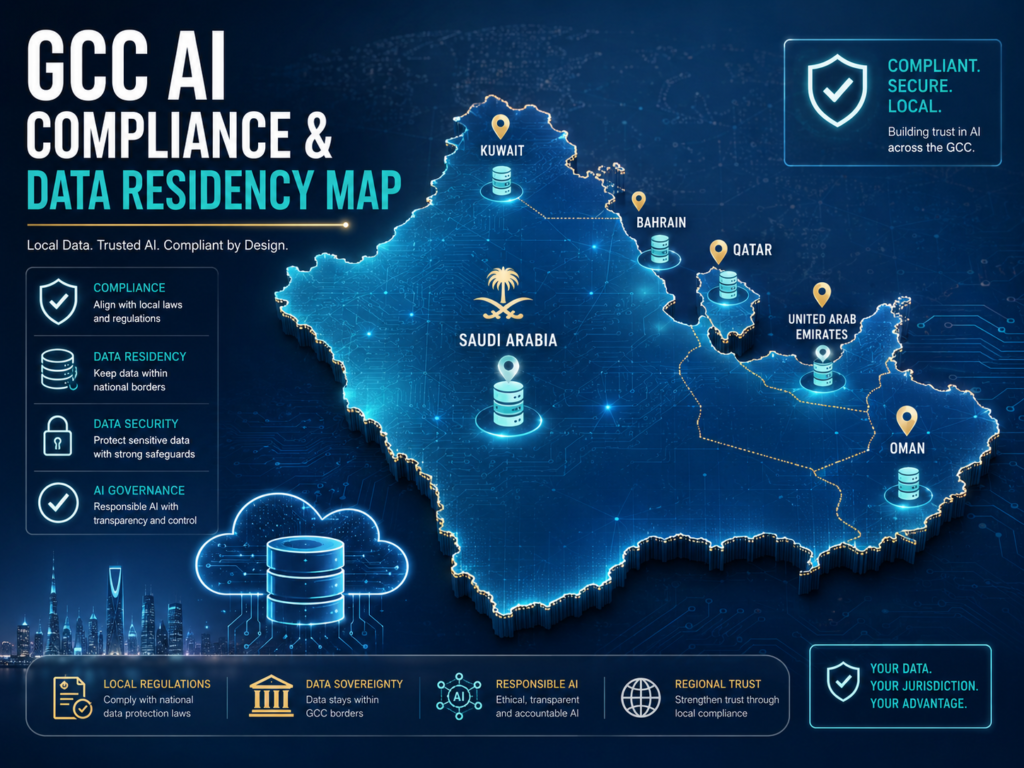
Compliance, Data Residency, and AI Governance in the GCC
For GCC businesses, compliance cannot be added at the end. It should influence platform selection, architecture, vendor contracts, data flows, audit logging, and exit planning from day one.
This is especially important for banking, government, healthcare, telecom, insurance, and national-sensitive workloads.
Saudi Compliance Signals.
Saudi financial institutions should treat AI supercomputing as a regulated risk-management decision, not just a technical upgrade.
SAMA’s cloud computing control expects member organizations to define, implement, monitor, and evaluate cybersecurity controls for hybrid and public cloud services. It also references risk assessment, due diligence, SAMA approval before cloud use, data-use limitations, and cloud security controls.
For Saudi banks and fintechs, that means AI workloads involving customer data should pass through security, legal, compliance, vendor-risk, and business-continuity review before production.
UAE Compliance Signals.
In the UAE, cloud transparency and trust are becoming more visible in the regulatory conversation. TDRA says its Cloud Service Provider initiative gathers information about providers operating in or engaging with the UAE market, while supporting collaboration, transparency, trust, and the cloud services regulatory framework.
For Dubai, Abu Dhabi, ADGM, and DIFC buyers, this makes provider due diligence more important. Teams should ask where data is hosted, how access is controlled, how incidents are reported, and whether AI outputs can be audited.
Qatar Compliance Signals.
Qatar-based financial institutions also need a structured approach. QCB’s cloud computing regulation requires appropriate policies, procedures, and controls for cloud use, including risk management, due diligence on cloud service providers, access, and confidentiality.
For QCB-regulated entities, AI infrastructure decisions should document data classification, approval workflows, vendor controls, resilience planning, and business continuity.
How to Evaluate AI Supercomputing Platforms GCC Enterprises Can Trust
Choosing the right platform is not only a procurement exercise. It is a business, compliance, and engineering decision.
The best option depends on your workloads, data sensitivity, budget, internal skills, performance needs, and target markets.
Compare GPU Cloud, Sovereign Cloud, and Private AI Clusters
Each model has a different trade-off.
| Option | Best For | Watch Out For |
|---|---|---|
| GPU cloud | Fast pilots, flexible scaling, experimentation | Cost sprawl, data residency, shared responsibility |
| Sovereign cloud | Regulated workloads, local control, trusted hosting | Provider availability, pricing, service maturity |
| Private AI cluster | High control, predictable long-term workloads | Capital cost, cooling, talent, operations burden |
| Hybrid model | Mixed workloads across risk levels | Governance complexity and integration effort |
A practical GCC strategy may combine local hosting, managed GPU capacity, secure APIs, and custom applications built with Python development services.
Check Arabic UX and Khaleeji Language Support
Arabic AI quality should be tested early. Modern Standard Arabic is not enough for many customer-facing use cases in Riyadh, Dubai, Abu Dhabi, Doha, or Jeddah.
Teams should test.
Gulf dialect understanding
Arabic search quality
Voice and text accuracy
Cultural context
English-Arabic switching
Hallucination risk in regulated answers
Weak Arabic handling can quickly damage trust, especially in banking, government, healthcare, and customer service.
Review Cloud Region and Data Residency Options
Cloud regions now shape AI procurement across the GCC. AWS lists Middle East regions in Bahrain and the UAE with three Availability Zones each. Microsoft lists UAE North, UAE Central, and Saudi Arabia East among its Azure geographies. Google Cloud opened its Doha region with three zones.
These options help, but region availability alone is not enough. Enterprises should still confirm service availability, GPU types, data residency terms, support model, incident response, and exit rights.
Industry Use Cases for AI Supercomputing Platforms in the GCC
AI supercomputing platforms are most valuable when they connect directly to business outcomes.
Fintech and Banking
A Riyadh fintech or GCC bank can use AI infrastructure for fraud detection, transaction monitoring, credit risk, anti-money-laundering support, customer-service automation, and compliance evidence.
The key is governance. Models that influence money, identity, or customer access should have monitoring, audit trails, human review, and fallback processes.
Government and Smart Cities
Government entities can use Arabic AI assistants, document search, policy analysis, translation, citizen-service automation, and smart-city optimization.
For these workloads, AI governance matters as much as performance. Mak It Solutions’ AI governance guidance can help teams think through roles, controls, review processes, and risk ownership.
Retail, Logistics, and Energy
A Dubai e-commerce brand can use AI for product discovery, personalized offers, customer segmentation, and mobile shopping experiences through mobile app development services.
A Jeddah logistics company can forecast delivery routes and warehouse demand. A Qatar energy firm can use AI for predictive maintenance, asset monitoring, safety workflows, and demand modeling.
These are not abstract use cases. They are practical ways to turn expensive compute into measurable business value.

Cost, Infrastructure, and Deployment Considerations
AI supercomputing can become expensive quickly if teams do not plan usage properly.
The biggest cost drivers include GPU type, GPU utilization, storage throughput, memory, networking, cooling, power, security, monitoring, and engineering support. Poor workload design can waste expensive GPU hours even when the platform itself is powerful.
Build vs. Buy
Buy when speed matters, internal skills are limited, or the workload is still experimental.
Build when control, isolation, and predictable long-term usage justify the investment.
Use a hybrid model when different workloads have different risk levels. For example, a public marketing chatbot may run differently from a regulated banking model or a confidential government analytics system.
Plan Pilots Before Production
A 60–90 day pilot is often enough to test business value, latency, Arabic quality, cost behavior, data controls, and operational readiness.
Before production, teams should add observability, monitoring, escalation paths, human review, and rollback plans. Mak It Solutions’ AI observability guide is useful before scaling AI into live operations.
Best Practices for a GCC-Ready AI Infrastructure Strategy
A strong AI compute strategy should start with risk, not hardware.
Classify Data First
Classify data before choosing a platform. At minimum, separate public, internal, confidential, regulated, and national-sensitive data.
This helps Saudi, UAE, and Qatar teams avoid costly redesigns later.
Match Workloads to Compute
Not every AI workload needs the same infrastructure.
Use larger GPU clusters for training, optimized environments for fine-tuning, and latency-focused deployment for inference. Where outputs affect customers, finance, health, or government decisions, add human-in-the-loop workflows.
Test Arabic Quality Before Signing
Run real prompts, real documents, real customer questions, and real dialect examples. Do not rely only on vendor demos.
Arabic-readiness testing should include accuracy, tone, retrieval quality, refusals, hallucination behavior, and escalation to human review.
Build Security and Governance Into the Platform
Security should include identity controls, encryption, zero trust, audit logs, monitoring, model access controls, and incident response.
For AI-era security planning, Mak It Solutions’ zero trust strategy is a helpful starting point.
Connect AI Infrastructure to Business Intelligence
AI platforms should feed measurable decisions. Connect outputs to dashboards, KPIs, and reporting workflows through business intelligence services.
This helps leaders see whether the AI investment is reducing cost, improving speed, increasing revenue, or lowering risk.
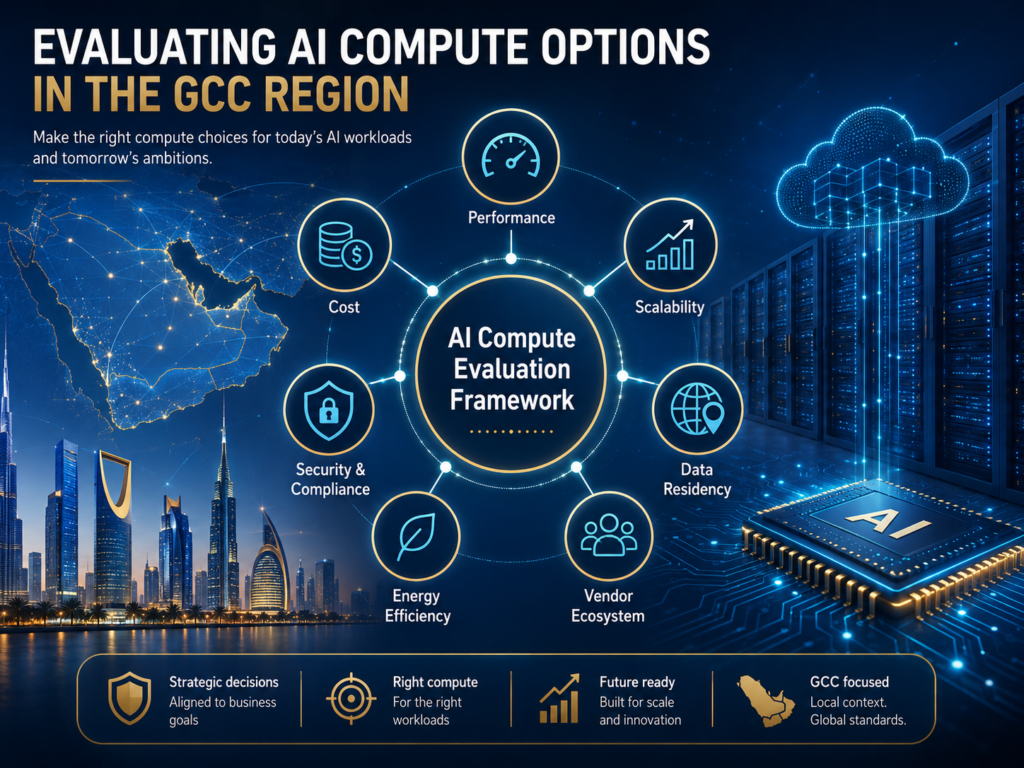
AI Compute Evaluation Framework for GCC Leaders
Use this simple framework before selecting a platform.
Define business use cases and risk level.
Classify data and residency requirements.
Compare GPU cloud, sovereign cloud, private cluster, and hybrid options.
Test Arabic UX, latency, reliability, and cost.
Review contracts, audit rights, incident response, and exit plans.
Add monitoring, human review, fallback, and governance controls.
This framework keeps the conversation practical. Instead of asking, “Which platform is most powerful?” your team asks, “Which platform is safest, fastest, and most useful for our actual workload?”
Final Thoughts
AI supercomputing platforms GCC organizations choose today will shape Arabic AI quality, digital sovereignty, compliance maturity, and customer trust for years.
The goal is not just more compute. The goal is trusted compute.
Before signing with a GPU cloud, sovereign cloud, or private AI cluster provider, confirm workload fit, data residency, Arabic UX quality, security controls, audit rights, exit planning, and total cost.
Planning AI infrastructure in Saudi Arabia, UAE, or Qatar? Book a consultation with Mak It Solutions to assess your workloads, compliance needs, data residency risks, and Arabic AI roadmap before you commit.( Click Here’s )
FAQs
Q : What are AI supercomputing platforms in the GCC?
A : AI supercomputing platforms in the GCC are high-performance infrastructure environments built for advanced AI workloads such as model training, fine-tuning, inference, Arabic LLMs, forecasting, and secure data processing. They usually combine GPU clusters, fast networking, storage, orchestration, security, and governance.
Q : Are AI supercomputing platforms allowed for Saudi banks?
A : They may be used, but Saudi banks should treat them as regulated technology decisions. SAMA’s cloud controls expect risk assessment, due diligence, approval processes, cybersecurity controls, and attention to data location and cloud-service governance.
Q : What makes UAE sovereign AI cloud different from standard cloud hosting?
A : UAE sovereign AI cloud focuses more strongly on data location, access control, governance, auditability, local trust, and regulated workload requirements. Standard cloud hosting may be enough for ordinary apps, but sensitive AI workloads need a deeper review of compliance, contracts, security, and operational control.
Q : Can Qatar enterprises use GPU-as-a-Service for Arabic AI workloads?
A : Yes, when the provider meets performance, security, data governance, and compliance requirements. MEEZA says its GPU-as-a-Service platform supports AI and machine learning workloads and is hosted and managed within Qatar.
Q : Which GCC industries benefit most from AI supercomputing?
A : Fintech, banking, government, healthcare, energy, logistics, telecom, retail, and e-commerce benefit most. These sectors rely on large datasets, regulated workflows, Arabic user experiences, forecasting, automation, and faster decision-making.
[…] Organizations evaluating larger GPU environments can also review Mak It Solutions’ AI supercomputing platforms GCC guide. […]
[…] That matters for Saudi fintech, UAE enterprises, Qatar government workloads, logistics, healthcare, retail, and Arabic AI projects. For deeper infrastructure context, see Mak It Solutions’ AI supercomputing platforms GCC guide. […]
[…] building production AI systems should combine that testing with secure architecture, scalable AI infrastructure, and clearly documented human […]