


Physical AI 2026: Essential Guide for IT Leaders
Physical AI 2026: Essential Guide for IT Leaders
Physical AI 2026: Essential Guide for IT Leaders
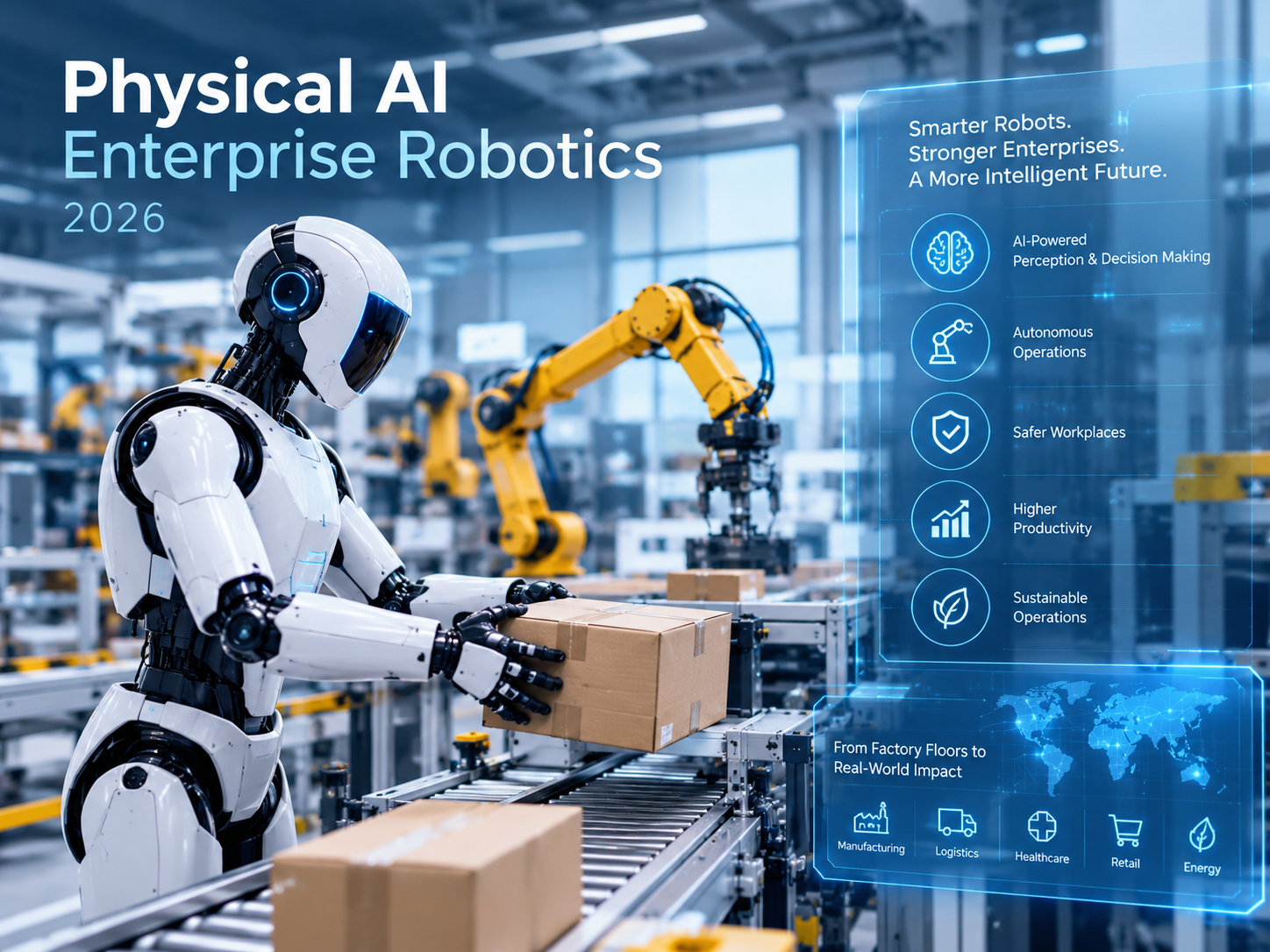
Physical AI 2026 is changing what enterprise automation can accomplish. Intelligent machines are moving beyond fixed instructions to recognize objects, respond to changing conditions, and perform physical tasks with greater flexibility.
Physical AI combines artificial intelligence, sensors, robotics, and control systems to help machines perceive their surroundings, make decisions, and interact with the real world. For enterprise IT teams, its value lies in connecting these capabilities securely with existing business applications, industrial equipment, and operational workflows.
Manufacturers in the United States, logistics operators in the United Kingdom, and industrial businesses across Germany are exploring where these technologies fit into their operations.
The opportunity is significant, but buying intelligent robots is only part of the equation. Successful deployment requires reliable IT/OT integration, cybersecurity, appropriate safety controls, workforce readiness, and a measurable business case.
What Is Physical AI in 2026?
Physical AI refers to artificial intelligence systems that perceive, reason about, and interact with physical environments through sensors, machine learning, and control technologies.
Unlike software-only AI, which primarily processes information or generates digital outputs, Physical AI can influence real-world operations.
Examples include autonomous mobile robots, robotic arms with AI-powered vision, and intelligent inspection equipment.
The broader technical field includes embodied AI and cyber-physical systems.
How Physical AI Perceives, Reasons, and Acts
Most Physical AI systems operate through a continuous perception–reasoning–action cycle.
Perception: Cameras, LiDAR, and other sensors collect information about the environment.
Reasoning: AI models interpret sensory inputs, identify objects, and determine suitable actions.
Action: Controllers translate decisions into physical movements.
Feedback: New sensor information helps the system adjust its behavior when conditions change.
Consider an autonomous warehouse robot moving inventory between storage areas.
If someone places a temporary obstacle in its path, an appropriately equipped robot can detect it, adjust its route, and continue operating within its defined safety limits.
That adaptability distinguishes many modern Physical AI applications from conventional automation.
Physical AI vs. Traditional Robotics
Traditional industrial robots are highly effective at repetitive, predefined tasks. Physical AI adds learning-enabled perception and adaptive decision-making, although its capabilities vary considerably by system.
| Traditional Robotics | Physical AI |
|---|---|
| Mostly predefined workflows | Potentially adaptive workflows |
| Often designed for predictable environments | Can accommodate changing environments |
| Primarily rule-based control | AI-assisted perception and control |
| Significant changes may require reprogramming | Some changes can be handled through learned models |
| Limited environmental interpretation | Richer sensor-based interpretation |
Physical AI is also closely related to embodied AI, which studies intelligence through physical interaction with environments.
Importantly, an AI-enabled robot is not necessarily fully autonomous. Human supervision and conventional safety systems remain essential in many deployments.
Physical AI Trends Shaping Enterprise IT in 2026
Several developments are making Physical AI increasingly relevant to enterprise technology planning.
Vision-language-action (VLA) models are being developed to connect visual observations and instructions with robotic actions.
Robotics simulation allows engineering teams to evaluate machine behavior in virtual environments before testing physical equipment.
Digital twins help organizations model facilities, equipment, and operational processes.
Platforms such as NVIDIA Isaac and NVIDIA Omniverse support robotics development and simulation.
According to the International Federation of Robotics, approximately 542,000 industrial robots were installed globally in 2024, highlighting the substantial automation infrastructure into which emerging AI capabilities may be introduced.
Editorial verification: Confirm statistics against the cited IFR World Robotics 2025 report before publication.
How Physical AI Integrates With Enterprise IT
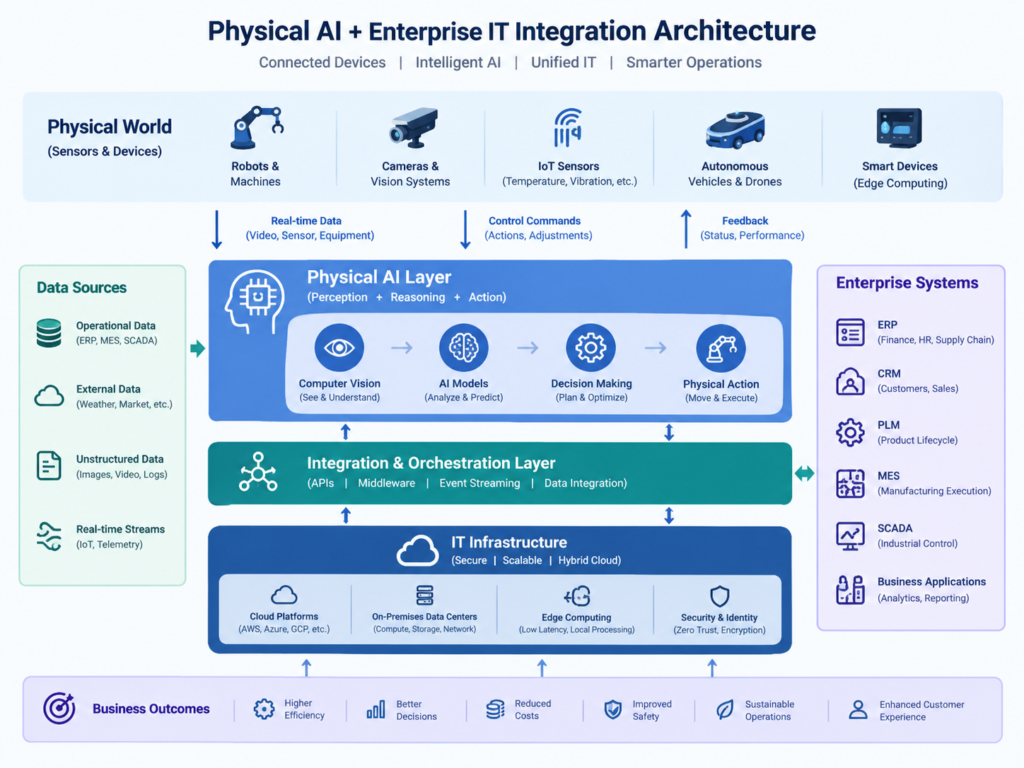
Physical AI becomes more useful when intelligent machines communicate securely with existing enterprise systems.
An autonomous robot operating independently may complete a physical task. A robot connected to inventory, production, or scheduling software can also contribute to a coordinated business process.
The challenge is making those connections dependable without compromising operational safety.
Connecting Robotics to ERP, MES, and WMS
Enterprise platforms provide business context that robots need to perform useful work.
ERP (Enterprise Resource Planning): Connects operational activities with enterprise resources, procurement, and inventory.
MES (Manufacturing Execution Systems): Coordinates production activities and manufacturing information.
WMS (Warehouse Management Systems): Manages warehouse inventory, picking, and material movement.
For example, a warehouse management system can assign a transport task to a robot. After completion, an integration service updates the relevant operational records.
Middleware, APIs, industrial gateways, and communication protocols such as OPC UA can support these connections.
Businesses developing integration services or custom dashboards may also evaluate web development services and Node.js backend development.
Edge AI, Cloud Computing, and Digital Twins
Not every robotics decision belongs in the cloud.
Physical machines often require immediate responses to environmental changes. Sending every decision to a remote server can introduce latency and connectivity risks.
Edge AI allows time-sensitive processing to happen close to the machine.
Cloud platforms such as AWS and Microsoft Azure can complement edge systems through centralized analytics, historical data storage, and model management.
Digital twins can help teams evaluate operational changes virtually before introducing them into production.
A practical enterprise architecture includes:
Sensors and intelligent robots: Capture environmental information and perform physical tasks.
Edge controllers: Manage local inference and interface with control systems.
Secure integration layer: Connect approved devices and enterprise applications through gateways, identities, and APIs.
ERP, MES, and WMS: Coordinate inventory, scheduling, and operational workflows.
Monitoring and governance: Provide performance visibility, audit trails, and oversight.
Safety-critical control functions should remain appropriately isolated and validated rather than depending solely on general-purpose AI or cloud connectivity.
IT/OT Integration and Robot Fleet Monitoring
Integrating Physical AI requires cooperation between enterprise IT and operational technology teams.
Enterprise architects focus on applications, connectivity, and data infrastructure. Plant engineers and operations teams understand machinery, physical constraints, and safety requirements.
Cybersecurity specialists help protect the environments connecting them.
Fleet orchestration platforms can coordinate robot assignments, track machine health, and identify operational exceptions.
Open frameworks such as ROS 2 support robotics software development, while Python development services can support complementary analytics and enterprise tools.
The objective is straightforward: robots should operate as reliable components of a managed enterprise environment rather than isolated machines.
Physical AI Use Cases and Enterprise ROI
Physical AI can support manufacturing, logistics, infrastructure monitoring, and other operations where machines must interact with changing physical environments.
However, technical capability alone does not justify investment.
Enterprise leaders need evidence that the proposed solution improves operational performance enough to justify its lifecycle costs.
AI-Powered Robotics in Manufacturing and Warehousing
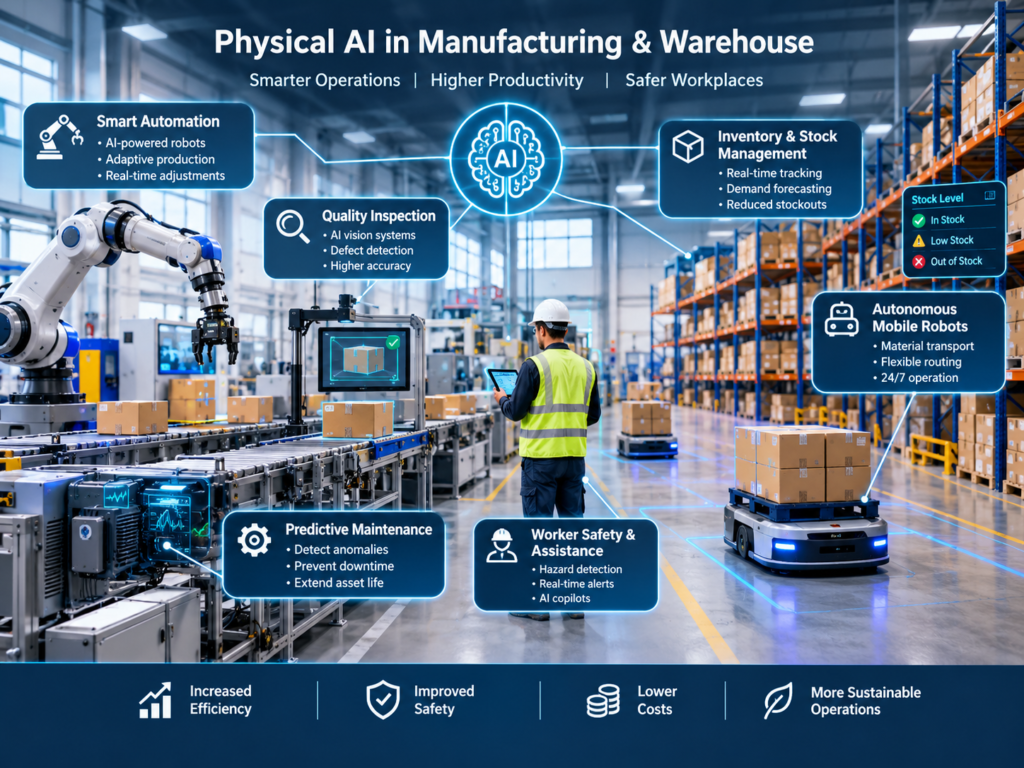
Manufacturing environments offer practical opportunities for AI-assisted inspection, materials handling, and production support.
Germany provides a relevant example.
BMW announced a humanoid robotics pilot at its Leipzig plant in 2026, exploring applications involving high-voltage battery assembly and component manufacturing.
The project illustrates how established manufacturers are evaluating intelligent machines within real production settings.
It remains important to distinguish a controlled pilot from proven, large-scale replacement of conventional industrial robotics.
In the United States, autonomous mobile robots can support warehouse transportation and inventory movement.
For enterprise IT teams, the broader challenge is integrating these systems with production planning, inventory management, and operational reporting.
Intelligent Machines in Data Centers, Healthcare, and Infrastructure
Physical AI also has potential beyond factory floors.
Intelligent inspection machines may assist with infrastructure monitoring, facility maintenance, and activities in potentially hazardous locations.
In data centers, automated inspection equipment could support selected monitoring tasks, subject to site-specific validation.
Healthcare environments may use intelligent mobile machines for internal logistics and equipment transportation.
Deployments in NHS facilities or US healthcare organizations demand careful attention to safety, privacy, human oversight, and applicable operational requirements.
For broader performance visibility, machine-generated information can feed into business intelligence dashboards.
These dashboards can help management compare throughput, machine availability, maintenance requirements, and operating costs.
Measuring Enterprise Robotics ROI
The most useful robotics business cases begin with measurable operational objectives.
Enterprises should compare documented benefits against the total cost of deployment and operation.
A simplified return on investment calculation is:
ROI (%) = [(Measured Benefits − Total Costs) ÷ Total Costs] × 100
Total costs may include.
Robotics hardware and supporting equipment
Software licenses and subscriptions
Enterprise integration and connectivity
Maintenance and technical support
Cybersecurity and safety validation
Workforce training
Operational downtime and system upgrades
Relevant performance indicators include throughput, task success rate, equipment availability, intervention frequency, and cost per completed operation.
The International Federation of Robotics reported approximately 4.66 million industrial robots operating worldwide in 2024, representing an increase of around 9% over the previous year.
Editorial verification: Confirm operational-stock figures against IFR’s World Robotics 2025 report.
These figures reflect the scale of industrial robotics, not a guaranteed return from adopting Physical AI.
Physical AI Cybersecurity, Safety, and Governance
A cybersecurity issue involving business software may disrupt operations or expose information.
A compromised intelligent machine can create additional risks because its decisions may affect physical equipment and surrounding people.
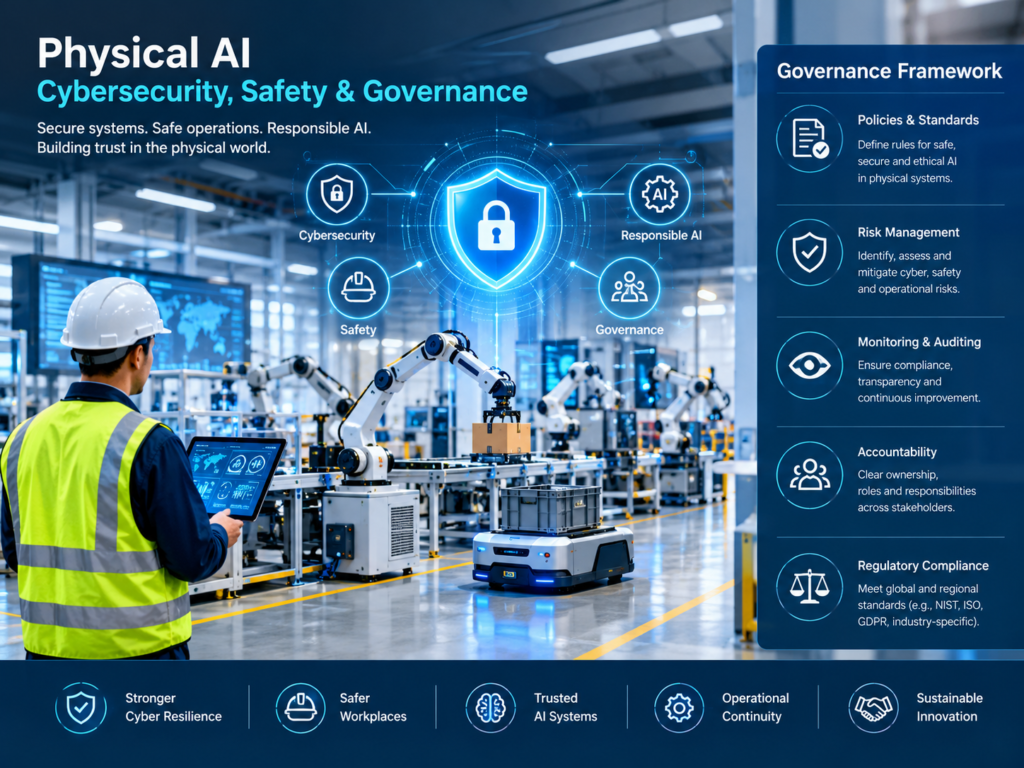
For this reason, cybersecurity and functional safety must be treated as connected but distinct engineering responsibilities.
Cybersecurity Controls for Connected Robots
Physical AI deployments should incorporate security from the initial architecture stage.
Practical safeguards include.
Strong device identity and authentication
Least-privilege access
Encrypted communications
Industrial network segmentation
Documented asset inventories
Secure software and firmware updates
Vulnerability monitoring and incident response
Segmentation is particularly important when enterprise applications communicate with industrial systems.
It helps limit unnecessary access and reduces the potential for attackers to move between connected environments.
The US National Institute of Standards and Technology provides the AI Risk Management Framework as voluntary guidance for identifying and managing AI-related risks.
Data reliability is another consideration. Organizations should establish controls that help prevent outdated, incorrect, or unauthorized information from influencing operational decisions.
Related guidance is available in Mak It Solutions’ article on AI agent data freshness safeguards.
Physical AI Safety and Human Oversight
AI-assisted decision-making must not bypass essential machinery safety protections.
Depending on the environment, deployments should include emergency stops, safety-rated controls, defined operating boundaries, appropriate human supervision, and tested fallback procedures.
Simulation can help engineers examine machine behavior before physical deployment.
But virtual testing cannot replace workplace-specific hazard assessments or validation under real operating conditions.
Standards such as ISO 10218 and IEC 62443 may inform industrial robotics safety and cybersecurity programs, respectively.
Organizations should determine which editions, standards, and legal requirements apply to their equipment and jurisdiction.
EU AI Act, GDPR, UK GDPR, and US Requirements
Compliance obligations depend on the country, industry, application, and risk classification.
In the European Union, the AI Act applies progressively.
The majority of its rules became applicable on August 2, 2026. Following amendments, high-risk requirements have later application dates for specified categories:
December 2, 2027: High-risk AI systems covered by Annex III.
August 2, 2028: High-risk AI systems associated with regulated products under Annex I.
Businesses should consult the European Commission’s AI Act guidance and the consolidated legal text.
GDPR and UK GDPR may apply when connected machines process identifiable personal data.
In the United States, organizations should also consider applicable OSHA workplace-safety requirements and sector-specific obligations. HIPAA may apply where protected health information is handled.
AI legislation, data protection law, machinery safety requirements, and voluntary technical standards serve different purposes.
Regulatory note.
This information is general guidance, not legal advice. Confirm requirements for the specific deployment and jurisdiction before implementation.
Physical AI Adoption Across the USA, UK, and Europe
Physical AI adoption strategies differ according to industrial infrastructure, workforce capabilities, and regulatory conditions.
An architecture suitable for one facility may need substantial adjustments before deployment elsewhere.
Physical AI in US Enterprises
US manufacturing and logistics organizations may focus on warehouse automation, production efficiency, and modernization of established enterprise systems.
For example, an automotive supplier in Detroit could evaluate intelligent robotic inspection connected to production software and centralized analytics.
The business case would depend on inspection accuracy, existing equipment compatibility, safety validation, and cost.
When expanding across multiple facilities, organizations also need consistent device management, cybersecurity policies, and operational reporting.
UK Robotics Adoption and Workforce Readiness
For UK organizations, Physical AI introduces questions about infrastructure readiness, workforce training, and safe integration with existing operations.
A logistics operator in Manchester might begin with autonomous material transportation before considering more complex robotic handling.
A phased approach provides time to evaluate reliability, train employees, and identify practical operating constraints.
Organizations should consider relevant Health and Safety Executive guidance, data protection responsibilities, and workplace policies.
German Industrie 4.0 and EU Industrial Robotics
Germany’s Industrie 4.0 ecosystem emphasizes connected production systems, industrial interoperability, and digitally coordinated manufacturing.
Physical AI can extend these ideas by enabling machinery to interpret environments and adjust selected actions.
BMW’s Leipzig pilot demonstrates the experimentation taking place within established automotive manufacturing.
Across the EU, businesses must also address applicable machinery rules, cybersecurity obligations, data protection, and interoperability with existing production equipment.
How to Implement Physical AI in Enterprise IT
An enterprise Physical AI strategy should begin with an operational problem, not a particular robot or AI model.
A tightly scoped pilot makes it easier to evaluate performance, integration complexity, safety, and financial outcomes.
Assess Business Readiness
Start by identifying a task that is repetitive, measurable, and suitable for controlled testing.
Evaluate existing machinery, application interfaces, data availability, network infrastructure, and workforce requirements.
Establish baseline performance metrics before choosing a technology provider.
Without a baseline, it becomes difficult to determine whether a deployment has actually improved operations.
Build a Secure Physical AI Implementation Roadmap
A practical implementation roadmap follows five stages.
Define the business objective. Identify the operational problem, expected benefits, and acceptance criteria.
Design the integration architecture. Map robots, edge infrastructure, enterprise systems, data flows, and safety boundaries.
Evaluate technology providers. Compare interoperability, support, cybersecurity, maintenance, and total ownership costs.
Validate through a pilot. Test task performance, physical safety, system resilience, and fallback procedures.
Review compliance and readiness. Confirm applicable legal obligations, workforce preparation, and production approval requirements.
Organizations may also need supporting application modernization, integration development, and analytics infrastructure.
Mak It Solutions’ enterprise technology services and guidance on unified data and AI platforms provide relevant context for these broader software decisions.
Scale Robotics Operations With Measurable KPIs
A successful pilot should demonstrate more than a working technical prototype.
Before expanding, organizations should confirm that the solution meets defined operational, safety, security, and financial expectations.
Continue monitoring task completion, uptime, intervention frequency, incident rates, and cost per operation.
Model performance may change as environmental conditions evolve, so maintenance and governance must continue after deployment.
Documented update procedures, rollback plans, and human escalation processes become particularly important as robot fleets grow.
The objective is not maximum automation at any cost. It is dependable automation that produces measurable value.
To Sum Up
Physical AI 2026 represents an important step toward more adaptive enterprise automation.
Intelligent robots can increasingly respond to changing conditions, but reliable business value depends on the systems surrounding them.
Secure IT/OT integration, practical safety controls, dependable data, and clear performance measurements will influence whether enterprise deployments succeed.
For CIOs, CTOs, and digital transformation leaders, the immediate priority is to identify where Physical AI can solve a genuine operational problem and validate that opportunity before scaling.
Mak It Solutions can help businesses evaluate the software architecture, systems integration, and analytics requirements supporting their automation strategies.
Contact Mak It Solutions to discuss an enterprise IT readiness assessment and explore practical next steps.
Key Takeaways
Physical AI combines AI-enabled perception, reasoning, and physical interaction to expand the capabilities of conventional automation.
Enterprise adoption depends on secure integration between intelligent machines, edge infrastructure, cloud services, and business applications.
Manufacturing, logistics, and infrastructure operations offer practical opportunities, but every use case requires financial and technical validation.
Cybersecurity, machinery safety, privacy, and human oversight must be considered throughout deployment.
Regional regulations and operational requirements influence how solutions are designed and deployed.
Controlled pilots, measurable KPIs, and lifecycle planning provide a more reliable path to scaling than immediate organization-wide adoption.
FAQs
Q : Does Physical AI require humanoid robots?
A : No. Physical AI is not limited to humanoid machines. Industrial robotic arms, autonomous mobile robots, inspection equipment, and other intelligent machines can incorporate AI-assisted perception and decision-making.
The appropriate design depends on the task, operating environment, reliability requirements, and cost.
Q : Can Physical AI work with legacy factory equipment?
A : Yes, depending on the equipment and integration requirements.
Industrial gateways, middleware, controllers, and protocols such as OPC UA can connect some existing machines with modern applications.
Older systems may require additional sensors, interface upgrades, or security controls. A readiness assessment helps identify compatibility issues before purchasing robotics equipment.
Q : What data is needed to train Physical AI systems?
A : Physical AI may use camera footage, sensor measurements, depth information, robot trajectories, annotated demonstrations, and simulated environments.
Requirements depend on the intended task and model architecture.
Organizations should assess data quality, privacy, representativeness, and security, then validate performance under real operating conditions.
Q : How long does an enterprise Physical AI pilot take?
A : There is no universal timeline.
A narrowly defined proof of concept may require considerably less work than a safety-critical deployment involving legacy machinery and multiple enterprise applications.
Hardware availability, integration complexity, safety testing, workforce preparation, and approval processes all affect the schedule.
Q : Should enterprises build or buy Physical AI solutions?
A : Many organizations should evaluate a hybrid approach.
Commercial robotics platforms may reduce hardware development and maintenance complexity, while custom software can support enterprise integration, analytics, and specialized workflows.
The decision should account for total ownership cost, interoperability, internal expertise, vendor dependence, and long-term support.
[…] Is Physical AI vs Traditional […]
[…] companies exploring physical AI and enterprise automation, this model shifts the discussion from purchasing technology to achieving measurable business […]