


Unified Data and AI Platform: Do You Need Both Stacks.
Unified Data and AI Platform: Do You Need Both Stacks.
Unified Data and AI Platform: Do You Need Both Stacks.
Enterprise technology leaders face a growing dilemma: should business intelligence (BI) and artificial intelligence (AI) continue running on separate technology stacks?
A unified data and AI platform offers a practical alternative. It allows organizations to share trusted datasets, business metrics, metadata, and governance across analytics and AI workloads without necessarily replacing specialized tools.
For most enterprises, the goal isn’t to combine everything into one system. It’s to eliminate unnecessary duplication while keeping dedicated infrastructure where performance, security, or operational requirements justify it.
The pressure to make this decision is increasing. McKinsey’s State of AI in 2025 survey found that 88% of respondents reported AI use in at least one business function, compared with 78% in the previous survey. Yet widespread adoption doesn’t automatically translate into efficient enterprise architecture.
The question is no longer simply whether BI and AI can share infrastructure. It’s which capabilities should converge—and which should remain independent.
Do Enterprises Still Need Separate BI and AI Stacks?
Most enterprises do not need completely separate BI and AI data foundations. Both can often share governed datasets, metadata, security policies, and business definitions.
However, specialized processing environments remain valuable for advanced model training, GPU-intensive workloads, low-latency inference, and strict security isolation.
The practical approach is to unify reusable data capabilities while preserving workload-specific execution.
Why Are Enterprises Combining BI and AI Platforms?
Traditional BI and AI environments frequently depend on the same operational data but process it through different pipelines.
A sales dataset, for example, might be copied into a reporting warehouse for dashboards and separately prepared for machine-learning forecasts.
This creates additional infrastructure to maintain and increases the risk of inconsistent results.
A shared foundation can help enterprises.
Reduce duplication: Reuse datasets rather than maintaining unnecessary copies.
Improve consistency: Apply common KPI definitions across reporting and AI applications.
Strengthen governance: Coordinate access permissions, metadata, and lineage.
Simplify operations: Reduce overlapping ingestion and transformation processes.
Improve collaboration: Give analytics, engineering, and AI teams access to trusted information.
Consider a New York financial services organization using transaction data for executive reports, fraud detection, and financial forecasting.
A unified foundation could support all these activities while allowing fraud-detection services to use dedicated processing resources.
Existing business intelligence services can help organizations connect reporting environments with modern data platforms without rebuilding every dashboard.
Unified vs. Separate BI and AI Stacks
| Evaluation Area | Separate Stacks | Unified Foundation |
|---|---|---|
| Data duplication | Often higher | Potentially lower |
| Data latency | Multiple pipeline delays | More shared access options |
| Governance | Different policies across systems | More coordinated controls |
| Operations | Multiple platforms and integrations | Fewer unnecessary boundaries |
| Flexibility | Independent tool selection | Depends on interoperability |
| Cost visibility | Often fragmented | Potentially clearer allocation |
A unified approach doesn’t automatically outperform separate environments.
Actual benefits depend on architecture, workload requirements, implementation quality, and ongoing operating costs.
When Should BI and AI Remain Specialized?
Some workloads require infrastructure that conventional analytics platforms cannot efficiently provide.
Common examples include GPU-intensive model training, real-time fraud detection, advanced machine-learning operations (MLOps), and security-sensitive systems.
A bank might share governed transaction data between BI dashboards and fraud-detection models while running inference on dedicated low-latency infrastructure.
The same principle applies to applications that require rapid data processing, as discussed in our guide to real-time data architecture for AI agents.
The objective is shared data and governance not forcing every workload onto the same processing engine.
What Is a Unified Data and AI Platform?
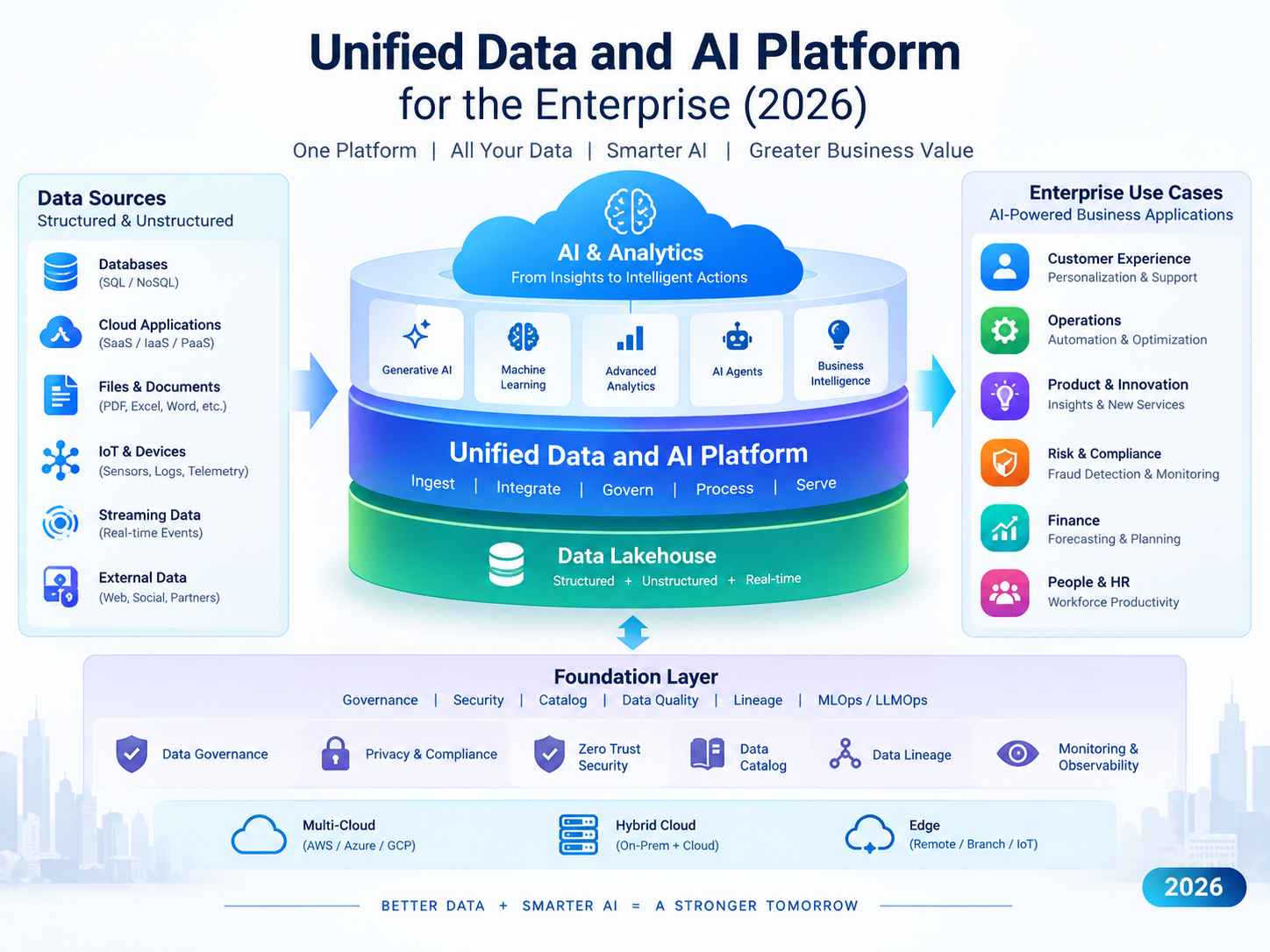
A unified data and AI platform is an enterprise architecture that connects data engineering, business intelligence, analytics, and AI through common data access, metadata, and governance capabilities.
It may incorporate warehouses, lake houses, semantic layers, catalogs, and federated services.
Importantly, a unified architecture does not require a single vendor, storage location, or computing environment.
Converged Data Platform vs. Traditional Enterprise Stack
Traditional enterprise architectures commonly move information between operational databases, ETL pipelines, warehouses, reporting tools, and machine-learning environments.
Every transfer introduces additional dependencies, operational effort, and potential inconsistencies.
A converged architecture reduces unnecessary boundaries by making trusted data and reusable services available across workloads.
This becomes particularly important when introducing AI agents.
If agents rely on inconsistent datasets or poorly defined business metrics, they may generate unreliable recommendations or take actions based on incorrect information.
Our guide to data contracts for AI explains how clearly defined expectations between data producers and consumers can reduce these risks.
Lakehouse, Semantic Layer, and Zero-Copy Integration
Several architectural capabilities make BI and AI convergence more practical.
Enterprise data lake house
A lake house combines flexible data-lake storage with capabilities traditionally associated with enterprise warehouses.
Technologies such as Apache Iceberg and Delta Lake can support open-table-based architectures and interoperability, depending on the implementation.
Shared semantic layer
A semantic layer establishes common business definitions for metrics such as revenue, customer retention, and profitability.
This helps dashboards, analytical applications, and AI systems interpret information consistently.
Our semantic layer for AI agents guide explores why consistent definitions are essential for trustworthy AI outputs.
Zero-copy integration and data federation
These approaches can reduce unnecessary data movement by enabling access to information without always creating additional physical copies.
However, performance, access permissions, network latency, and provider dependencies still require evaluation.
What Does a Unified BI and Machine Learning Architecture Look Like?
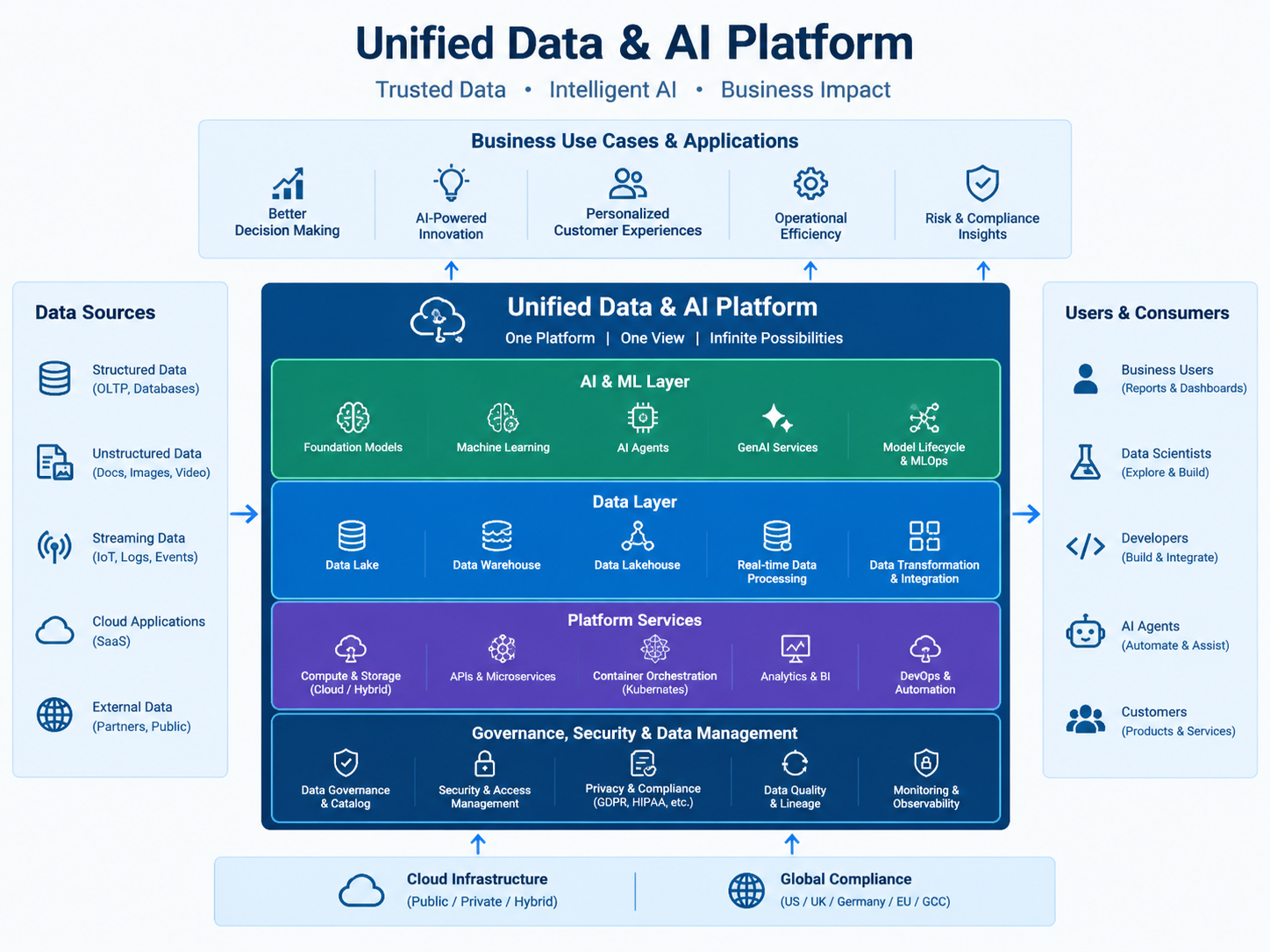
A practical architecture separates shared data capabilities from specialized execution environments.
Enterprise data sources
CRM · ERP · SAP · SaaS applications · Operational databases
↓
Unified data foundation
Lakehouse / Data warehouse / Federated access
Shared metadata · Semantic layer · Data lineage · Governance
↓
Specialized workloads
| BI and Analytics | AI and Machine Learning |
|---|---|
| Dashboards | Model training |
| Enterprise reporting | Retrieval-augmented generation |
| KPI monitoring | AI agents |
| Business forecasting | Model inference |
Both workload categories rely on governed information, but each can retain appropriate computing resources.
This model supports reusable AI-ready infrastructure without forcing organizations to abandon established analytics tools.
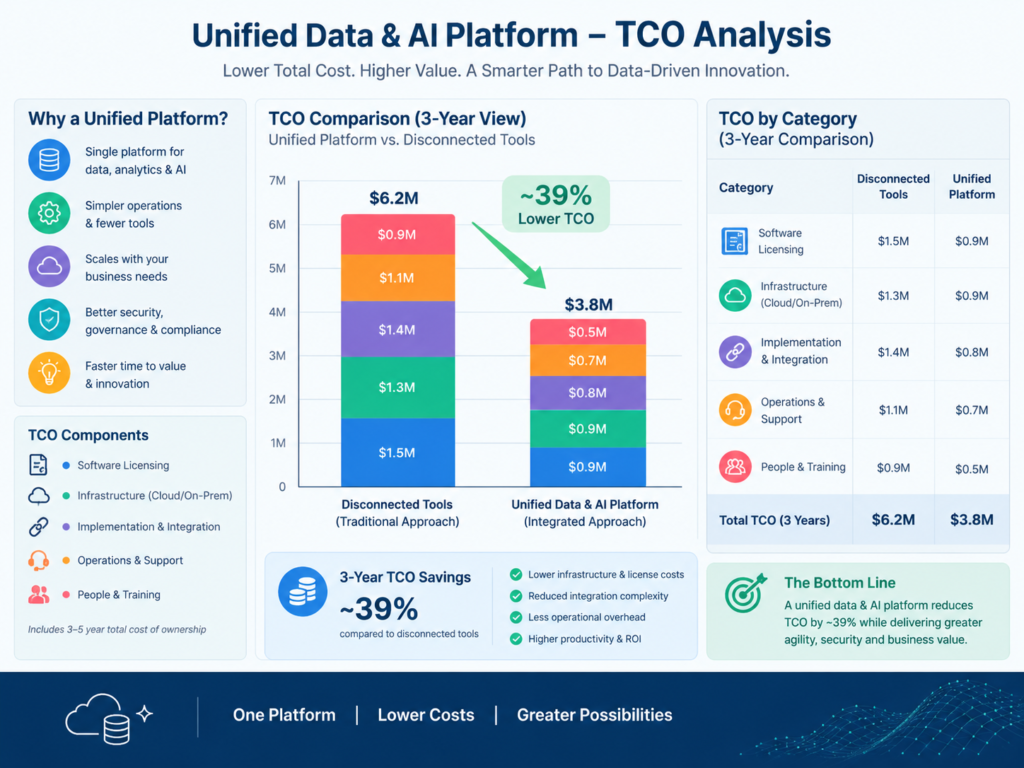
How Much Can Data Platform Consolidation Save?
Consolidation may reduce storage duplication, overlapping licenses, pipeline maintenance, and administrative overhead.
However, there is no universal savings percentage.
Costs depend on migration complexity, vendor licensing, workload consumption, cloud architecture, and organizational requirements.
The Real Cost of Separate BI and AI Infrastructure
Enterprises should assess the complete operating environment rather than comparing platform subscription prices alone.
Relevant expenses include compute, storage, network transfers, software licenses, technical support, engineering effort, governance operations, and disaster recovery.
Cloud spending provides useful context.
In November 2024, Gartner forecast worldwide public-cloud end-user spending of approximately $723.4 billion in 2025, representing projected annual growth of 21.5%.
These figures describe Gartner’s market forecast, not actual enterprise savings from consolidation.
The distinction matters. A smaller number of platforms does not necessarily mean lower total spending, especially when AI compute requirements increase.
How to Calculate Unified Data Platform TCO
A consistent total cost of ownership (TCO) model is essential when comparing architectures.
Three-year TCO = Infrastructure + Licensing + Operations + Governance + Migration + Switching Costs
Include direct expenses and less visible operational requirements.
Temporary dual-running environments during migration.
Application rewrites and data transformations.
Employee training and workflow changes.
GPU processing and cloud consumption.
Network egress, backup, and disaster recovery.
Vendor support and potential exit costs.
Compare the current architecture, proposed unified environment, and any realistic hybrid alternative.
A defensible business case uses measured spending baselines, representative workload benchmarks, and sensitivity analysis rather than unsupported savings claims.
Migrating Legacy BI and AI Workloads Safely
Migration should begin with an inventory of existing datasets, reports, applications, owners, and dependencies.
Identify critical business metrics and security requirements before changing data pipelines.
Next, select lower-risk workloads for testing.
Validate reporting accuracy, query performance, access controls, refresh schedules, and downstream AI behavior before expanding the migration.
Effective AI metadata management can make this process easier by documenting ownership, lineage, and technical dependencies.
A phased approach provides opportunities to identify problems before they affect mission-critical operations.
Which Unified Data and AI Platform Fits Your Enterprise?
There is no universally superior platform.
The right choice depends on existing infrastructure, analytical workloads, AI requirements, governance policies, and the organization’s ability to manage change.
Microsoft Fabric vs. Databricks vs. Snowflake
| Platform | Core Strength | Particularly Relevant For |
|---|---|---|
| Microsoft Fabric | Integrated analytics, OneLake, and Power BI | Microsoft-centered environments |
| Databricks | Lakehouse architecture, engineering, ML, and AI | Data science-intensive organizations |
| Snowflake | Managed analytics, data sharing, and integrated AI capabilities | Enterprise analytical workloads |
These are general platform characteristics, not performance rankings.
A Microsoft-oriented business may find Fabric easier to integrate into existing reporting workflows.
An organization with extensive machine-learning development may prioritize Databricks, while a business focused on managed analytics and data sharing may evaluate Snowflake.
Final selection should be based on workload testing, including query performance, concurrency, data volumes, operational requirements, and long-term costs.
SAP Business Data Cloud and IBM watsonx.data
SAP Business Data Cloud deserves consideration where maintaining SAP business context and application integration is central to enterprise operations.
IBM watsonx.data may suit organizations evaluating hybrid architectures, data interoperability, and governance-oriented ecosystems.
For example, a manufacturing company in Munich with extensive SAP operations may prioritize preserving established business definitions and minimizing integration complexity.
In that environment, practical compatibility can matter more than an extensive feature list.
Open Lakehouse vs. Proprietary Platform
Vendor flexibility should be part of every enterprise evaluation.
Examine open table formats, API compatibility, catalog interoperability, data export, and the portability of pipelines and models.
Open formats can reduce some switching barriers, but proprietary orchestration and security configurations may still create dependencies.
These decisions should support measurable business outcomes rather than technology adoption for its own sake.
Our guide to decision intelligence vs. business intelligence provides additional context on connecting analytics capabilities with business decisions.
How Do Governance and Data Sovereignty Affect BI/AI Convergence?
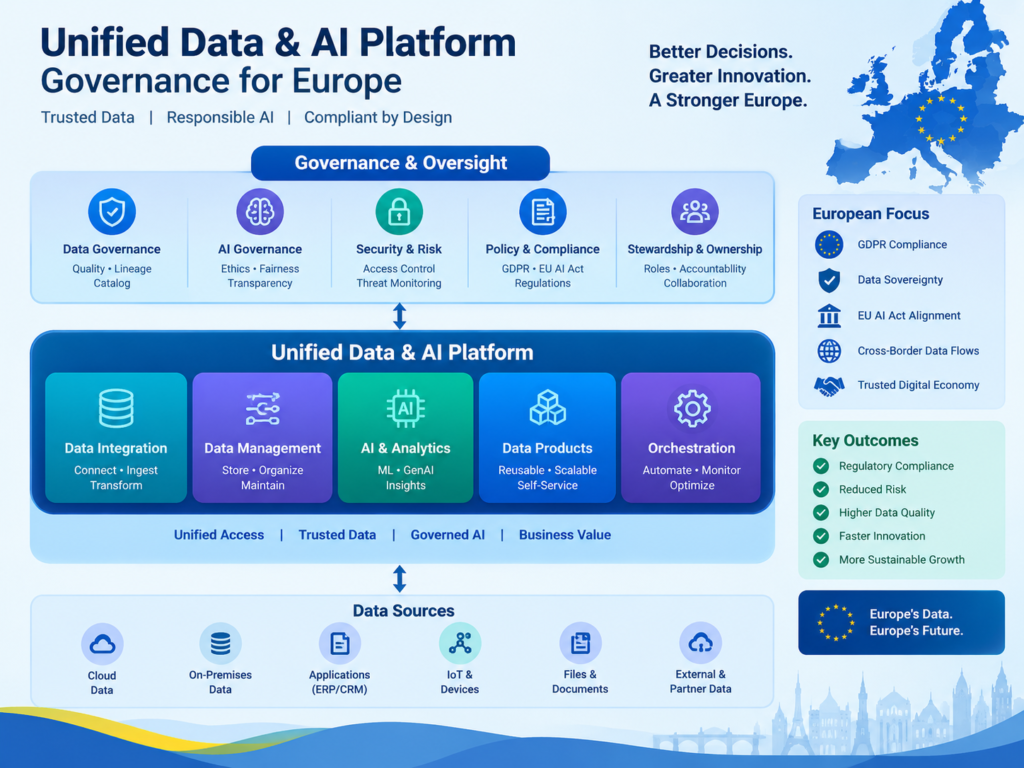
A shared platform may simplify data governance, but it does not automatically guarantee regulatory compliance.
Enterprises must evaluate where data is stored, who can access it, how it moves across borders, and which regulations apply.
These requirements are particularly important for businesses operating across the United States, United Kingdom, Germany, and wider European Union.
Unified Governance, Security, and AI Auditability
A strong governance framework should consider.
Role-based and attribute-based access controls.
Encryption and secure authentication.
Data lineage and audit logging.
Retention policies and workload isolation.
Model access, retrieval permissions, and AI output monitoring.
Governance must cover more than conventional dashboards.
Model training, retrieval-augmented generation (RAG), and AI agents also require appropriate data access and oversight.
Organizations preparing AI applications can use our guide to preparing business data for AI agents as a starting point.
US and UK.
US healthcare organizations handling regulated patient information must evaluate applicable HIPAA requirements, including security safeguards, access controls, auditing, and relevant vendor arrangements.
In the UK, organizations processing personal data must consider UK GDPR and the Data Protection Act 2018.
Some healthcare environments may also face additional NHS-related requirements.
SOC 2 reports can assist with vendor assurance, but they are not substitutes for HIPAA or GDPR compliance.
Relevant official references include US HHS HIPAA guidance and the UK Information Commissioner’s Office.
Germany and EU.
German enterprises must consider the EU GDPR, commonly called DSGVO in Germany, alongside applicable national and sector-specific obligations.
Financial institutions supervised by BaFin may also need to address the Digital Operational Resilience Act (DORA), particularly regarding ICT risk, third-party dependencies, and operational resilience.
The EU AI Act introduces risk-based obligations for relevant AI systems, with different provisions applying according to their implementation schedules.
Official resources include the European Commission’s GDPR framework, DORA information, and EU AI Act guidance.
Data residency alone is not enough. International transfers, sub processors, remote administrative access, contractual safeguards, and recovery arrangements also matter.
Regulatory requirements should be reviewed against each organization’s circumstances with qualified legal and compliance professionals.
A Practical Framework for Deciding What to Consolidate
The best starting point is a structured assessment of shared data capabilities, specialized workloads, operational costs, and regulatory requirements.
Rather than replacing platforms immediately, enterprises should establish which architectural changes solve identifiable business problems.
Five Questions to Ask Before Consolidating
Can BI and AI reuse the same trusted datasets and business definitions?
Which workloads genuinely require dedicated computing resources or isolation?
Will consolidation improve total cost of ownership over three years?
Can the proposed architecture satisfy security, governance, and regulatory requirements?
How easily can datasets, applications, and models move between providers?
Document the answers in an architecture decision matrix.
This creates a practical basis for comparing platform options and communicating trade-offs to business stakeholders.
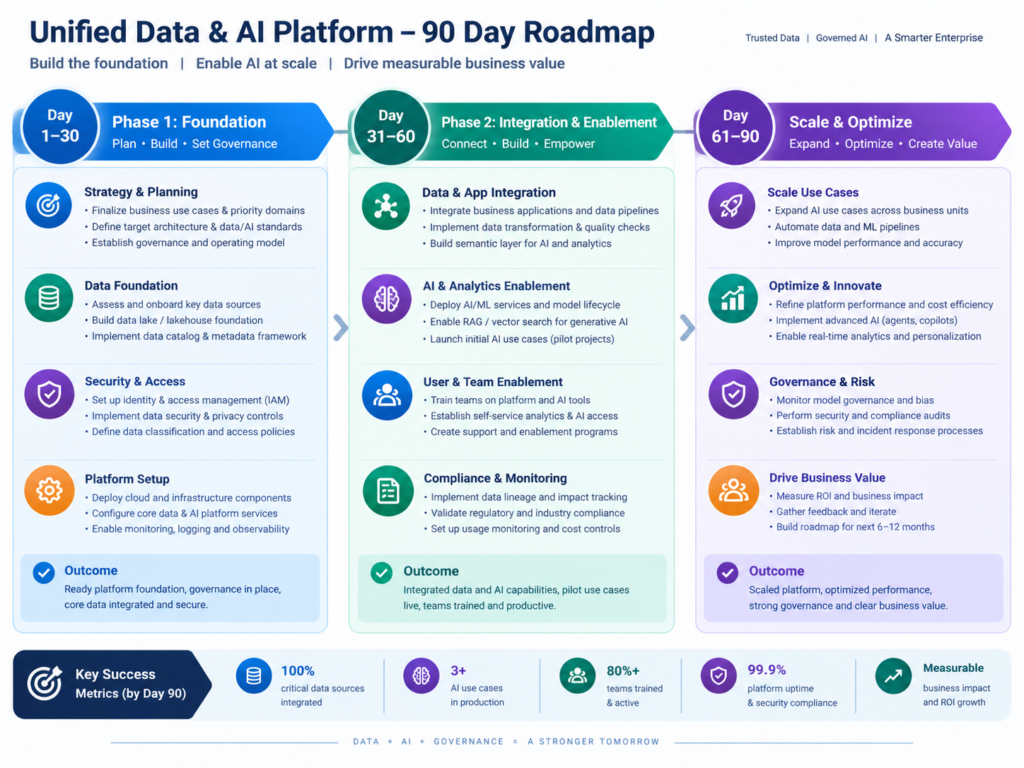
A 90-Day BI and AI Platform Assessment Roadmap
| Timeline | Phase | Key Activities |
|---|---|---|
| Days 1–30 | Discover and baseline | Inventory datasets, applications, ownership, metrics, and existing costs |
| Days 31–60 | Pilot and validate | Benchmark BI and AI workloads, governance controls, and performance |
| Days 61–90 | Decide and plan | Complete vendor evaluation, migration sequencing, risk review, and business case |
This is an illustrative assessment roadmap, not a guaranteed implementation timeline.
The complexity of existing systems may require a longer evaluation.
When to Engage a Data Platform Modernization Partner
Independent expertise can be helpful when organizations manage regulated workloads, multi cloud infrastructure, legacy enterprise applications, or complicated migrations.
Look for partners who can assess data architecture, analytics requirements, security, governance, and lifecycle costs without forcing a predetermined vendor choice.
A useful engagement starts with business objectives and technical evidence not a platform demonstration.
To Sum Up
A unified data and AI platform can help enterprises reduce unnecessary fragmentation, improve consistency, and establish stronger connections between business intelligence and artificial intelligence.
But unification should not come at the expense of performance, security, portability, or flexibility.
For organizations across the US, UK, Germany, and the wider EU, a balanced architecture combines governed data, consistent business definitions, interoperable services, and specialized execution where required.
The strongest strategy is to consolidate what creates shared value and retain what serves a distinct operational purpose.
Not sure which parts of your enterprise infrastructure should converge?
Mak It Solutions can help your organization assess existing data systems, analytics applications, governance requirements, and modernization opportunities.
Contact our team to request a platform-convergence readiness assessment and identify practical next steps.
Key Takeaways
Unify trusted datasets, metadata, and governance before replacing specialized BI or AI tools.
Evaluate complete three-year TCO, including migration and vendor-exit costs.
Compare Microsoft Fabric, Databricks, Snowflake, SAP, and IBM using actual enterprise workloads.
Review applicable security, privacy, AI governance, and operational resilience obligations.
Validate architecture through phased pilots and preserve practical exit options.
FAQs
Q : Can existing Power BI dashboards work with a unified data and AI platform?
A : Yes. Many existing Power BI dashboards can connect to a unified data foundation without requiring complete reconstruction.
Migration effort depends on semantic models, supported connectors, transformations, and refresh requirements. Pilot testing should confirm report accuracy, performance, and permissions.
Q : Does a unified analytics platform replace the need for a data warehouse?
A : Not necessarily. A unified architecture can incorporate existing warehouses or consolidate selected workloads into a lake house.
The decision depends on performance, concurrency, reliability, governance, and cost. Existing warehouses should not be retired until suitable replacement capabilities are validated.
Q : What hidden costs should enterprises consider during BI and AI migration?
A : Common overlooked expenses include application rewrites, dual-running environments, staff retraining, GPU consumption, network egress, security testing, and disaster recovery.
A three-year TCO model should separate one-time migration costs from recurring operational expenses.
Q : Can a unified data and AI platform support multiple cloud providers?
A : Yes, depending on its architecture, integrations, and deployment options.
Open formats, compatible APIs, and federated data access can improve interoperability across AWS, Azure, Google Cloud, and private infrastructure. However, cross-cloud costs, performance, and governance should be tested.
Q : How can European businesses reduce vendor lock-in when consolidating data platforms?
A : Evaluate open data formats, export procedures, contractual flexibility, regional deployment options, and model portability.
A practical test is to migrate representative datasets and workloads to an alternative environment. This helps reveal actual switching costs and technical dependencies before making a long-term commitment.