


AI Agent Data Freshness: 9 Proven Safeguards
AI Agent Data Freshness: 9 Proven Safeguards
AI Agent Data Freshness: 9 Proven Safeguards
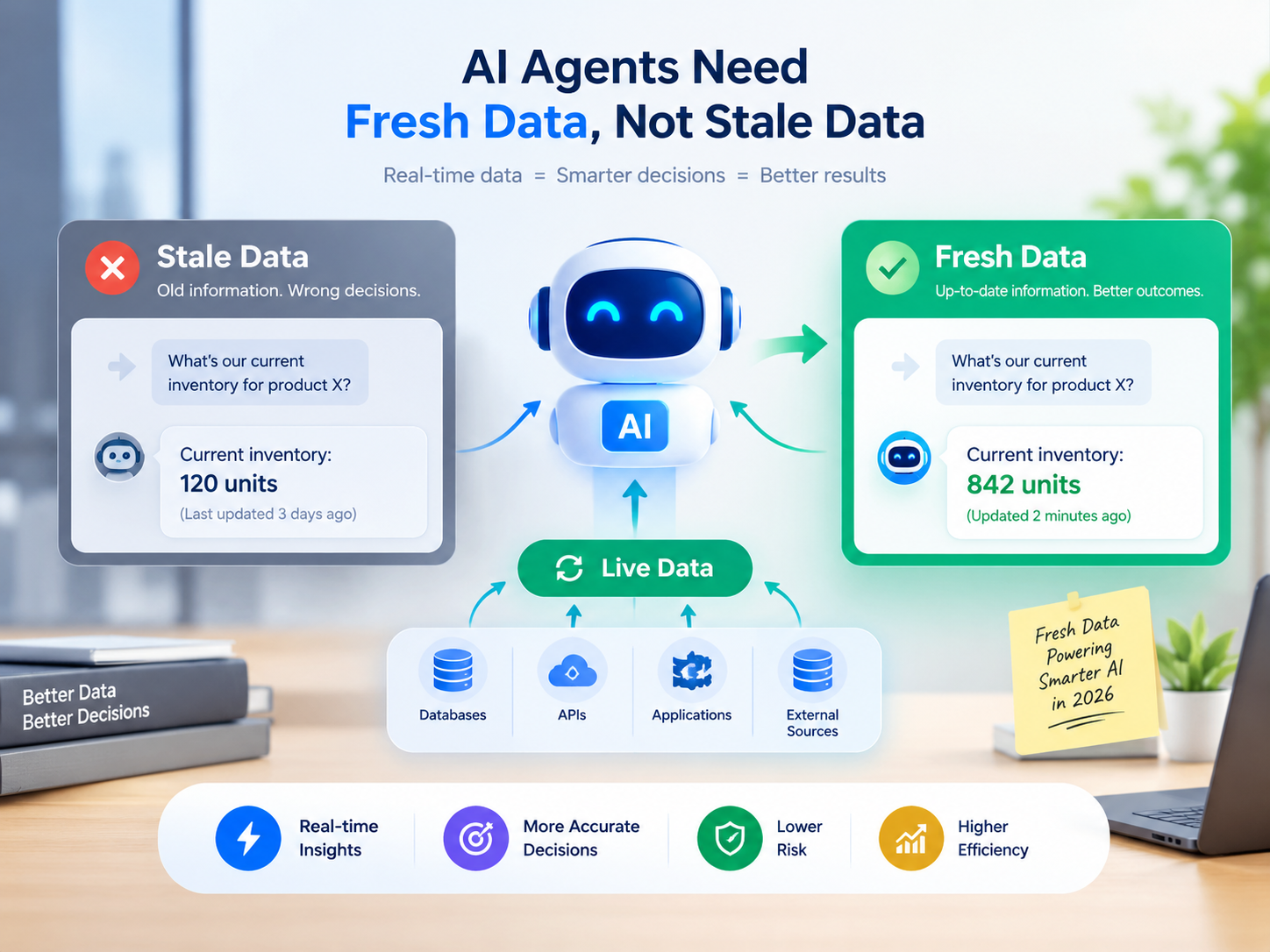
An AI agent retrieves a customer’s account details, prepares an update, and executes it. But what happens if another system changes that account between retrieval and execution?
The agent may act on information that was correct moments earlier but is now outdated. This is the challenge of AI agent data freshness, and it becomes particularly serious when autonomous systems handle payments, customer records, permissions, or inventory.
To prevent AI agents from acting on stale data, organizations need to define freshness requirements, verify authoritative sources, invalidate outdated caches, and check record versions before critical actions. Atomic conditional writes, safe retries, and monitoring provide additional protection when data changes during execution.
The problem extends beyond slow databases. Even a fast retrieval system can return information that no longer reflects the current business state.
For enterprises building real-time data architecture for AI agents, the goal is not simply faster information retrieval. It is ensuring that agents make decisions using valid information and execute those decisions safely.
Here are nine practical safeguards for achieving that.
What Is AI Agent Data Freshness, and Why Does It Matter?
AI agent data freshness describes how accurately the information used by an AI agent reflects the latest relevant state of its authoritative data source.
An agent may receive outdated information because of delayed data pipelines, stale API caches, outdated retrieval-augmented generation (RAG) indexes, or changes made by other applications.
The distinction matters because retrieving information recently does not guarantee that the information itself is current.
Data Freshness vs. Data Consistency
Although closely related, freshness and consistency address different aspects of agent reliability.
| Concept | Meaning | Practical example |
|---|---|---|
| Data freshness | Whether information reflects recent source changes | Checking the latest account balance |
| Data consistency | Whether records and operations obey compatible state rules | Preventing conflicting account updates |
| Safe execution | Whether an action remains valid when committed | Rejecting a transfer after authorization changes |
A data freshness service-level objective (SLO) establishes the maximum acceptable age of information for a particular workload.
For example, an internal reporting assistant may tolerate several minutes of delay. A financial agent executing a transaction may require authoritative verification at execution time.
Five Common Causes of Stale Data
Stale data typically enters autonomous workflows through these sources.
Delayed ingestion: Data pipelines receive source updates late.
Outdated API caches: Cached responses remain accessible after records change.
Stale RAG indexes: Vector databases continue retrieving superseded documents.
Persistent agent memory: Agents reuse historical context without checking whether it remains valid.
Time-of-check-to-time-of-use (TOCTOU) gaps: Data changes after verification but before execution.
Consider a CRM agent preparing a customer account adjustment. If a support representative modifies the account during that process, the agent’s original plan may no longer be appropriate.
Reliable business intelligence and data integration help reduce these risks, but execution controls remain essential.
How to Prevent AI Agents From Using Stale Data: 9 Safeguards
A dependable freshness strategy needs protection across source validation, retrieval, and execution.
Reducing cache time-to-live (TTL) can help, but it cannot eliminate replication delays or prevent another process from changing a record after retrieval.
The following safeguards address those gaps.
Safeguards 1–3: Validate Data Freshness and Sources
Establish risk-based freshness thresholds
Define how current each category of information must be.
Critical data, including account balances, authorization status, and payment instructions, generally needs stricter validation than historical reports or reference documentation.
Monitor timestamps and replication delays
Track source-update timestamps, ingestion times, and downstream availability.
A recently cached response is not necessarily fresh if the upstream pipeline has not processed an important change.
Verify authoritative data sources
Identify the actual system of record for every consequential decision.
Store source identifiers and record-version metadata when possible. Avoid using an LLM’s internal memory as proof of current operational state.
These controls should form part of the organization’s broader enterprise development services and integration architecture.
Safeguards 4–6: Keep Cached and Retrieved Data Current
Configure workload-specific cache TTLs
Use shorter expiration periods for frequently changing information and longer periods for relatively stable data.
However, TTL expiration only limits cache age. It does not guarantee that the underlying source is current.
Implement event-driven cache invalidation
Change data capture (CDC), event notifications, and update hooks can invalidate affected cached records whenever source information changes.
This reduces reliance on scheduled refreshes and unnecessary polling.
Retrieve live information before sensitive actions
When an agent handles balances, access permissions, inventory reservations, or similar high-impact operations, it should consult the authoritative API when necessary.
Live retrieval is especially useful when cached or indexed information cannot reliably satisfy the required freshness threshold.
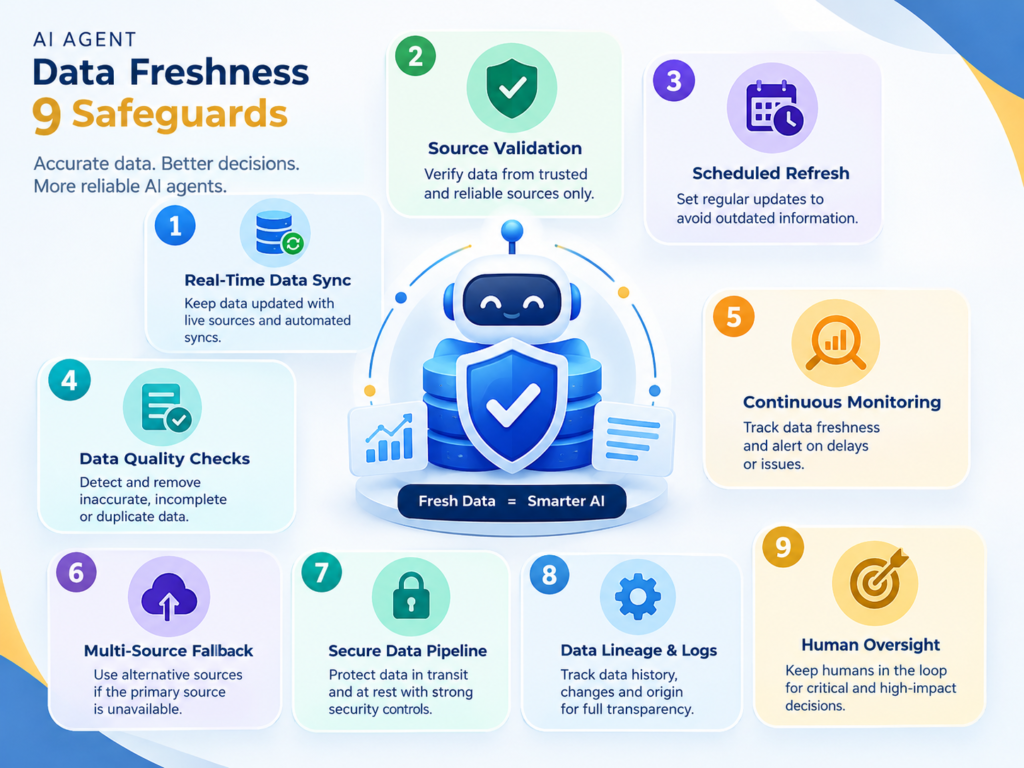
Safeguards 7–9: Verify State Before Execution
Recheck critical assumptions
Before committing an important change, verify that the information supporting the planned action remains valid.
This includes record status, ownership, authorization, and relevant dependencies.
Use optimistic concurrency control
Record versions, database conditional writes, and HTTP ETag/If-Match mechanisms help detect changes made by another process.
For example, AWS documentation on optimistic locking describes how version-based conditional writes reject conflicting updates.
Design safe retries and recovery
Use idempotency keys and bounded retry policies to help prevent duplicate effects.
When a version conflict occurs, the agent should retrieve the latest state and reconsider its plan rather than repeating an outdated instruction automatically.
Together, these safeguards help prevent stale reads from becoming incorrect business actions.
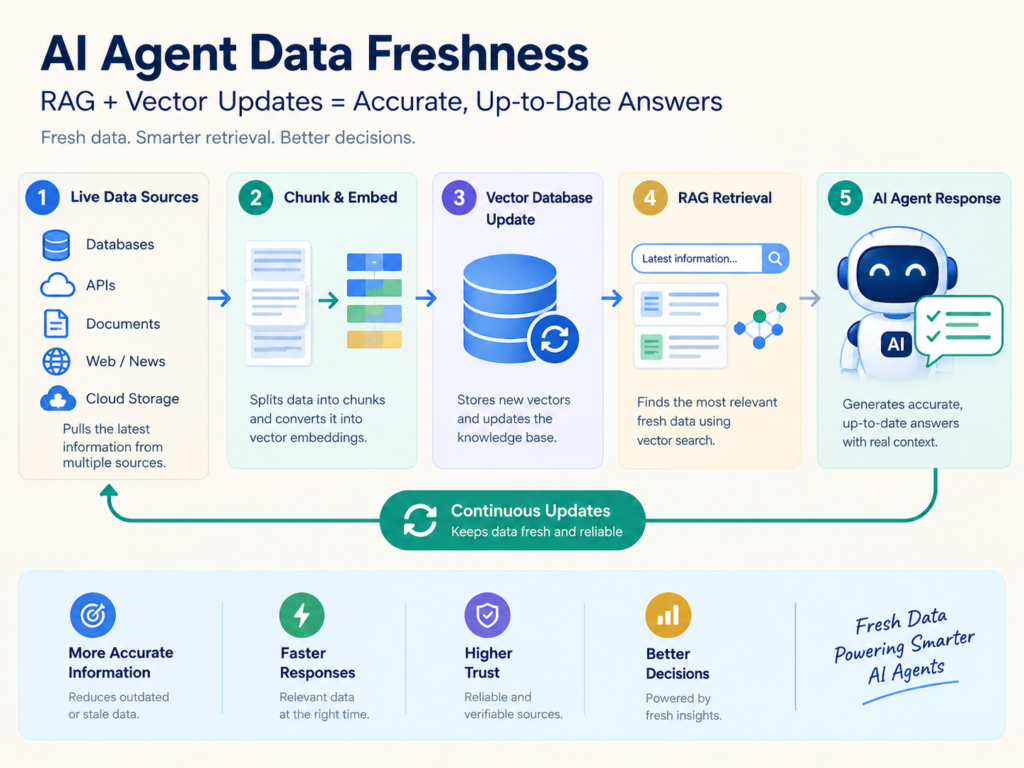
How to Keep RAG and AI Agent Memory Up to Date
Retrieval-augmented generation allows agents to use documents and knowledge beyond their training data. But a RAG system is only as current as its underlying information pipeline.
Updating a source document does not mean the corresponding embedding or vector index is immediately updated.
Identify Stale Embeddings and Vector Index Delays
A typical RAG workflow involves document ingestion, processing, embedding generation, indexing, and retrieval.
Delays can occur at any stage.
Monitor these signals.
Source-to-ingestion delay
Embedding-generation latency
Vector-index visibility lag
Cached retrieval-result age
Source-document version mismatches
Imagine an internal security assistant retrieving an outdated access-control policy even though the organization has already published a replacement.
The retrieval process may function correctly from a technical perspective, yet the resulting recommendation could still be wrong.
Use Event-Driven Updates and Version Metadata
Connect document-change events to incremental indexing processes.
Store source identifiers, document versions, and update timestamps alongside retrieval chunks. Superseded material should be replaced or excluded from results when appropriate.
Teams using Python development services for data pipelines can incorporate these validation and indexing mechanisms into their RAG workflows.
For permission-sensitive information, check current access rights rather than assuming that permissions stored alongside old embeddings remain valid.
Agent memory also needs boundaries. Historical context may support reasoning, but it should not override the latest authoritative operational data.
How to Enforce AI Agent State Consistency Before Execution
Freshness checks alone cannot prevent every stale-data failure.
A record can change after the agent verifies it but before its update reaches the database. This is a TOCTOU problem.
Prevent TOCTOU Errors With Atomic Version Checks
A safer workflow follows this sequence:
Read → Plan → Verify → Execute
Conceptually, the implementation looks like this
record = source.read(record_id) plan = agent.plan(record) current = source.read(record_id) if current.version != record.version: raise ReplanRequired() source.update_if_version_matches( record_id, plan.update, expected_version=current.version )
The important protection is the final atomic conditional update.
A separate verification read is useful, but only the atomic write condition prevents a concurrent change from silently invalidating the operation.
If the action depends on multiple records or permissions, those dependencies may need transactional protection as well.
Combine Concurrency Control With Idempotency
Optimistic concurrency control detects conflicting updates before they commit. Multiversion concurrency control (MVCC) can also support consistent database operations, depending on the system.
Idempotency keys address a different problem: duplicate execution.
For example, a payment agent might retry a request after a network timeout. Without idempotency protection, that retry could create an unintended duplicate payment.
For systems built around APIs and distributed services, Node.js development services can support the implementation of conditional requests, idempotency mechanisms, and reliable error handling.
When operations span multiple services, additional safeguards may include reconciliation, compensating transactions, and human approval.
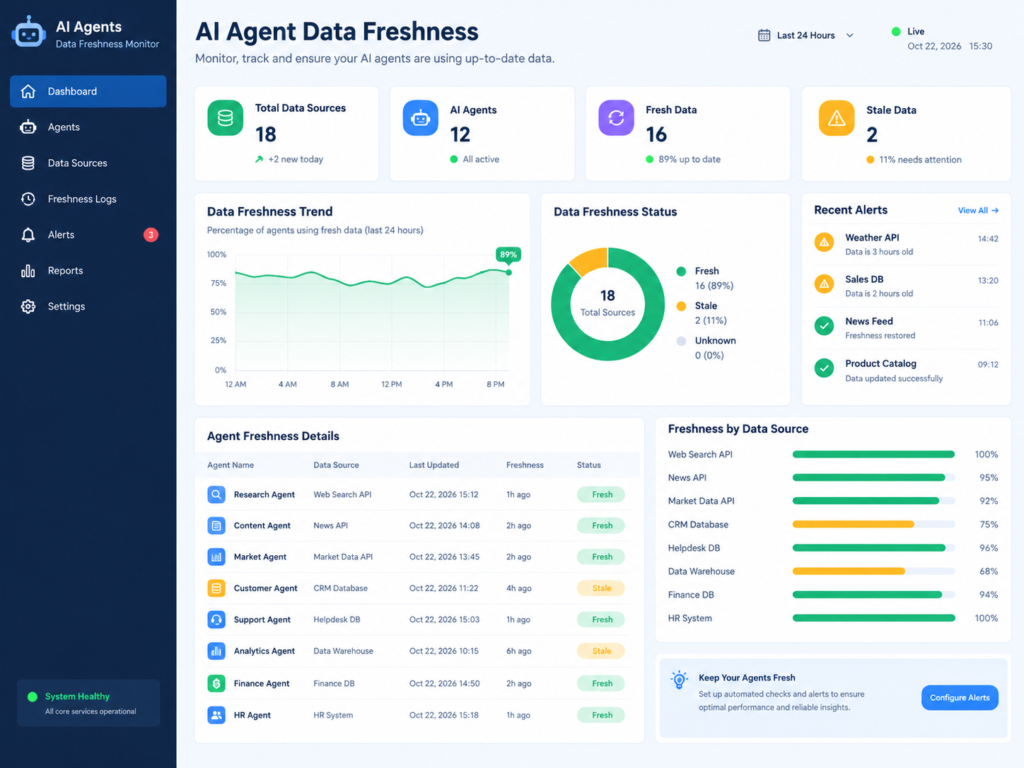
How to Monitor AI Agent Data Freshness in Production
Freshness safeguards need continuous monitoring after deployment.
An agent may behave correctly during testing but encounter delayed pipelines, concurrent updates, or failed invalidation events under production traffic.
Track Freshness Lag and Version Conflicts
Monitor the relationship between source changes, retrieval, and agent execution.
Useful metrics include.
| Metric | What it reveals |
|---|---|
| Source data age | How old the underlying information is |
| Ingestion lag | Delay between source changes and pipeline processing |
| Index visibility lag | Time before updated documents become searchable |
| Stale-read rate | Frequency of outdated information being retrieved |
| Version conflicts | Actions blocked because records changed |
| Pre-action validation failures | Planned actions rejected before execution |
Tools such as Open Telemetry and AWS CloudWatch can help correlate agent requests, data-pipeline events, validation checks, and execution outcomes.
This visibility matters as AI adoption expands.
McKinsey’s 2025 State of AI research reported that 78% of surveyed respondents said their organizations used AI in at least one business function, compared with 72% in an early-2024 survey. These figures describe broad AI adoption, not specifically autonomous-agent deployment.
Establish a Recovery Process for Unsafe Actions
When essential information is stale or cannot be verified, agents should follow a documented recovery sequence:
Detect → Block → Refresh → Re-plan → Retry safely or escalate
Production logs should preserve relevant source versions, validation results, execution identifiers, and audit events.
Avoid collecting unnecessary sensitive personal information.
Enterprise risk reinforces the value of sound operational controls. IBM’s 2024 Cost of a Data Breach Report reported a global average data breach cost of USD 4.88 million.
That figure relates to cybersecurity breaches, not losses caused by stale AI-agent data. It provides broader security-risk context rather than a direct estimate of freshness failures.
For related guidance, see the enterprise technology insights published by Mak It Solutions.
AI Agent Data Freshness in the USA, UK, and EU
The technical principles of data freshness remain broadly applicable across regions. Governance, documentation, and oversight requirements, however, depend on the workflow and the applicable regulatory framework.
USA.
A financial automation platform in New York may require current balance verification, transaction authorization, and auditable updates.
Healthcare systems operating in Boston or elsewhere in the United States may need additional safeguards when processing protected health information.
HIPAA, relevant SOC 2 assurance requirements, and PCI DSS can affect security and data-handling expectations, depending on the system.
These frameworks have different scopes and should not be treated as interchangeable compliance standards.
UK.
In London fintech systems, agents interacting with Open Banking APIs should verify relevant permissions and transaction information before executing sensitive operations.
Systems processing NHS-related personal information may need stronger accuracy, confidentiality, and access-control measures.
The UK Information Commissioner’s Office guidance explains the importance of keeping personal information accurate and updated where necessary.
Germany and EU.
Enterprise systems in Frankfurt and Berlin may combine AI agents with financial infrastructure, ERP platforms, and distributed data services.
In these environments, reliable data provenance, state verification, and operational documentation can support internal governance.
Germany’s GDPR framework (DSGVO), applicable BaFin requirements, and the EU AI Act require separate assessments.
According to the European Commission’s AI Act guidance, obligations are being introduced in phases. Under the updated implementation timetable, certain high-risk AI-system rules apply from December 2, 2027, while requirements for some AI systems embedded in regulated products apply from August 2, 2028.
Not every enterprise AI agent is classified as a high-risk AI system. Applicability depends on its intended purpose and the relevant legal provisions.
For German-language technical research, KI-Agenten Datenaktualität und Konsistenz sicherstellen describes the goal of maintaining freshness and consistency in AI agents.
Production Checklist for Reliable AI Agent Actions
Before deploying an autonomous workflow, confirm that its data sources, retrieval systems, and execution mechanisms can support the required reliability level.
Pre-Deployment AI Agent Data Freshness Checklist
Define risk-based freshness SLOs for critical workflows.
Identify authoritative data sources and record-version mechanisms.
Document cache invalidation, retrieval, and indexing policies.
Implement atomic conditional writes and pre-action validation.
Establish freshness monitoring, failure handling, and escalation procedures.
A successful readiness review should include tests for concurrent modifications, unavailable authoritative sources, delayed indexing, and duplicate execution attempts.
When Should Enterprises Review Their Infrastructure?
An architecture assessment becomes especially valuable when agents depend on frequently changing records, multiple asynchronous pipelines, or actions with significant operational consequences.
Review the existing stack before investing in additional tools.
Focus on CDC coverage, source verification, version-aware APIs, indexing delays, observability, and recovery behavior.
The appropriate solution is the one that satisfies measurable freshness requirements without introducing unnecessary operational complexity.
Concluding Remarks
Reliable AI automation depends on more than intelligent models and fast APIs.
AI agent data freshness requires a deliberate combination of authoritative source checks, updated retrieval systems, concurrency protection, and safe execution practices.
The central principle is straightforward: an AI agent should not execute a consequential action unless the information supporting that action is still valid.
Mak It Solutions helps businesses evaluate data pipelines, enterprise integrations, and AI workflow architectures.
Request an enterprise AI architecture assessment to identify stale-data risks and strengthen the reliability of your next production deployment.
Key Takeaways
Recently retrieved data can still be stale when an AI agent acts on it.
Nine safeguards help address source validation, retrieval freshness, and safe execution.
RAG pipelines and agent memory need source-version tracking and effective invalidation.
Atomic conditional writes help prevent concurrent updates from silently invalidating actions.
Idempotency, monitoring, and recovery procedures reduce the consequences of execution failures.
Regional governance should reflect the actual business use case and applicable legal obligations.
FAQs
Q : Can an AI agent use recently retrieved data that is already outdated?
A : Yes. Information can become stale immediately after retrieval if another application modifies the authoritative record.
Agents should verify critical assumptions before executing consequential actions. Atomic conditional writes provide stronger protection than a second read alone.
Q : What is an acceptable data freshness threshold for an AI agent?
A : There is no universal threshold.
An internal knowledge assistant may tolerate several minutes of delay, while payment execution, inventory reservation, and access-control changes may require execution-time verification.
Organizations should define freshness SLOs based on data volatility, business risk, and operational requirements.
Q : Can stale embeddings affect AI agent decisions?
A : Yes. Outdated embeddings may cause an agent to retrieve superseded policies, product information, or instructions.
Event-driven indexing, source-version metadata, and cache invalidation reduce this risk. Critical operational decisions should also use authoritative verification where needed.
Q : Should AI agents stop working when their data source is unavailable?
A : For consequential actions, agents should generally block execution when essential state or authorization cannot be verified.
Low-risk, read-only workflows may still provide clearly labeled cached information with timestamps and limitations.
The appropriate response depends on the action’s risk and the organization’s documented failure policy.
Q : When should enterprises invest in dedicated data freshness monitoring?
A : Dedicated monitoring becomes useful when autonomous agents rely on complex pipelines, multiple data sources, rapidly changing records, or high-impact actions.
Organizations should first assess whether existing observability systems can track freshness lag, stale reads, indexing delays, and version conflicts.
Additional tools should address measurable reliability gaps rather than simply increase the number of monitoring dashboards.