


Real-Time Data Architecture for AI Agents: Best Guide
Real-Time Data Architecture for AI Agents: Best Guide
Real-Time Data Architecture for AI Agents: Best Guide
An AI agent can produce a convincing answer and still make the wrong business decision. The problem often isn’t the AI model itself. It’s the outdated information behind its response.
Real-time data architecture for AI agents connects live enterprise systems, streaming events, authenticated APIs, and retrieval tools so agents can make decisions using timely, trustworthy information. Four practical patterns support this: event-driven execution, live API retrieval, streaming RAG, and hybrid architecture.
Consider an inventory agent approving an order based on stock levels from ten minutes earlier. Or a financial assistant using an outdated account balance. Both situations show why data freshness matters just as much as intelligent reasoning.
The business case is growing. According to Confluent’s 2025 Data Streaming Report, 89% of surveyed IT leaders said data streaming platforms helped ease AI adoption challenges involving data access, quality, and governance.
The challenge is choosing an architecture that balances speed with correctness, security, reliability, and operating cost.
What Is Real-Time Data Architecture for AI Agents?
Real-time data architecture for AI agents is a system design that allows intelligent agents to receive incoming events, retrieve current business information, maintain relevant context, and execute authorized actions.
It connects enterprise data sources with AI reasoning through streaming pipelines, operational APIs, retrieval systems, and governance controls.
Traditional chatbots often answer questions using relatively static knowledge. Enterprise AI agents have different requirements. They may need to respond when a payment fails, an order changes status, or an infrastructure service becomes unavailable.
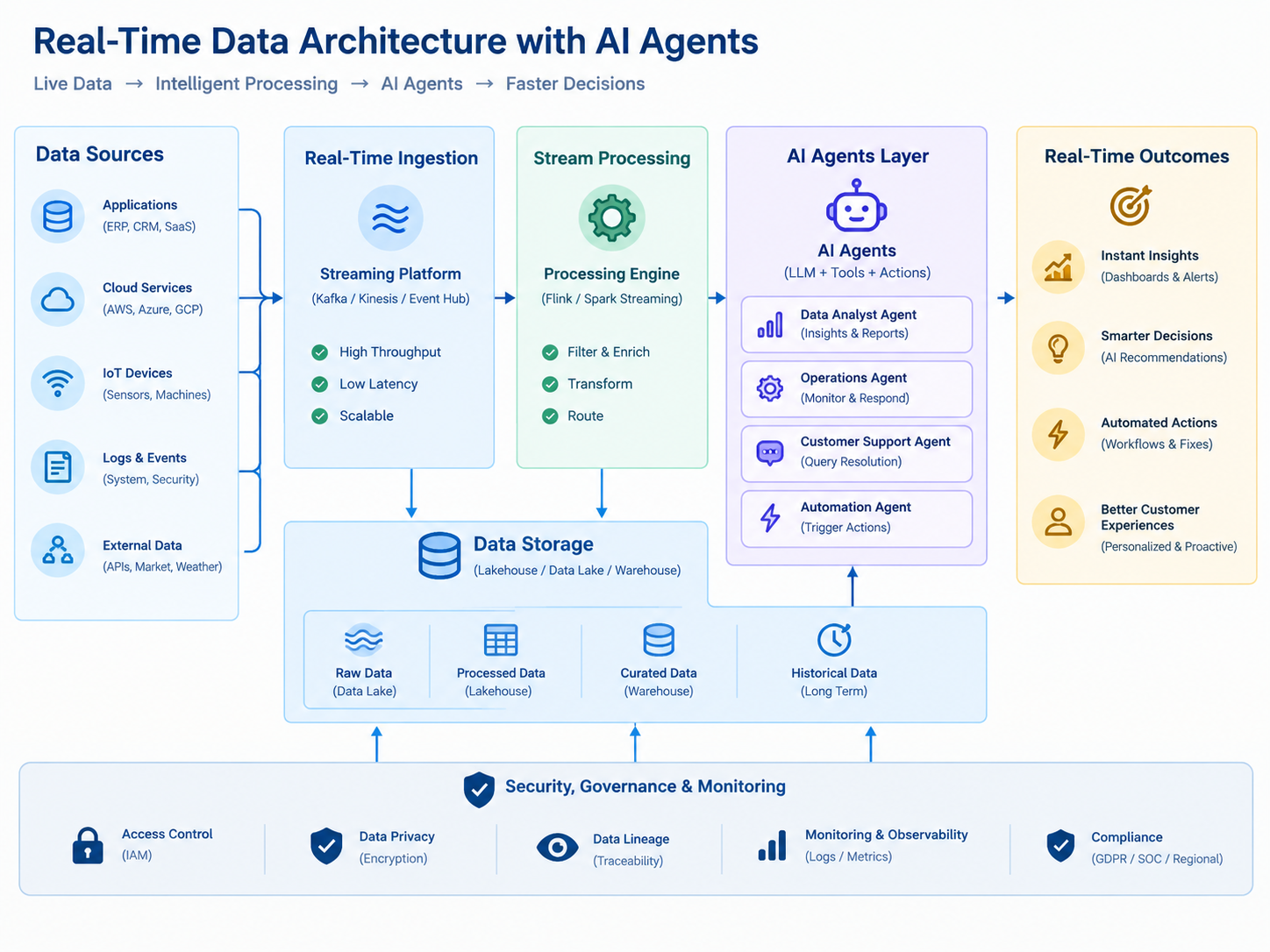
The 7 Core Layers of an Enterprise AI Agent Architecture
A production AI agent architecture typically includes seven connected layers.
Data sources.
CRM platforms, ERP systems, operational databases, and SaaS applications.
Data ingestion.
Change data capture (CDC), webhooks, and application events.
Event streaming.
Platforms such as Apache Kafka that distribute operational changes.
Stream processing.
Tools such as Apache Flink that validate, transform, and enrich events.
Data storage and retrieval.
Operational databases and vector stores providing current facts and contextual knowledge.
Agent orchestration.
AI components responsible for reasoning, retrieval, tool selection, and workflow coordination.
Governed execution.
Authorization, policy enforcement, action processing, and audit logging.
Reference architecture: Live enterprise data to governed agent action
CRM / ERP / Databases → CDC / Webhooks → Kafka / Flink → APIs and Vector Store → AI Agent → Policy Check → Authorized Action → Audit Log
Conceptual architecture. Actual implementations may use different services, processing paths, and security boundaries.
Organizations can extend existing business intelligence and data integration capabilities instead of rebuilding their data infrastructure from scratch.
Low Latency vs. Data Freshness vs. Consistency
These concepts are related, but they solve different problems.
Latency: How long information takes to travel through the system.
Freshness: How recently the underlying information was updated.
Consistency: Whether the information reflects a valid and sufficiently coherent business state.
A streaming event might reach an AI agent within milliseconds. However, that event may no longer represent the latest account balance or inventory status.
This distinction matters when an agent performs transactions.
Fast event delivery does not guarantee correct business decisions. For high-impact operations, agents should verify critical information against an authoritative system before taking action.
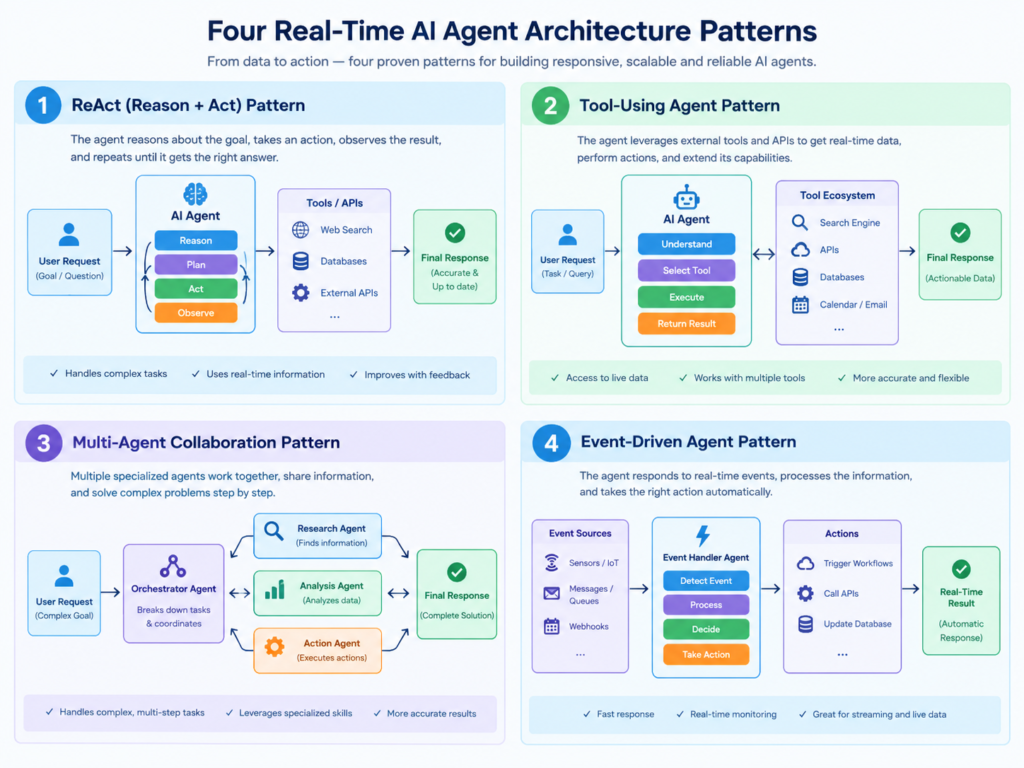
4 Real-Time Data Architecture Patterns for AI Agents
There is no single architecture that suits every AI workflow. The right pattern depends on how quickly information changes, how agents access it, and what happens if a decision is wrong.
Event-Driven AI Agents
Event-driven agents respond to changes published through Kafka, message queues, or webhooks.
For example, an e-commerce platform can publish an event when inventory falls below a threshold. An AI agent can evaluate the event, check replenishment rules, and initiate an approved workflow.
Best suited for: Operational alerts, fulfillment automation, infrastructure monitoring, and reactive workflows.
Advantages.
Reduces unnecessary polling.
Supports asynchronous processing.
Allows multiple services to consume events.
Enables replay when supported by the event infrastructure.
Trade-offs: Events may arrive more than once, consumers can fall behind, and delivery order requires careful design.
Live API Retrieval Architecture
Live API agents request operational information directly when it is needed.
A banking assistant, for example, can query an authenticated account service before explaining an available balance.
Best suited for: Account verification, current inventory checks, transaction status, and customer information.
Advantages.
Provides access to authoritative operational systems.
Avoids maintaining a separate streaming pipeline for every use case.
Can simplify development for smaller workloads.
Trade-offs: Response time depends on API performance, availability, rate limits, and the consistency of the underlying service.
Live APIs are often the simplest choice when an agent needs current facts but does not need continuous event processing.
Streaming RAG Architecture
Streaming retrieval-augmented generation (RAG) continuously refreshes the information available to an AI agent.
Instead of relying on an occasionally updated knowledge base, streaming RAG processes changes as source information evolves.
A typical workflow looks like this.
Source Update → Change Detection → Document Processing → Embeddings → Vector Index → Agent Retrieval
This approach works well for changing support documentation, company policies, operational manuals, and product knowledge.
Best suited for: Enterprise knowledge assistants, customer support, technical documentation, and policy retrieval.
Trade-offs: Embedding generation, indexing delays, document permissions, and stale records can affect retrieval quality.
A vector database is not a replacement for a transactional system. An agent should not use semantic search alone to verify balances, permissions, or payment status.
Hybrid AI Agent Architecture
Hybrid architectures combine events, live APIs, semantic retrieval, and controlled business actions.
Consider a financial risk workflow.
An incoming payment-risk event activates an agent. The agent retrieves the relevant risk policy, checks the transaction’s latest status through an authenticated API, and submits its proposed action to an authorization service.
The result is a workflow that combines timely event processing with contextual reasoning and authoritative verification.
Best suited for: Complex enterprise automation, regulated workflows, multi-system decisions, and high-impact operations.
Trade-offs: Hybrid systems introduce more dependencies, infrastructure costs, monitoring requirements, and potential failure points.
Architecture Comparison Matrix
| Architecture | Best use case | Freshness characteristics | Complexity |
|---|---|---|---|
| Event-driven | Alerts and reactive automation | Low event lag; state may require verification | Medium |
| Live API | Current operational facts | Current at query time, subject to source consistency | Low–medium |
| Streaming RAG | Frequently changing knowledge | Depends on embedding and indexing lag | Medium–high |
| Hybrid | Complex, governed actions | Combines event context and live verification | High |
The reliability and security requirements also differ.
| Pattern | Correctness control | Security priority | Recovery approach |
|---|---|---|---|
| Event-driven | Idempotent handlers | Event access permissions | Replay and dead-letter queues |
| Live API | Authoritative queries | Scoped API credentials | Retries and fallbacks |
| Streaming RAG | Source validation | Document-level access controls | Reindexing |
| Hybrid | Transactional checks | Independent policy enforcement | Replay and compensating actions |
These are qualitative comparisons. Actual latency, cost, and reliability depend on infrastructure, workloads, and implementation choices.
How to Build Streaming Data Pipelines for AI Agents
A dependable streaming pipeline needs more than a fast message broker.
It must capture changes accurately, process events reliably, maintain usable context, and prevent unauthorized or duplicate actions.
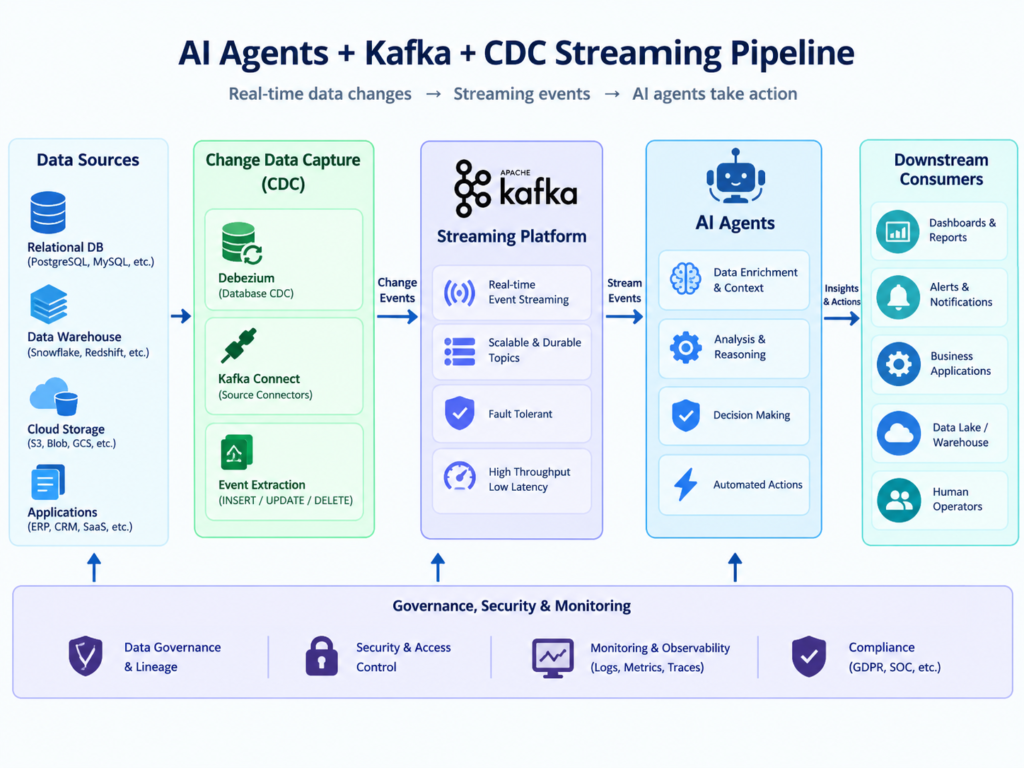
Apache Kafka, Debezium, CDC, and Apache Flink
Several established technologies can support this architecture.
Apache Kafka distributes and retains event streams, allowing downstream consumers to process operational changes.
Debezium captures database changes through CDC, reducing the need for applications to repeatedly query for updates.
Apache Flink supports stateful stream processing, including transformations, enrichment, and event-time processing.
Schema Registry helps teams manage evolving event contracts and assess compatibility between producers and consumers.
Not every project needs this full stack.
Webhooks may be sufficient for application notifications. Managed queues work well for asynchronous jobs, while scheduled polling remains reasonable for information that changes infrequently.
The important decision is matching infrastructure to actual business requirements.
Teams should also consider data contracts for AI to reduce failures caused by inconsistent schemas and unexpected upstream changes.
Ordering, Replay, Idempotency, and Backpressure
Production streaming systems must handle failures without creating incorrect business outcomes.
Common safeguards include.
Partition keys.
Preserve ordering where related events require it.
Idempotency keys.
Prevent repeated processing from creating duplicate business actions.
Bounded retries.
Avoid unlimited retry loops when dependencies fail.
Dead-letter queues.
Isolate events that require investigation.
Schema versioning.
Manage event contract changes safely.
Backpressure.
Prevent slow consumers from being overwhelmed.
For example, a payment request may succeed even though the agent never receives its confirmation.
If the workflow blindly retries, it risks creating another transaction.
Idempotency controls at the receiving business service help prevent that outcome.
Reliable execution also depends on well-designed APIs and backend engineering practices.
Live Database Queries vs. Vector Stores
Operational databases and vector stores answer different types of questions.
An operational database helps determine whether an invoice has already been paid.
A vector store helps identify which company policy applies to the invoice.
Both can contribute to an agent’s decision, but they are not interchangeable.
Illustrative workflow.
Invoice Event → Kafka → AI Agent → Policy Retrieval → Live Invoice API → Authorization → Action
The authoritative invoice lookup reduces the risk of acting on outdated retrieval results.
Securing and Monitoring Enterprise AI Agent Architecture
Connecting AI agents to live enterprise systems introduces risks beyond ordinary chatbot deployment.
Agents may retrieve sensitive data, invoke tools, or initiate actions in operational systems. Security controls must therefore extend across the entire data-to-action workflow.
MCP, OAuth 2.0, and Secure Data Access
The Model Context Protocol (MCP) provides a standardized way for AI applications to interact with external tools and data sources.
However, MCP connectivity does not automatically guarantee secure integration.
Enterprise implementations should use.
Authenticated tools and appropriate OAuth 2.0 authorization flows.
Short-lived, scoped credentials where supported.
Least-privilege access permissions.
Server-side authorization for sensitive operations.
Transaction limits and explicit approval requirements.
An agent should never gain permission to perform an action simply because a tool exposes that capability.
Observability, Audit Trails, and Failure Recovery
Monitoring only model response time provides an incomplete picture of agent reliability.
Teams should track event delivery lag, retrieval freshness, tool-call failures, decision latency, and action outcomes.
Open Telemetry can help connect traces across distributed services, while service-level objectives establish acceptable operational behavior.
Correlation identifiers are particularly useful for following a workflow from its original event through agent reasoning and final execution.
A recovery strategy should also address failed tool calls, timeouts, replay, and compensating operations when an action cannot be rolled back.
Data Governance and Human Approval
Sensitive workflows require explicit boundaries.
Minimize personal information, enforce retention policies, and separate development credentials from production access.
Human approval should be considered for high-impact actions, such as significant financial transfers and sensitive clinical decisions.
SOC 2 assurance, PCI DSS requirements, and applicable privacy laws should be evaluated separately. No architecture pattern or security protocol automatically establishes compliance.
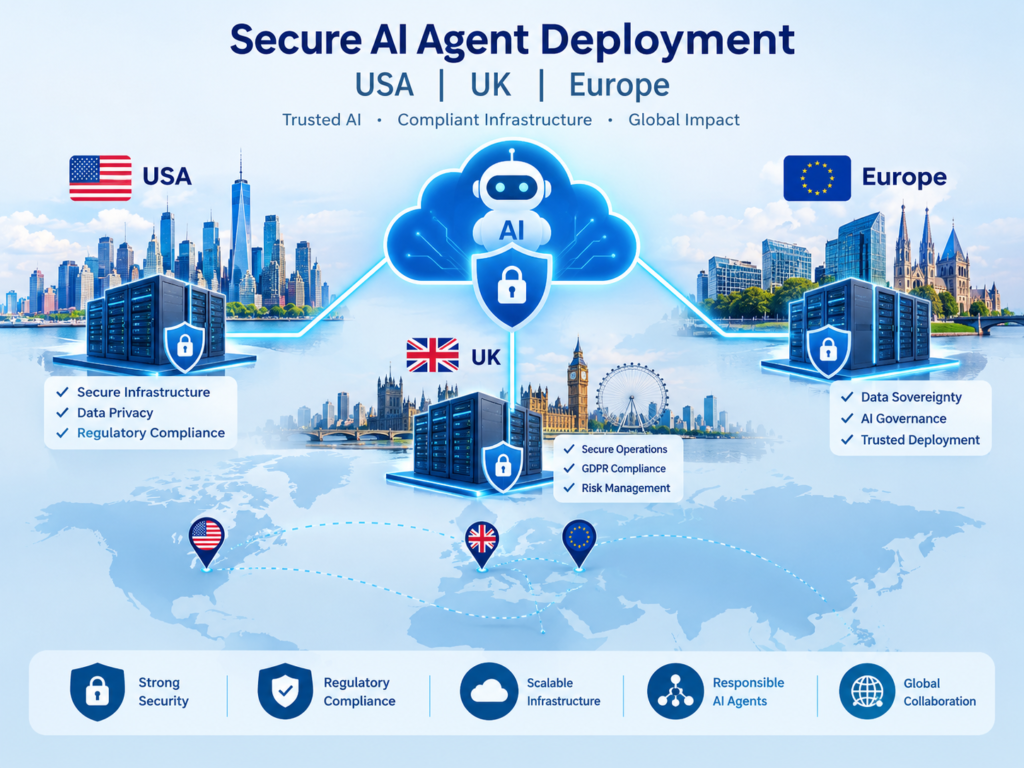
Real-Time AI Agent Deployment in the USA, UK, and Europe
Enterprise AI architecture must reflect the legal, security, and operational environment in which it runs.
Cloud-region selection can help address latency and data-residency requirements, but hosting location alone does not establish regulatory compliance.
USA.
A New York financial-services organization might use event-driven processing to identify unusual transaction activity while relying on authenticated banking APIs to verify current account state.
Healthcare organizations face additional considerations.
In Boston, for example, AI systems processing protected health information may be subject to HIPAA obligations when operated by covered entities or business associates.
The US Department of Health and Human Services provides guidance on these responsibilities.
AWS, Microsoft Azure, and Google Cloud deployment decisions should account for access controls, contractual terms, network performance, and applicable security obligations.
UK: UK GDPR, NHS, and Open Banking
A London-based financial organization could connect authorized Open Banking APIs with AI-assisted decision workflows.
Such systems need reliable authentication, appropriate customer permissions, and controls over the actions an agent can request.
NHS-related systems may require additional organizational approvals and healthcare data safeguards.
The UK Information Commissioner’s Office explains UK GDPR principles covering lawful processing, data minimization, security, and accountability.
Germany and EU.
A Frankfurt banking platform may prioritize regional processing, auditability, transaction verification, and integration with established financial controls.
For German teams, Echtzeit-Datenarchitektur für KI-Agenten involves more than fast data movement. It also requires attention to ereignisgesteuerte Architektur (event-driven architecture) and Datensouveränität (data sovereignty).
Depending on the organization and use case, relevant obligations may include.
GDPR/DSGVO for personal data processing.
The EU AI Act for applicable AI systems and providers.
DORA for covered financial entities and relevant ICT arrangements.
BaFin supervisory requirements.
National requirements implementing NIS2.
These frameworks differ in scope, applicability, and implementation schedules. Legal obligations should be assessed against the specific deployment rather than assumed from the technology stack.
EU cloud hosting can support data-residency objectives, but international data transfers and remote access still require evaluation.
Choosing the Best Architecture for Production AI Agents
Start with the business decision the agent must make, not the streaming technology you want to deploy.
An internal knowledge assistant may work well with APIs and periodically refreshed retrieval.
A fraud-monitoring workflow may need event-driven processing and real-time verification.
A regulated agent performing actions across multiple enterprise systems may require a hybrid design with independent authorization.
Architecture Decision Checklist
Before selecting your architecture, evaluate.
Freshness.
How old can information be before it becomes unsafe or unusable?
Correctness.
Which system provides the authoritative business state?
Latency.
What is the maximum acceptable end-to-end response time?
Scalability.
How many events, queries, and actions must the platform handle?
Security.
Which identities, permissions, approval gates, and regional controls apply?
Resilience.
What happens when events arrive twice or dependencies fail?
Cost.
Can the team operate and maintain the selected infrastructure?
For workflows involving business decisions, it can also help to compare decision intelligence and business intelligence.
Start With a Focused Proof of Concept
Avoid migrating every business workflow at once.
Choose a bounded use case with measurable success criteria. Test ingestion lag, retrieval freshness, end-to-end latency, authorization, tool failures, and recovery behavior.
Industry survey findings reinforce the interest in these capabilities.
Confluent’s 2024 Data Streaming Report found that 63% of surveyed IT leaders believed data streaming platforms extensively or significantly supported AI progress.
Its 2025 report found that 86% regarded investments in data streaming as an important or strategic IT priority.
These results indicate strong interest among surveyed enterprises. They do not prove that every organization needs streaming infrastructure or that a particular architecture will deliver better results.
Production readiness still depends on workload-specific testing.
Final Thoughts
A successful real-time data architecture for AI agents does more than move information quickly. It helps agents work with relevant context, verify authoritative facts, recover from failures, and perform actions within clearly defined security boundaries.
For some organizations, authenticated APIs will be enough. Others may benefit from Kafka-based streaming, continuously updated RAG, or a hybrid enterprise architecture.
The best approach is the one that meets your business requirements without introducing unnecessary complexity.
Mak It Solutions can help your organization explore integration requirements, evaluate architecture options, and define a practical proof of concept.
Request an AI agent architecture consultation to discuss your enterprise data sources, security requirements, and deployment goals.
Key Takeaways
Choose architecture based on the workflow: Event-driven, live API, streaming RAG, and hybrid patterns address different requirements.
Freshness is not the same as correctness: Fast events can still contain outdated business state.
Design for failures: Idempotency, replay, bounded retries, and backpressure are essential reliability controls.
Keep security independent of agent reasoning: Tools, APIs, and business actions need explicit authorization.
Assess regional obligations: US, UK, German, and EU deployments may face different privacy and sector-specific requirements.
Validate before scaling: Test real-world latency, accuracy, action correctness, resilience, and total operating cost.
FAQs
Q : Does every AI agent need Apache Kafka?
A : No. Many AI agents operate effectively using authenticated REST APIs, application webhooks, or managed message queues.
Kafka becomes useful when multiple services consume shared event streams, scalable processing is necessary, or replay and event retention are important.
Q : How fresh should a vector database be for AI agents?
A : Required freshness depends on the rate of data change and the risk of using outdated information.
A documentation assistant may tolerate several minutes of indexing delay. An agent handling operational transactions may need tighter controls and authoritative API verification before executing an action.
Q : Can AI agents process sensitive enterprise data without storing it in prompts?
A : Yes. Agents can use governed retrieval systems and permission-controlled APIs without permanently including complete source records in stored prompts.
However, sensitive content may still enter the model’s inference context or appear in service logs. Organizations should review provider terms, logging configurations, retention policies, and access permissions.
Q : What causes duplicate actions in event-driven AI workflows?
A : Common causes include message redelivery, network timeouts, repeated tool calls, and lost acknowledgments.
Stable idempotency keys, unique transaction identifiers, transactional safeguards, and retry-safe endpoints help prevent unwanted duplicate actions.
Q : How should enterprises measure real-time AI agent reliability?
A : Measure performance across the complete data-to-action lifecycle.
Useful metrics include event lag, retrieval-index freshness, tool failure rates, end-to-end latency, action correctness, authorization outcomes, and recovery time.
A reliable agent should produce not just fast responses, but accurate, authorized, and observable business outcomes.