


Data Contracts for AI: Prevent Costly Failures
Data Contracts for AI: Prevent Costly Failures
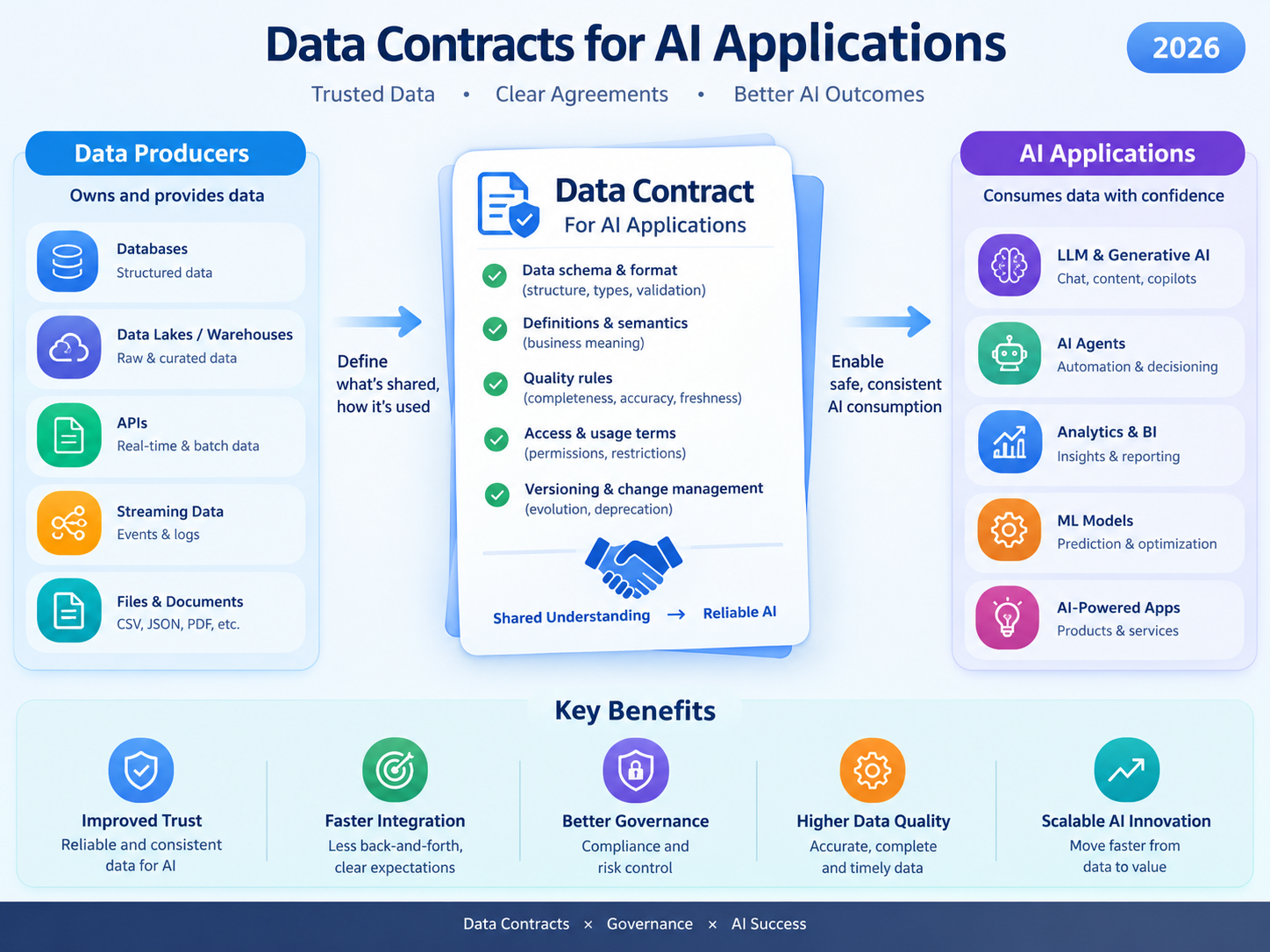
Data Contracts for AI: Prevent Costly Failures
A small change in a customer database can create a surprisingly large problem for an AI system. Imagine a CRM administrator renaming customer age to age . The application continues working, but the machine learning pipeline suddenly receives data it doesn’t recognize. Predictions fail, dashboards become unreliable, and engineers are left investigating what went wrong.
Data contracts for AI help prevent these failures by establishing clear, testable agreements about the structure, meaning, quality, freshness, and ownership of data. They allow teams to detect incompatible changes before those changes disrupt machine learning models, large language models (LLMs), or retrieval-augmented generation (RAG) pipelines.
The need for better data management is well documented. According to Gartner research published in February 2025, 63% of surveyed organizations either lacked appropriate data management practices for AI or were unsure whether they had them.
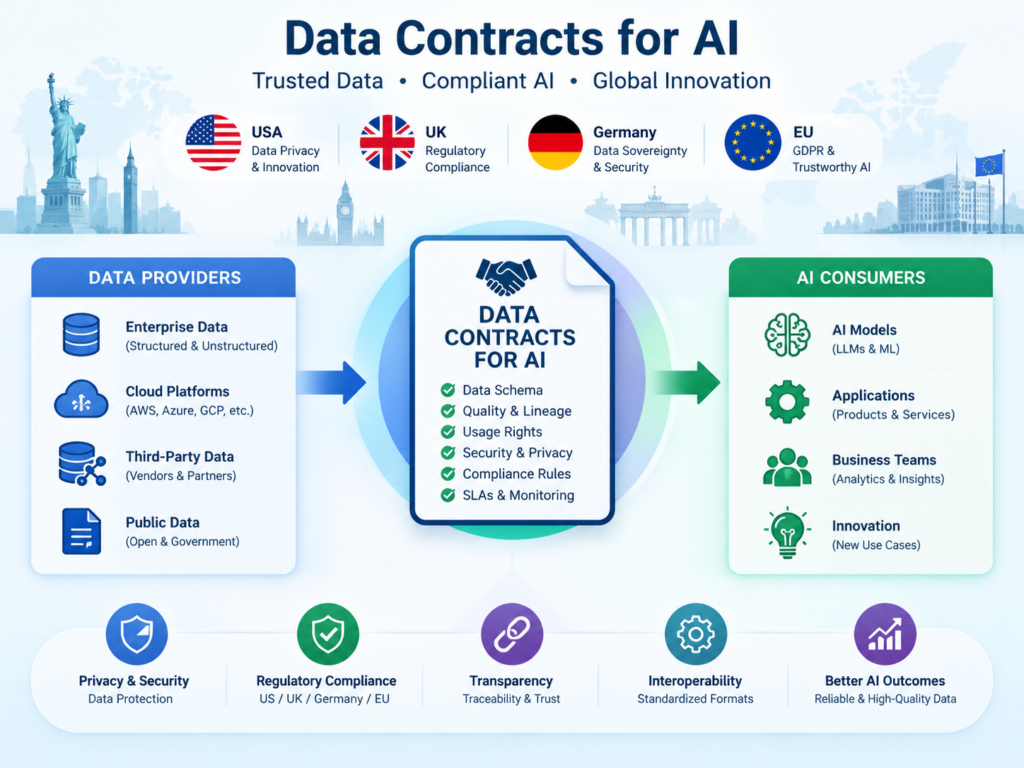
For enterprises operating across the US, UK, Germany, and European Union, dependable data is not simply a technical advantage. It is also an important foundation for responsible AI governance.
What Are Data Contracts for AI and Why Do They Matter?
A data contract is an agreement between the teams producing data and the systems consuming it. It specifies what the data should contain, how fields should be interpreted, which quality standards apply, and how changes must be managed.
Instead of waiting for a production failure, teams can use automated validation to identify problems earlier.
How Data Contracts Connect Producers and AI Consumers
Data producers may include CRM applications, enterprise databases, APIs, and Apache Kafka streams. Consumers can include feature stores, training pipelines, analytics platforms, and AI agents.
A typical data contract defines.
Schema: Field names, data types, and required attributes.
Business meaning: Consistent definitions and acceptable values.
Data quality: Completeness, uniqueness, and validation thresholds.
Freshness: Expected update frequency and availability.
Ownership: Who maintains the data and handles violations.
Change management: How updates are reviewed, versioned, and approved.
These rules give producers and consumers a common reference point.
AI metadata management supports this process by documenting dataset ownership, provenance, and intended use.
Why AI Systems Need Consistent Data
Machine learning models depend on stable inputs. Missing identifiers, unexpected categories, outdated records, or inconsistent feature definitions can affect predictions even when the model itself hasn’t changed.
Consider a fraud detection system that expects a transaction amount in US dollars. If an upstream system begins supplying amounts in cents without updating the definition, the values may remain numerically valid while their meaning changes completely.
A well-defined data contract makes these expectations explicit.
For organizations building AI agents, a semantic layer for AI agents can further support consistent business definitions.
Data Contracts vs. Schema Validation
Schema validation checks whether data matches an expected structure. Data contracts cover a broader set of expectations.
For example.
Schema validation checks whether risk score contains a numeric value.
A data contract can additionally specify that risk score must fall between 0 and 1, cannot be missing, and must be updated within an agreed period.
A valid structure doesn’t always mean the data is suitable for an AI application.
How Data Contracts Protect ML, LLM, and RAG Pipelines
Data contracts reduce the risk of incompatible fields, missing values, and unexpected upstream changes reaching AI systems. Their value extends beyond traditional machine learning to enterprise knowledge retrieval and AI agents.
Preventing Breaking Changes in Training and Inference
Imagine a customer segmentation model trained using three account categories. An upstream CRM update introduces a fourth category that the prediction pipeline cannot process correctly.
Without validation, the pipeline might reject records, misclassify customers, or produce unreliable results.
With appropriate contract enforcement, the system can.
Detect the unexpected category.
Flag the contract violation.
Reject or quarantine affected records.
Notify the responsible data owner.
Allow processing to resume after an approved correction.
The same approach helps identify incompatible feature definitions between model training and production inference.
However, data contracts alone cannot eliminate training-serving skew. Teams must also verify that feature transformations and model inputs remain consistent.
Data Contracts for LLMs, RAG, and AI Agents
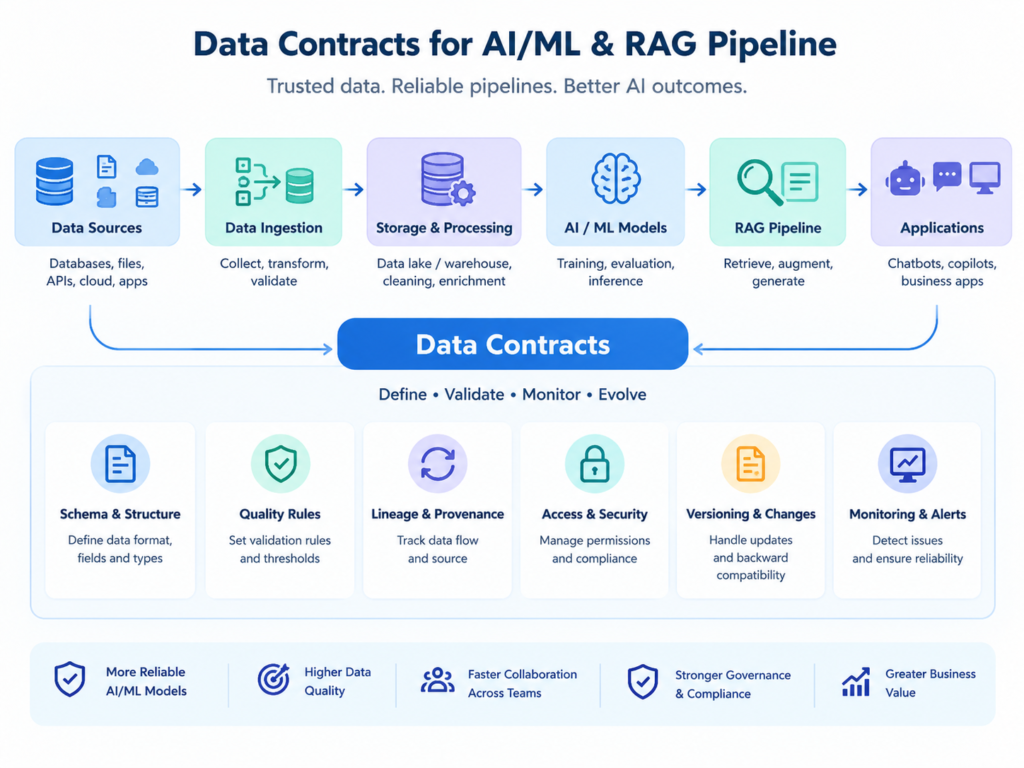
LLMs and RAG applications often rely on documents, databases, and API responses from multiple enterprise sources.
Contracts can help validate.
Document identifiers and supported formats.
Source timestamps and freshness.
Required metadata.
Access classifications and permitted uses.
Expected API response structures.
For example, a customer support AI assistant may retrieve policy documents from an internal knowledge base. A contract can help prevent documents with missing identifiers or invalid classifications from being ingested.
This becomes especially relevant when preparing business data for AI agents or comparing knowledge graphs and vector databases.
An important limitation: Validating source data does not guarantee that an AI model will generate factually correct answers. Retrieval evaluation, grounding checks, and output monitoring remain necessary.
Contract Violations vs. Statistical Data Drift
A contract violation occurs when data breaks an agreed rule. Statistical data drift occurs when the characteristics or distribution of data change over time.
Suppose a credit risk model receives a growing proportion of high-risk applications. Every record may satisfy the contract, but the changing distribution could still affect model performance.
Data contracts are therefore part of AI reliability, not a substitute for continuous model monitoring.
Data Contracts vs. Data Quality Testing and Observability
These technologies work best together, but they solve different problems.
| Approach | Main purpose | Role in AI pipelines |
|---|---|---|
| Data contracts | Define expectations and responsibilities | Establish agreed rules |
| Data quality testing | Check data against rules | Detect or reject invalid records |
| Data observability | Monitor data health and anomalies | Investigate pipeline incidents |
| Model monitoring | Track model behavior | Detect drift and performance degradation |
Contracts Define Rules; Tests Enforce Them
A contract might require every customer record to contain a unique identifier. An automated data quality test checks whether the actual records satisfy that requirement.
In practice, maintaining the contract without enforcing its rules provides limited protection. Validation should be integrated into the workflows where failures can be prevented or detected quickly.
Where Observability and Lineage Fit
Data observability helps teams identify missing batches, freshness delays, unexpected volume changes, and processing anomalies.
Data lineage explains where information originated, how it was transformed, and which downstream systems depend on it.
These capabilities complement contracts by helping engineers understand the cause and impact of violations.
For a broader perspective, see our enterprise AI observability guide.
Building a Layered Reliability Strategy
A reliable enterprise AI architecture combines documented expectations, automated quality checks, operational visibility, and model evaluation.
This approach helps teams detect problems at the data layer while monitoring whether the AI system continues to behave as intended.
How to Implement Data Contracts for AI Pipelines
Implementing data contracts does not require redesigning an entire enterprise data platform.
A practical starting point is to select one business-critical dataset, identify its consumers, document expectations, and automate checks around it.
Define Ownership, Schemas, and Quality Requirements
Begin with a dataset that directly affects business decisions, such as customer features used for fraud detection.
Document.
The data producer and downstream consumers.
Required fields and business definitions.
Accepted data types and values.
Quality thresholds and freshness requirements.
Sensitive-data classifications.
Ownership, escalation, and approval responsibilities.
Organizations with more complex requirements can connect these agreements to an existing AI data governance framework.
Create a YAML Data Contract
The Open Data Contract Standard (ODCS) provides a vendor-neutral way to document data agreements.
This example declares required fields, a unique customer identifier, a numeric risk score range, and a null-value quality rule.
It illustrates the contract structure, but it has not been validated against a connected dataset. Actual enforcement depends on the selected data backend and available validation capabilities.
Teams can use data contract lint to check specification validity. Runtime checks require suitable data connections and testing configuration.
A freshness expectation, such as a 24-hour service-level agreement (SLA), should be added through an appropriate validated rule.
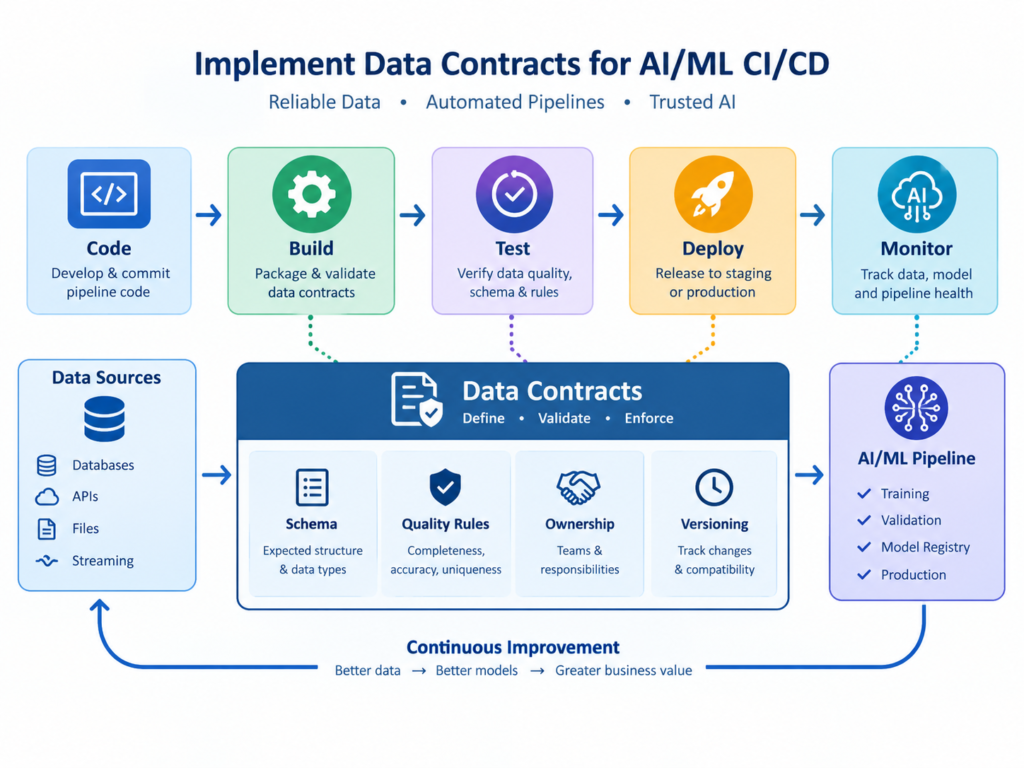
Enforce Contracts Through CI/CD
Contracts become more effective when validation is part of continuous integration and deployment.
Consider an upstream change in which customer _ age is renamed to age.
A controlled workflow would look like this.
Change proposed: The producer modifies a field.
Validation triggered: Automated checks compare the proposed change with contractual expectations.
Incompatibility detected: The deployment is blocked or flagged for review.
Consumers notified: Affected teams approve a migration or request correction.
Release completed: Compatibility is restored and the updated pipeline is tested.
Production ingestion checks can provide another layer of protection by rejecting or quarantining invalid records.
The appropriate response depends on the risk of the dataset and the operational consequences of blocking it.
Version Contracts and Manage Changes
Store contracts in version control and review them whenever schemas, business definitions, or consumer requirements change.
Breaking changes should trigger a version update, compatibility assessment, and approval from affected consumers.
Clear ownership is especially important. When a violation occurs, teams need to know who can investigate, authorize corrective action, and restore normal processing.
Data Governance and Compliance in the US, UK, Germany, and EU
Data contracts can strengthen documentation, accountability, and data quality controls across regulated environments.
However, a data contract does not independently establish legal or regulatory compliance. Organizations must implement all applicable privacy, security, access management, and governance requirements separately.
United States.
Consider a healthcare organization in New York exchanging approved patient information with an analytics provider.
A data contract can specify expected FHIR resource structures, required attributes, source ownership, and validation procedures.
When protected health information is involved, applicable HIPAA safeguards, access restrictions, and business associate agreements remain necessary.
The US Department of Health and Human Services provides guidance on covered entities and related obligations.
United Kingdom.
A London-based financial institution may rely on data from several internal systems to support fraud detection or customer analytics.
Contracts can document data definitions, provenance, accuracy expectations, and update frequency.
These controls can support governance practices relevant to the UK GDPR and sector-specific requirements.
Organizations operating in NHS-related environments or regulated financial services should also assess their applicable sector rules.
The Information Commissioner’s Office explains the accuracy principle under UK data protection law.
Germany and EU.
A Berlin-based enterprise deploying AI applications may need to document dataset provenance, permitted uses, access controls, and data handling responsibilities.
Data contracts can support these governance processes while helping teams maintain consistent information across systems.
In Germany, GDPR is commonly referred to as DSGVO. Depending on the industry, organizations may also need to consider expectations from BaFin or BSI.
For the EU AI Act, data contracts can help support relevant data management and documentation obligations, but the applicable requirements depend on the AI system and its classification.
Under the EU AI Act timetable updated through the AI Omnibus, important high-risk requirements apply from.
2 December 2027: Certain high-risk AI systems under Annex III.
2 August 2028: High-risk AI integrated into regulated physical products under Annex I.
Other AI Act provisions already apply. Organizations should assess the specific obligations affecting their systems rather than treating these dates as a universal compliance deadline.
See the European Commission’s AI Act enforcement guidance for the applicable framework.
Regulatory note: This section provides general information, not legal advice. Seek qualified guidance for compliance decisions.
Choosing Data Contract Tools and Best Practices
The most suitable tooling depends on existing infrastructure, engineering capabilities, and the degree of automation required.
ODCS, dbt Model Contracts, Soda, and Great Expectations
These technologies serve related but different purposes.
| Technology | Primary strength |
|---|---|
| Open Data Contract Standard (ODCS) | Vendor-neutral contract specification |
| dbt Model Contracts | Structural enforcement for supported dbt models |
| Soda | Data quality checks and monitoring |
| Great Expectations | Data validation and expectation-based testing |
ODCS focuses on documenting the agreement. The other technologies can support particular aspects of validation and enforcement.
Organizations do not necessarily need every tool. The priority is choosing a combination that works with existing data workflows.
What to Evaluate Before Choosing a Platform
Look beyond the number of supported integrations.
Consider compatibility with databases, streaming systems, cloud platforms, and CI/CD tools. Evaluate how the technology handles schema evolution, quality rules, alerts, permissions, versioning, and operational maintenance.
A tool that fits an existing engineering workflow may be more useful than a feature-rich platform that introduces unnecessary complexity.
Best Practices for Enterprise Adoption
Start small and expand based on measurable results.
Choose a critical dataset, assign ownership, automate essential validation, and document how violations should be resolved.
The wider adoption of AI reinforces the need for these foundations. According to McKinsey’s 2025 State of AI report, 78% of respondents said their organizations used AI in at least one business function, compared with 72% in an earlier 2024 survey.
The same report documented reported generative AI use rising from 33% in 2023 to 71% in 2024. Mak It Sol
These findings describe survey-reported adoption, not evidence that every organization has achieved production-scale AI reliability.
As more business processes depend on AI, organizations need dependable data foundations alongside model development.
Last Words
Reliable AI starts with data that teams can understand, validate, and trust.
Data contracts for AI provide a practical way to reduce unexpected changes, strengthen accountability, and build more dependable enterprise AI pipelines. They are particularly useful when multiple teams or applications depend on shared information.
At Mak It Solutions, we help businesses explore practical improvements to their data architecture, validation workflows, and AI governance processes.
Contact Mak It Solutions to discuss a scoped technical review of your most failure-prone AI dataset.
Key Takeaways
Data reliability: Contracts identify incompatible changes and help prevent avoidable pipeline failures.
Clear accountability: Ownership, quality expectations, and change procedures become explicit.
AI integration: ML, LLM, RAG, and AI agent workflows can benefit from validated data inputs.
Layered protection: Contracts work alongside quality testing, observability, and model monitoring.
Governance support: Documented data expectations can strengthen compliance-related processes without replacing legal safeguards.
Practical implementation: Begin with a critical dataset, automate essential checks, and expand as requirements grow.
FAQs
Q : Can data contracts for AI prevent hallucinations?
A : Not directly. Data contracts improve the consistency and quality of information entering AI systems, but they cannot guarantee accurate generated responses. Combine them with retrieval evaluation, source verification, output testing, and appropriate human oversight.
Q : Should small AI teams use data contracts?
A : Yes, especially when applications share datasets or upstream changes frequently disrupt pipelines. Small teams can begin with a simple version-controlled YAML contract, essential validation rules, and clear ownership responsibilities.
Q : Do data contracts require a dedicated platform?
A : No. Teams can use existing schema validators, SQL checks, version control, and CI/CD infrastructure. Dedicated platforms become more useful when many teams share datasets or centralized contract management is required.
Q : How often should AI data contracts be updated?
A : Update contracts whenever schemas, business definitions, quality expectations, or consumer requirements change. Breaking changes should be reviewed and approved before deployment. Periodic reviews also help maintain accuracy.
Q : How can businesses measure the value of data contracts?
A : Useful indicators include contract violations, blocked breaking changes, incident detection and resolution times, freshness breaches, and downstream failures related to data quality. Teams can also measure the proportion of critical pipelines protected by automated checks.