


Decision Intelligence vs Business Intelligence: Key Facts
Decision Intelligence vs Business Intelligence: Key Facts
Decision Intelligence vs Business Intelligence: Key Facts
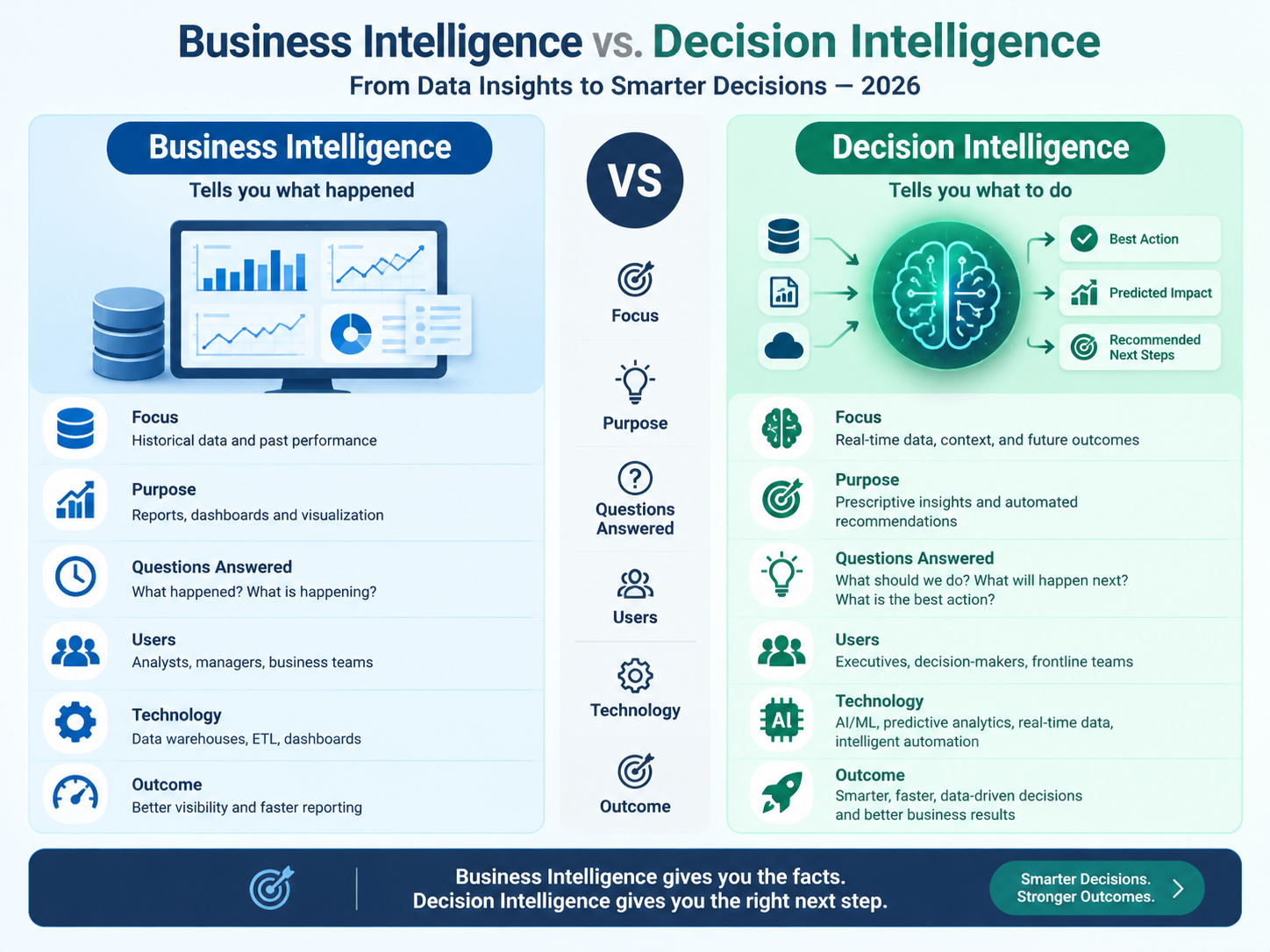
Dashboards can tell you why sales dropped, where costs increased, or which operations are falling behind. But they don’t always tell you what to do next. That’s where the debate around decision intelligence vs business intelligence becomes important.
Business intelligence (BI) helps organizations understand performance through data, reports, and dashboards. Decision intelligence (DI) goes further by evaluating possible actions, supporting decisions, and measuring their outcomes.
For CIOs, Chief Data Officers (CDOs), and enterprise technology leaders, the question isn’t necessarily which technology is better. It’s which approach can help the organization move from understanding problems to solving them.
What Is Decision Intelligence vs Business Intelligence?
The fundamental difference between business intelligence and decision intelligence is their purpose.
Business intelligence focuses on understanding business performance. Decision intelligence focuses on improving the decisions made using that information.
Both rely on trustworthy data, but they support different parts of the decision-making process.
What Is Business Intelligence (BI)?
Business intelligence involves collecting, organizing, analyzing, and presenting data to help organizations understand how they perform.
Common BI platforms include Microsoft Power BI, Tableau, and Qlik. These tools allow businesses to monitor revenue, track operational KPIs, analyze customer behavior, and identify performance trends.
For example, a retail company might use a BI dashboard to discover that certain products regularly sell out during peak shopping periods.
BI makes that problem visible. Managers still need to decide how to respond.
Although BI traditionally emphasizes descriptive and diagnostic analytics, modern platforms increasingly offer forecasting and AI-assisted features.
Organizations building their reporting foundations can explore business intelligence services to understand the analytics and integration capabilities they may need.
What Is Decision Intelligence (DI)?
Decision intelligence brings data, analytics, decision models, business rules, and operational processes together to improve business choices.
Instead of stopping at a performance report, DI evaluates possible responses based on business objectives, available resources, constraints, and risks.
Consider the same retailer facing stock shortages. A decision intelligence system could assess demand forecasts, warehouse inventory, transportation costs, and supplier availability before recommending where to move stock.
Depending on the system’s design, a manager might approve the recommendation or an authorized workflow might execute it automatically.
Importantly, decision intelligence doesn’t always require artificial intelligence. Rules-based systems and mathematical optimization can also support structured decisions.
How Do Business Intelligence and Decision Intelligence Work Together?
BI and DI often work best as complementary capabilities.
Imagine a manufacturer facing repeated shipment delays.
A BI dashboard identifies the delayed orders and affected production lines. A decision intelligence workflow then evaluates alternative production schedules, supplier options, and delivery priorities.
The operations manager reviews the recommendation, approves an appropriate change, and monitors whether delivery performance improves.
BI provides the visibility. DI connects that visibility with decisions, actions, and measurable results.
Both depend on accurate, consistent, and appropriately governed business data.
Decision Intelligence vs Business Intelligence.
The most useful way to compare these approaches is to look at their objectives, outputs, and operational responsibilities.
|
Feature |
Business Intelligence (BI) |
Decision Intelligence (DI) |
|---|---|---|
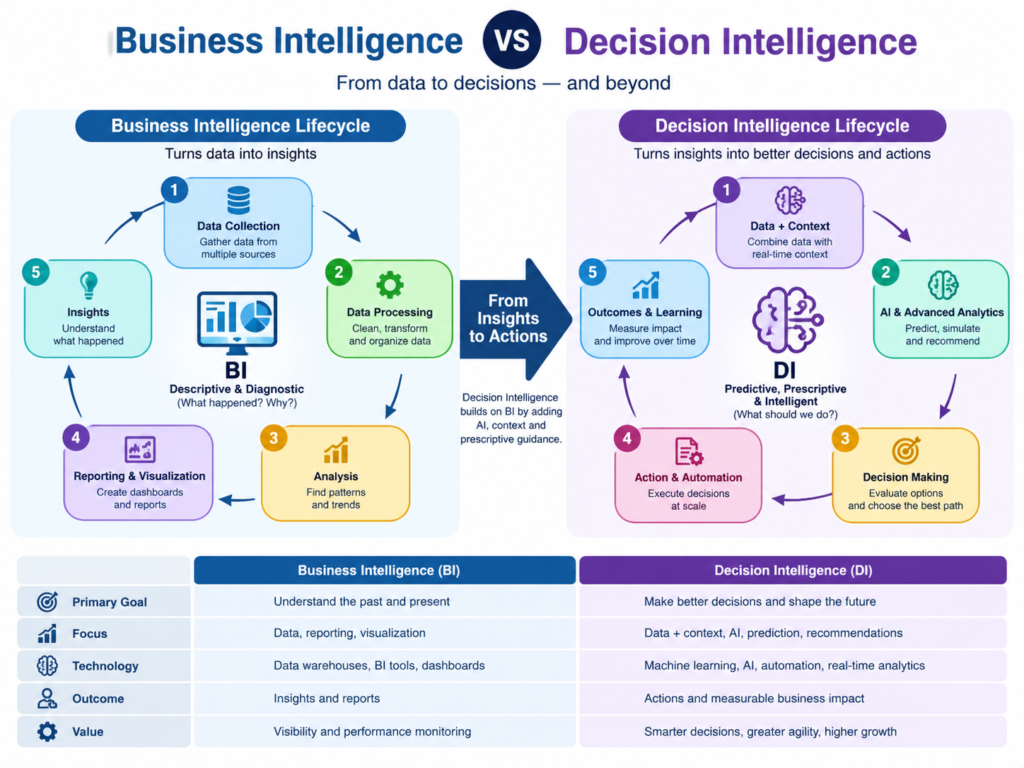
| Primary purpose | Understand business performance | Improve decisions and outcomes |
| Main outputs | Dashboards, reports, insights | Recommendations and governed actions |
| Analytics focus | Descriptive and diagnostic, increasingly predictive | Predictive, prescriptive, and optimization |
| AI requirements | Optional or built into the platform | Optional, often used for complex decisions |
| Automation | Reporting and analytics workflows | Decision support and operational workflows |
| Primary users | Analysts, managers, business teams | Decision owners, operations teams, analysts |
| Success measures | Data quality, reporting adoption, insight speed | Decision speed, quality, operational benefits, ROI |
These differences aren’t absolute. Modern BI platforms increasingly include advanced analytics, while decision intelligence solutions may incorporate dashboards and reporting tools.
The distinction lies in how organizations use these capabilities.
BI vs DI.
Business intelligence usually helps people interpret information and draw conclusions.
Decision intelligence introduces a more structured process for choosing what happens next.
That process may involve analytical models, business rules, human approvals, automated workflows, and outcome monitoring.
However, introducing automation doesn’t transfer responsibility away from the organization.
Businesses remain accountable for the decisions their systems recommend or execute.
Traditional BI vs AI-Powered Decision Intelligence
Traditional BI is particularly effective for reporting, visualization, and performance monitoring.
AI-powered decision intelligence can add capabilities such as demand forecasting, anomaly detection, scenario simulation, and optimization.
For example, an AI-supported scheduling system might predict likely production delays and compare alternative plans before recommending adjustments.
Yet AI-generated recommendations aren’t automatically accurate or appropriate. Their reliability depends on data quality, model validation, operational constraints, and effective oversight.
Decision Intelligence vs Predictive and Prescriptive Analytics
These terms are related, but they aren’t interchangeable.
Predictive analytics estimates what may happen, such as future customer demand or equipment failure risk.
Prescriptive analytics evaluates potential responses and helps identify suitable actions.
Decision intelligence connects these analytical capabilities with decision ownership, execution processes, business constraints, and outcome measurement.
A demand forecasting model may support decision intelligence, but forecasting alone doesn’t create a complete decision-making system.
How Does AI Decision Intelligence Improve Business Decisions?
AI can help decision intelligence systems process complex information, identify patterns, forecast outcomes, and compare potential actions.
The bigger opportunity lies in connecting those analytical capabilities with real operational decisions.
Enterprise adoption provides useful context. McKinsey’s State of AI 2025 research reported that approximately 88% of respondents said their organizations used AI in at least one business function. The same research reported approximately 23% scaling agentic AI within at least one function.
These figures describe surveyed organizations rather than all businesses worldwide. They also don’t establish that AI adoption automatically produces better decisions.
From BI Dashboards to Decision Automation
A practical decision intelligence lifecycle follows six connected stages.
Data
Insight
Decision options
Approval
Action
Outcome measurement
Consider a logistics company experiencing delivery delays.
Its analytics platform identifies the routes with the highest delays. A decision model evaluates alternative routes, vehicle availability, delivery priorities, and additional transportation costs.
An authorized manager approves a revised schedule, and the business measures whether delivery performance improves.
The important improvement isn’t simply generating another recommendation. It’s establishing a repeatable process that connects insights with results.
Predictive Models, Optimization, and Agentic AI
Machine learning helps organizations forecast demand, estimate risk, and identify patterns that may be difficult to detect manually.
Optimization techniques compare possible actions against business constraints, such as budgets, staffing levels, equipment capacity, or delivery deadlines.
Agentic AI may coordinate tasks across connected software systems through APIs and operational tools.
For example, an authorized AI workflow could gather inventory information, request a forecasting calculation, and prepare a recommended replenishment plan.
However, greater autonomy requires stronger controls around permissions, error handling, validation, and escalation.
Organizations developing these capabilities may benefit from specialized Python development and back-end integration services.
Human Oversight, Explain ability, and AI Governance
Decision intelligence becomes more valuable when decision-makers can understand the basis for recommendations.
A dependable implementation should provide.
Clear ownership of decisions and outcomes.
Documented rules, constraints, and approval requirements.
Traceable recommendations and decision logs.
Access controls and human escalation procedures.
Monitoring for model errors, drift, and unintended consequences.
Regular assessments of operational and regulatory risks.
Human oversight becomes particularly important when automated decisions affect financial outcomes, employment, healthcare, or individual rights.
Strong data lineage and metadata management also help organizations establish where information originated and how it influenced a decision.
Decision Intelligence Use Cases in the USA, UK, and Europe
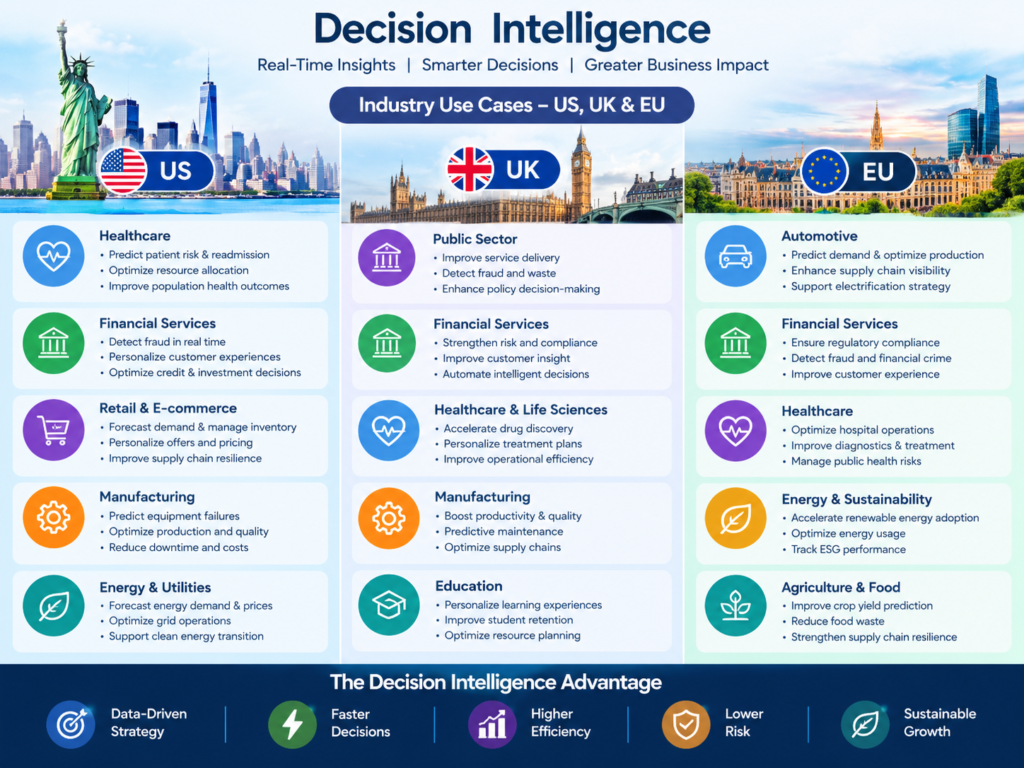
Decision intelligence is particularly useful for recurring decisions involving operational complexity, measurable business value, and competing constraints.
Its applications vary by industry and regulatory environment.
USA.
In the United States, financial institutions can use decision models to prioritize suspicious transactions for investigation.
For example, a New York banking operations team might combine transaction monitoring insights with risk scores and investigation capacity to determine which alerts require immediate attention.
Healthcare organizations may use similar techniques for staffing, capacity forecasting, and resource planning.
A Boston healthcare network could evaluate patient demand patterns alongside available personnel and clinical resources before preparing staffing recommendations.
Where protected health information is involved, organizations must consider applicable HIPAA privacy and security requirements.
Retailers can also combine demand analytics with inventory optimization to improve stock allocation and reduce unnecessary transfers.
UK.
UK organizations can apply decision intelligence to financial risk management, resource allocation, and public-service planning.
A London financial services team could use structured decision workflows to prioritize compliance reviews or investigate unusual account activity.
Within the NHS, appropriately governed analytics and decision models may help organizations evaluate patient-flow scenarios and operational capacity.
Regulatory oversight matters. The UK GDPR and the Data (Use and Access) Act 2025 establish requirements relevant to automated processing of personal data.
The updated framework permits certain significant solely automated decisions in wider circumstances while requiring safeguards, including information about decisions, opportunities to make representations, human intervention, and the ability to contest decisions. Restrictions also apply when special-category data is involved.
Organizations should assess their particular processing activities before introducing automated decision workflows.
Germany and EU.
Germany’s manufacturing sector provides a practical setting for combining BI reporting with decision optimization.
A Stuttgart manufacturer, for instance, might use dashboards to monitor equipment performance and production delays.
A decision intelligence system could then evaluate alternative schedules, material availability, and delivery commitments before recommending production changes.
Financial institutions operating in Frankfurt may also need to consider applicable BaFin requirements, GDPR (DSGVO), and Digital Operational Resilience Act (DORA) obligations.
Eurostat reported that approximately 20% of EU enterprises with at least ten employees used AI technologies in 2025.
For EU deployments, the AI Act introduces additional considerations depending on the system’s classification, purpose, and applicable implementation dates.
Regulatory obligations shouldn’t be inferred solely from a product’s AI features. Organizations need to assess actual use cases, processing risks, and the relevant legal provisions.
Decision Intelligence Platforms vs BI Tools.
Choosing between BI and DI isn’t just a software procurement decision.
Implementation costs depend on existing infrastructure, data quality, operational complexity, integration requirements, and the level of governance needed.
The strongest business case comes from identifying where improved decisions can produce measurable benefits.
Leading BI Tools and Decision Intelligence Platforms in 2026
Several established technology providers support business intelligence, decision management, and enterprise optimization.
|
Platform |
Relevant capabilities |
|---|---|
| Microsoft Power BI | Reporting, dashboards, data visualization |
| Tableau | Visual analytics and data exploration |
| Qlik | BI, analytics, and data integration |
| IBM | Decision management and business automation |
| SAS | Advanced analytics and decisioning |
| FICO | Decision management and optimization |
| ACTICO | Decision automation and business rules |
| Aera Technology | Enterprise decision intelligence and automation |
These products don’t all serve identical purposes, and some platforms cover multiple categories.
For a meaningful evaluation, enterprises should review the specific product modules, available integrations, deployment options, licensing requirements, security capabilities, and total operating costs.
Implementation Costs, Integration, and Scalability
A decision intelligence project may involve more than purchasing software licenses.
Common cost categories include data engineering, software subscriptions, infrastructure, model development, API integrations, security, testing, employee training, and ongoing monitoring.
An organization with mature data pipelines may be able to reuse much of its existing BI infrastructure.
By contrast, businesses operating disconnected legacy systems may need substantial integration work before advanced decision automation becomes practical.
Technology development services can support these integrations, but the implementation scope should follow a clearly defined business requirement rather than an unnecessarily complex technology architecture.
How to Measure Decision Intelligence ROI
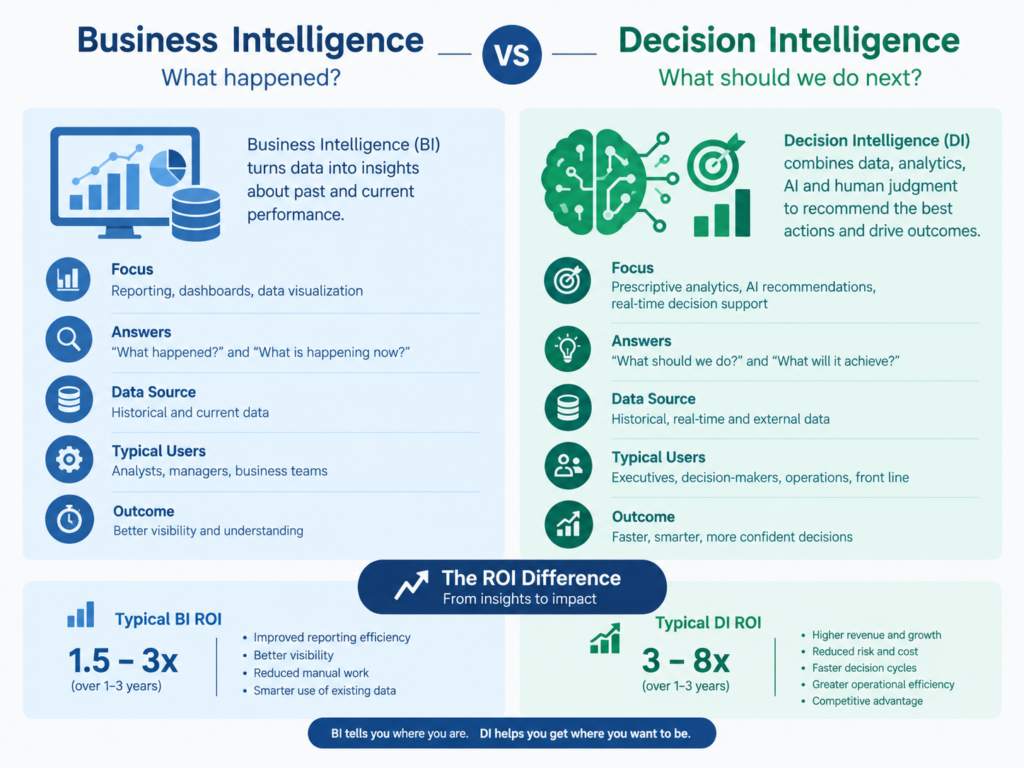
Decision intelligence should be evaluated through actual business outcomes, not simply the number of automated processes or deployed models.
Useful measurements include decision processing time, cost per decision, accuracy of recommendations, human override rates, operational efficiency, and realized financial improvements.
Consider a hypothetical project that generates $150,000 in attributable benefits against $100,000 in total implementation and operating costs.
ILLUSTRATIVE ROI CALCULATION
Attributable benefits
$150,000
Total costs
$100,000
Calculated ROI
50%
This is a hypothetical example, not a reported customer result.
Actual ROI depends on whether benefits are measurable, attributable to the implementation, and sustainable over time.
Enterprises should establish baseline performance before deployment and evaluate results against comparable operating conditions.
Should Your Enterprise Choose BI, DI, or Both?
For many organizations, the best answer isn’t to replace business intelligence with decision intelligence.
It’s to determine where reporting is sufficient and where more structured decision support could create additional value.
When Business Intelligence Is Enough
BI may be the right investment when teams need better reporting, clearer KPIs, consistent business definitions, and more accessible operational data.
For example, a company struggling with inconsistent sales reports will probably benefit more from improving its reporting infrastructure than immediately building an automated pricing system.
Reliable data and reporting remain essential foundations.
When Decision Intelligence Delivers Greater Value
DI becomes attractive when business decisions are frequent, complex, time-sensitive, and measurable.
Examples include fraud investigation prioritization, inventory allocation, production scheduling, and operational capacity planning.
These workflows often involve competing constraints and repeated decisions that can be evaluated against clear performance measures.
The goal isn’t always full automation. In many cases, reliable recommendations with human approval provide the most practical starting point.
A Practical BI-to-DI Implementation Roadmap
Organizations considering decision intelligence can begin with a focused, measurable workflow.
Identify a business decision. Choose a recurring process with clear ownership, measurable outcomes, and a practical opportunity for improvement.
Establish a baseline. Measure current costs, decision times, error rates, and operational outcomes.
Develop a controlled pilot. Connect the relevant data sources, analytical models, business rules, and operational systems.
Apply appropriate governance. Define permissions, approval requirements, audit logs, and escalation procedures.
Measure real outcomes. Compare pilot performance with the baseline while accounting for operational changes and risk.
Scale based on evidence. Expand the solution only after confirming reliability, compliance, and business value.
Starting with a manageable use case helps organizations test both technical feasibility and operational value without committing prematurely to enterprise-wide automation.
Final Words
The real value of decision intelligence vs business intelligence becomes clearer when the discussion moves beyond software features.
Business intelligence helps organizations understand what is happening. Decision intelligence helps them evaluate what to do about it and measure whether the chosen action worked.
For enterprises in the USA, UK, Germany, and across Europe, the most effective approach is often to strengthen BI foundations while introducing decision intelligence where better decisions can deliver measurable operational value.
Mak It Solutions can help your organization evaluate analytics infrastructure, integration requirements, and practical opportunities for AI-supported decision workflows.
Contact Mak It Solutions to discuss a scoped platform assessment and the next steps for your organization.
Key Takeaways
BI makes business performance visible. It supports reporting, analysis, and performance monitoring.
DI connects insights with decisions. It helps organizations evaluate alternatives, take governed actions, and measure results.
AI can strengthen DI, but isn’t always essential. Business rules and optimization techniques also support structured decisions.
Reliable data and governance matter. Poor data, unclear accountability, and inadequate controls can undermine both approaches.
Implementation costs depend on the business context. Integration requirements and ongoing operational responsibilities often matter as much as licensing.
A focused pilot is a sensible starting point. Organizations should demonstrate measurable value before expanding decision automation.
FAQs
Q : Can small and medium-sized businesses benefit from decision intelligence?
A : Yes. Smaller businesses can use decision intelligence to improve recurring decisions related to inventory, scheduling, pricing, and customer operations.
They don’t necessarily need an enterprise-scale AI platform. Existing business data, decision rules, and simple optimization tools may provide a practical starting point.
Q : Does decision intelligence require machine learning?
A : No. Decision intelligence can work through business rules, decision tables, and mathematical optimization without machine learning.
Machine learning becomes useful when decisions depend on forecasting uncertain outcomes, recognizing complex patterns, or adapting to changing conditions.
Q : Can Microsoft Power BI integrate with decision intelligence systems?
A : Yes. Power BI can be part of a broader decision intelligence architecture through shared data sources, APIs, data pipelines, and compatible workflow services.
For example, Power BI might display operational performance while a separate decision service evaluates alternatives and records recommendations. Actual integration capabilities depend on the products, architecture, licensing, and security requirements.
Q : What data quality is needed before adopting decision intelligence?
A : Data should be sufficiently accurate, complete, timely, and relevant to the decisions being supported.
Organizations should also establish consistent business definitions, appropriate access controls, data lineage, and validation procedures. Higher-risk decisions generally require stronger assurance and oversight.
Q : How long does a decision intelligence pilot typically take?
A : A narrowly scoped pilot may take several weeks to a few months, depending on data availability, technical integrations, workflow complexity, and governance requirements.
Regulated or technically complex implementations may take longer. Rather than relying on a fixed timeline, enterprises should establish measurable acceptance criteria and evaluate progress against them.