
AI Adoption Roadmap GCC for Saudi & UAE Teams
AI Adoption Roadmap GCC for Saudi & UAE Teams
AI Adoption Roadmap GCC for Saudi & UAE Teams
An AI adoption roadmap GCC companies can trust is a practical plan for moving AI from idea to measurable business value across Saudi Arabia, the UAE, Qatar, and the wider region. It connects readiness, use cases, governance, cloud, Arabic UX, and ROI so teams can launch safer pilots and scale with confidence.
For most GCC companies, the best starting point is not “Which AI tool should we buy?” It is “Which business problem is worth solving, what data do we need, and how will we control risk?”
Why GCC Companies Need an AI Roadmap Now
AI is no longer just an innovation experiment for GCC companies. In Riyadh, Dubai, Abu Dhabi, and Doha, leadership teams are under pressure to prove value from GenAI tools, chatbots, automation, and analytics without creating compliance, security, or customer-trust problems.
The challenge is simple: many teams launch AI pilots before checking data quality, integrations, approval workflows, or ROI ownership.
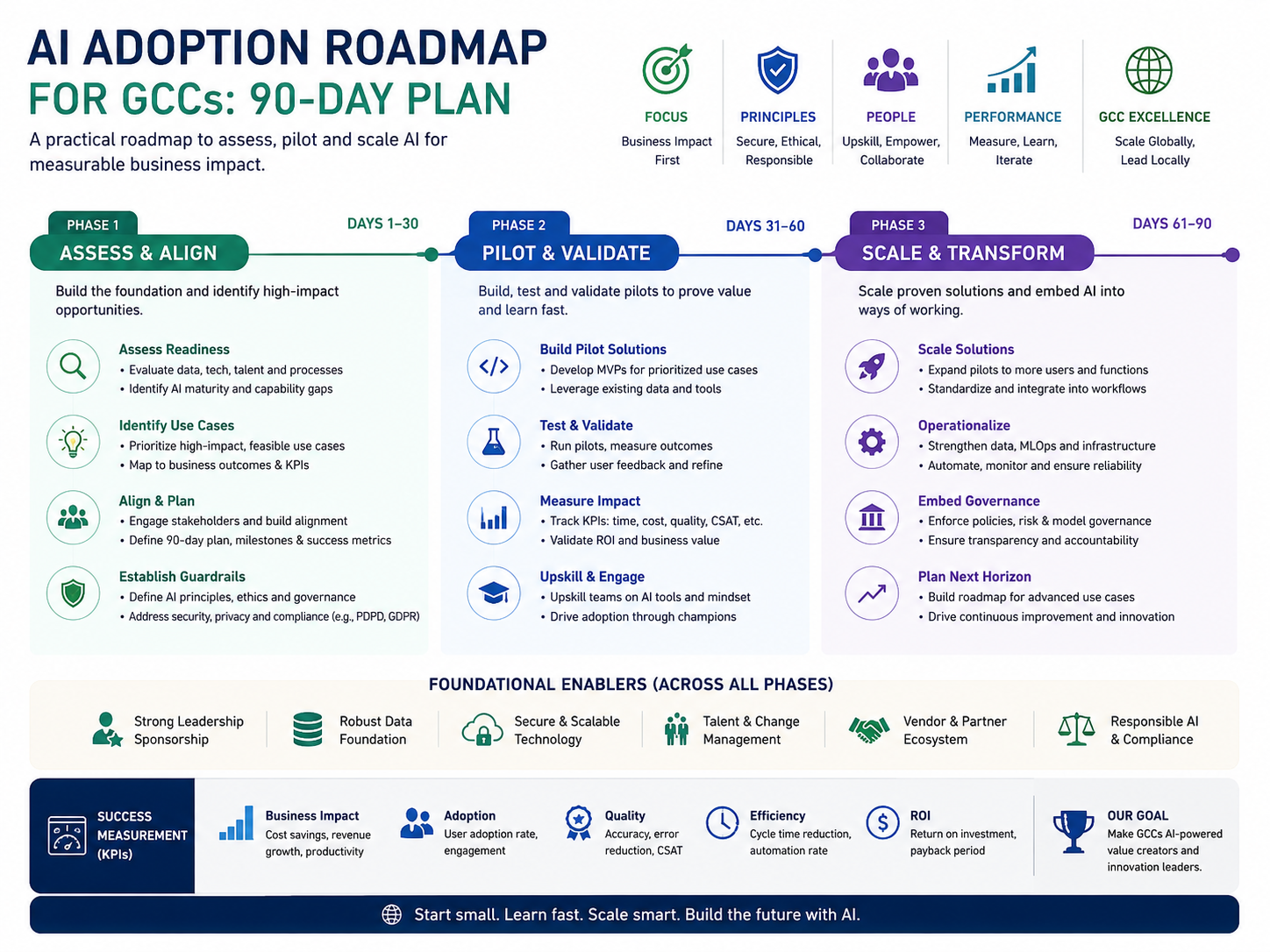
A practical AI adoption roadmap GCC teams can follow should move through six stages.
AI readiness assessment
Use-case selection
Governance and compliance controls
Pilot design and testing
Production deployment
ROI-led scaling
This keeps AI grounded in business outcomes, not hype.
What Is an AI Adoption Roadmap for GCC Companies?
An AI adoption roadmap is a structured plan that helps a business decide where AI fits, what data is required, which risks must be controlled, and how success will be measured.
How the Roadmap Connects Strategy, Data, and ROI
A roadmap links business goals with technical readiness.
For example, a retailer in Dubai may want AI-powered personalization, while a Riyadh fintech company may need fraud detection with stronger governance and human review. In both cases, AI only works when the team can connect clean data, secure systems, and measurable KPIs.
Teams can also use business intelligence services to turn pilot results into clear dashboards for leadership.
Why Saudi, UAE, and Qatar Companies Need Localized Planning
GCC companies often work across Arabic and English customer journeys, regulated industries, and fast-moving digital markets.
Saudi Arabia’s SDAIA describes the Personal Data Protection Law as protecting personal data and defining controller obligations, while the UAE AI Strategy is linked to government performance and UAE Centennial 2071 goals. Qatar Central Bank also lists Artificial Intelligence Guidelines under its fintech resources, which matters for financial institutions and fintech teams.
That means a global AI playbook is rarely enough. GCC companies need local planning for data, language, regulation, cloud, and customer expectations.
Where Generic AI Roadmaps Fail in GCC Markets
Generic roadmaps often miss the details that make or break adoption in this region.
Arabic UX and right-to-left interface quality
Bilingual search, chat, and support journeys
Sector-specific rules in finance, healthcare, and government
Local cloud and data-residency preferences
Procurement expectations for enterprise and public-sector buyers
Human oversight for sensitive decisions
For GCC businesses, localization is not a final polish. It is part of trust, adoption, and risk control.
Assess AI Readiness Before Choosing Use Cases
Before selecting tools, run an AI readiness assessment.
This step prevents teams from choosing exciting use cases that cannot be delivered safely or measured properly.
Review Data Quality, Cloud Maturity, and Integrations
Start by checking whether customer, finance, logistics, HR, and support data is clean, accessible, and legally usable.
Ask practical questions.
Where is the data stored?
Who owns it?
Is it complete enough for AI?
Can it connect with CRM, ERP, mobile apps, or portals?
Is sensitive data protected before AI tools access it?
Strong integration layers matter, especially when AI connects to business systems through back-end development services.
Map Business Goals Across Riyadh, Dubai, Abu Dhabi, and Doha
Different teams may have different priorities.
A Riyadh team may focus on regulated fintech automation. A Dubai team may prioritize e-commerce growth. Abu Dhabi teams may care more about enterprise governance. Doha teams may focus on data residency and financial-sector guidance.
The same roadmap should allow local execution without losing regional consistency.
Check Arabic UX and Bilingual Workflows
AI chatbots, internal copilots, and search assistants must understand Arabic terms, English business language, and bilingual switching.
This is especially important for
Government services
Healthcare platforms
Logistics portals
Retail and e-commerce apps
Banking and fintech support journeys
Arabic UX is not just translation. It includes tone, terminology, cultural context, and clear escalation when the AI cannot answer safely.
Prioritize AI Use Cases for a 90-Day Pilot
Start small, but choose a use case that matters.
A good first pilot should be useful, measurable, and realistic within a controlled scope.
Choose High-Impact Use Cases
Strong AI pilot candidates in the GCC include.
Arabic customer support
Fraud alerts
Demand forecasting
Document review
Route optimization
Employee knowledge search
Sales and product recommendations
Compliance workflow automation
A Dubai e-commerce brand, for example, may combine AI recommendations with mobile app development services to improve product discovery inside its app.
Score Use Cases by Feasibility, Risk, Cost, and ROI
Use a simple scorecard before approving the pilot.
| Criteria | What to Check |
|---|---|
| Data availability | Is the right data accessible and usable? |
| Business impact | Will the result matter to revenue, cost, speed, or service quality? |
| Risk level | Could the AI affect customers, finances, legal decisions, or personal data? |
| Implementation effort | Can the team build and test it within the pilot scope? |
| KPI clarity | Can success be measured clearly? |
This keeps AI use-case prioritization practical instead of emotional.
Compare Saudi, UAE, and Qatar Pilot Priorities
In Saudi Arabia, regulated fintech projects may need closer alignment with SDAIA, NDMO, PDPL, and SAMA expectations.
In the UAE, Dubai and Abu Dhabi teams may prioritize customer experience, digital commerce, DIFC, ADGM, or enterprise AI governance. ADGM guidance highlights the need for approved and documented governance frameworks for managing risks related to big data analytics and AI.
In Qatar, QCB-regulated financial services should review AI and fintech guidance before launch. Qatar Central Bank’s AI guideline was issued to regulate AI use within the financial sector.
Build AI Governance and Compliance Controls
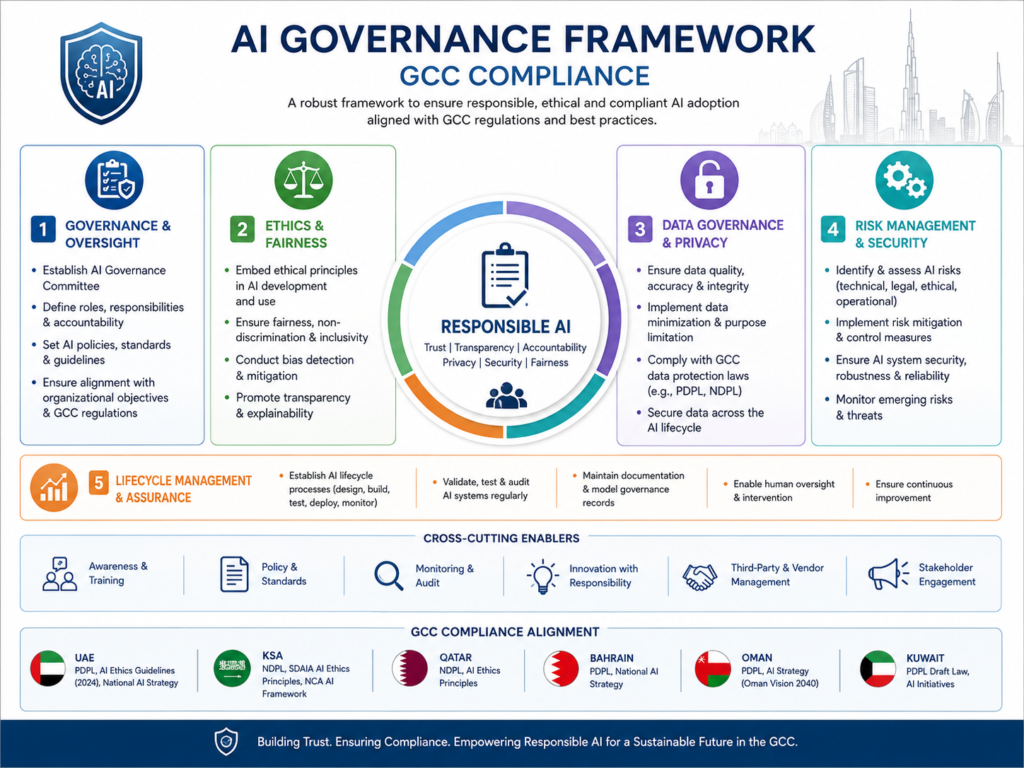
Governance should not be added after the pilot. It should be built into the roadmap from the start.
Common AI risks include
Personal data misuse
Biased or inaccurate outputs
Weak vendor controls
Unclear accountability
Insecure APIs
Poor audit trails
No human review for sensitive decisions
Align Saudi AI Projects with Local Data Expectations
Saudi projects should map personal data, define retention rules, document lawful use, and keep human review for sensitive decisions.
SDAIA’s data protection guidance states that the PDPL protects personal data and defines obligations that controllers must fulfill.
In practice, this means AI teams should avoid feeding sensitive customer or employee data into tools without clear approval, security controls, and documented purpose.
Consider UAE Governance Signals
The UAE AI Strategy aims to support UAE Centennial 2071 goals and improve government performance.
For UAE financial services, ADGM guidance is also important because it emphasizes governance, risk management, and documented control frameworks for AI and big data analytics.
For business leaders, the practical takeaway is clear: document how AI is selected, tested, approved, monitored, and escalated.
Include Qatar AI and QCB Checkpoints
A Doha bank, fintech, or regulated business should review QCB guidance, MCIT signals, data classification, vendor access, model monitoring, and customer disclosure requirements.
For sensitive AI workflows, keep a human-in-the-loop process. Mak It Solutions’ guide on human-in-the-loop AI workflows is a useful companion for this stage.
Move from AI Pilot to Production in 90 Days
This is the practical heart of an AI adoption roadmap GCC teams can execute.
The goal is not to build everything at once. The goal is to prove one valuable use case, under control, with measurable outcomes.
Readiness, Use-Case Design, and Success Metrics
Select one use case.
Then confirm.
Data access
Arabic and English user journeys
Security requirements
Business owner
Technical owner
Risk owner
Success metrics
For example, a Riyadh fintech startup may target faster onboarding review while keeping sensitive decisions human-approved.
Prototype, Test, and Validate
Build a limited proof of concept and test it with real business users.
Review.
Accuracy
Latency
Security
User experience
Arabic response quality
Cost per interaction
Escalation handling
Teams building AI-ready workflows can use Python development services for automation, data processing, and back-end logic.
Deploy, Monitor, Govern, and Prepare to Scale
Move the pilot into controlled production.
Track output quality, user adoption, cloud cost, support tickets, risk incidents, and business impact. A Dubai e-commerce brand may scale AI support inside its app after validating Arabic response quality and conversion impact.
This is where AI starts becoming operational value instead of a demo.
Plan Data Residency, Cloud, and Security for GCC AI
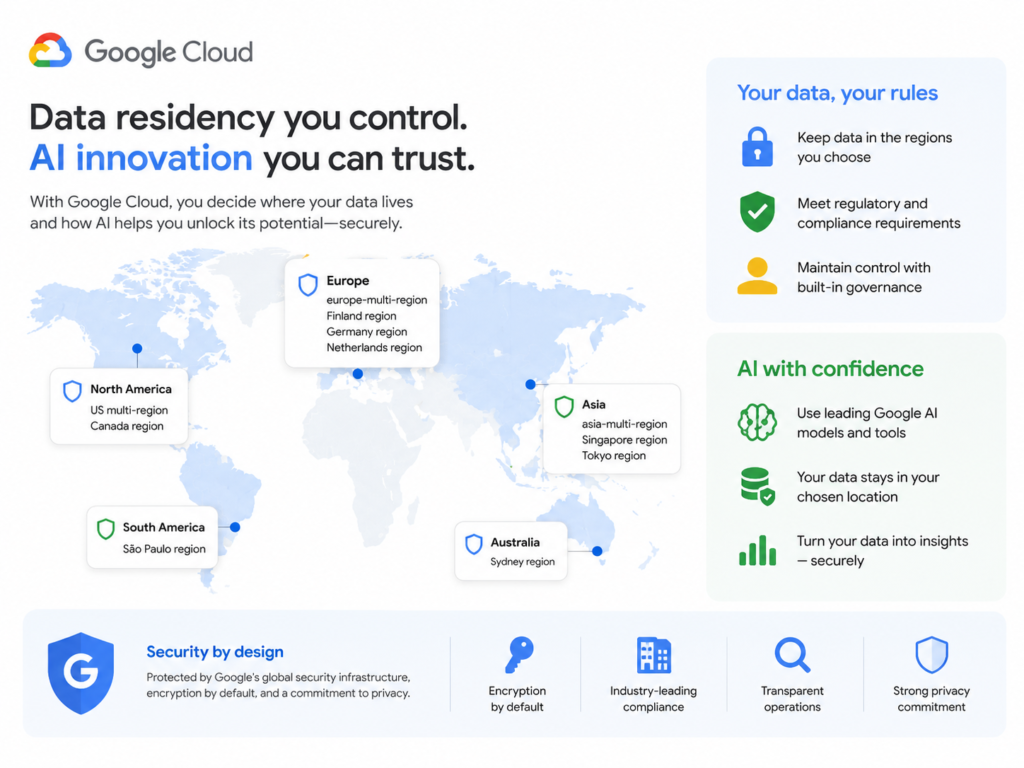
AI success depends on secure infrastructure.
Before scaling, decide where data will live, who can access it, and how the business will recover if systems fail.
Compare Local Hosting Options Across the GCC
Data-residency decisions should consider.
Sector rules
Customer trust
Latency
Business continuity
Vendor availability
Internal security policies
Sensitive government, fintech, and healthcare workloads usually need stronger controls than low-risk marketing automation.
Use Regional Cloud Signals Where Relevant
AWS lists Middle East regions in Bahrain and the UAE, each with availability zones. Microsoft lists UAE and Qatar cloud regions, including Qatar Central in Doha and UAE regions in Abu Dhabi and Dubai. Google Cloud has also opened a Doha region with three zones.
Cloud availability can change by service, workload, and compliance need, so teams should validate current region support before making final architecture decisions.
Reduce AI Risk with Security and Human Oversight
Use.
Role-based access control
Encryption
Logging
API security
Vendor reviews
Model evaluation
Human approval for sensitive outputs
Incident response plans
AI should make work faster, but not less accountable.
Measure AI ROI and Scale Across the GCC
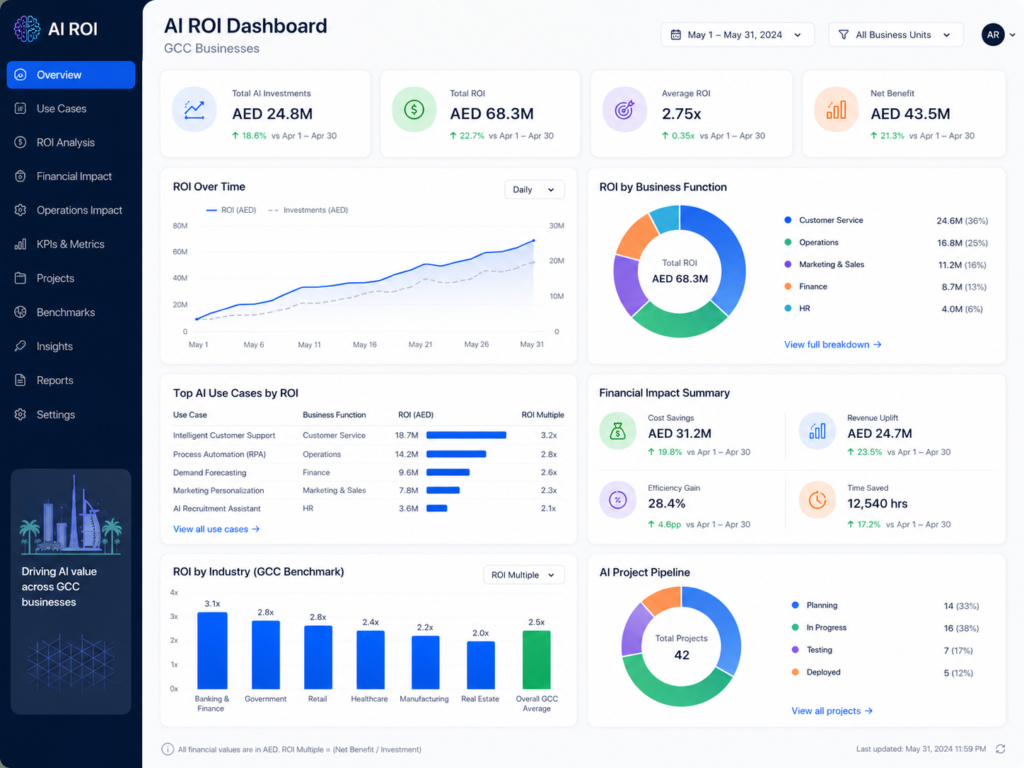
AI must become measurable, not magical.
Before launching the pilot, define what success means.
Define AI ROI Metrics Before Pilot Launch
Useful AI ROI metrics include.
Time saved
Cost reduced
Conversion uplift
Customer satisfaction
Error reduction
Faster response times
Lower manual workload
Compliance review efficiency
A Doha SME using local cloud options may measure faster response times and improved local data control. A UAE retailer may track conversion uplift and support deflection. A Saudi fintech may measure onboarding speed while monitoring compliance quality.
Build an AI Operating Model
A lightweight AI operating model should define.
Who approves AI use cases
Who owns data access
Who reviews risk
Who monitors model performance
Who handles incidents
Which prompts, tools, and vendors are allowed
For enterprise teams, AI-native development platforms can support delivery discipline and repeatable workflows.
Expand Successful Pilots Across the GCC
Once one pilot proves value, adapt it country by country.
Saudi Arabia, the UAE, Qatar, Kuwait, Bahrain, and Oman may share similar business goals, but compliance reviews, Arabic UX testing, hosting choices, and customer expectations should still be localized.
Concluding Remarks
The strongest AI adoption roadmap GCC companies can use starts with readiness, then moves into use-case prioritization, governance, pilot execution, secure cloud planning, and ROI-led scaling.
For GCC leaders, the opportunity is real, but the safest path is structured. Start with one valuable pilot, prove it, govern it, and scale it carefully.
Ready to move from AI ideas to production value? Contact Mak It Solutions to book a consultation, explore custom web development support, or request a tailored GCC AI strategy for Saudi Arabia, the UAE, Qatar, and the wider region.( Click Here’s )
FAQs
Q : Is an AI adoption roadmap different for Saudi Arabia and the UAE?
A : Yes. Saudi Arabia projects often need stronger alignment with SDAIA, NDMO, PDPL, and SAMA expectations, especially in fintech, government, and data-heavy platforms. UAE projects may focus more on TDRA signals, Dubai digital commerce, DIFC, ADGM, and the UAE AI Strategy.
Q : What AI use cases work best for Qatar businesses?
A : Qatar businesses often benefit from AI customer support, document automation, financial risk analysis, logistics forecasting, and internal knowledge search. For QCB-regulated companies, AI use cases should be reviewed for explain ability, data governance, audit trails, and human oversight.
Q : Do GCC companies need Arabic UX for AI chatbots?
A : Yes. Arabic UX is not only translation. It includes tone, terminology, right-to-left interface quality, bilingual switching, and culturally respectful responses.
Q : How long does it take to launch an AI pilot in Dubai or Riyadh?
A : A focused AI pilot can often be designed, tested, and deployed in about 90 days when data is ready and the scope is controlled. Dubai teams may prioritize customer experience and app growth, while Riyadh teams may need more compliance review if financial or personal data is involved.
Q : What industries in the GCC benefit most from AI adoption?
A : Fintech, government, logistics, healthcare, retail, and e-commerce are strong candidates. These sectors often have high-volume workflows, measurable KPIs, and clear automation opportunities, but regulated use cases need stronger governance and human accountability.