
Blogs
Google Preferred Sources: The Ultimate 2026 Guide
Content Editor · November 16, 2026 · 13 min read
Direct answer
Can a small independent publisher use Google Preferred Sources?
Yes. Independent publishers can participate when their eligible websites appear in Google's source preferences tool. The feature is not limited to major national news organizations.
Google Preferred Sources gives publishers an opportunity to turn occasional search visitors into loyal readers. Instead of relying entirely on search rankings, publications can encourage audiences to choose their…
Google Preferred Sources: The Ultimate 2026 Guide
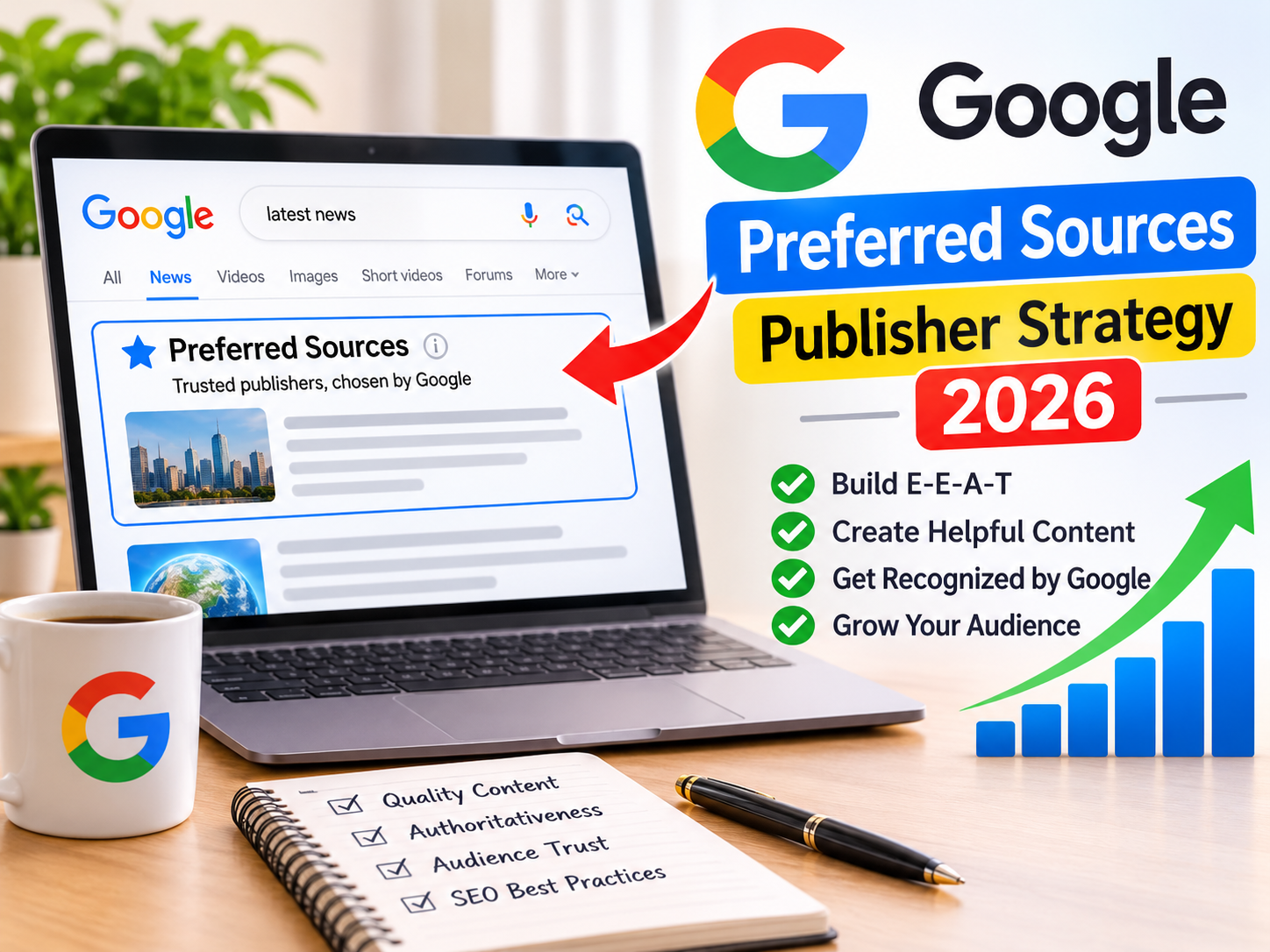
Google Preferred Sources gives publishers an opportunity to turn occasional search visitors into loyal readers. Instead of relying entirely on search rankings, publications can encourage audiences to choose their websites as trusted sources within Google Search.
When readers add a website as a Preferred Source, Google may show its relevant content more frequently in personalized Top Stories results. Selected publications can also receive preferred-source labels in supported AI Overviews and AI Mode experiences.
For publishers across the USA, UK, Germany and wider EU, a successful Google Preferred Sources strategy combines original content, straightforward implementation, audience engagement and reliable SEO practices.
What Are Google Preferred Sources and How Do They Work?
Google Preferred Sources is a Search personalization feature that lets readers select websites they want to see more often in relevant news results.
It gives audiences greater influence over which publications appear in their personalized search experiences. However, it does not guarantee higher organic rankings, increased website traffic or citations in AI-generated answers.
According to Google Search Central's official documentation, selected websites become more likely to appear in Top Stories and may receive a Preferred label in supported AI Search experiences.
How Google Search Source Preferences Work
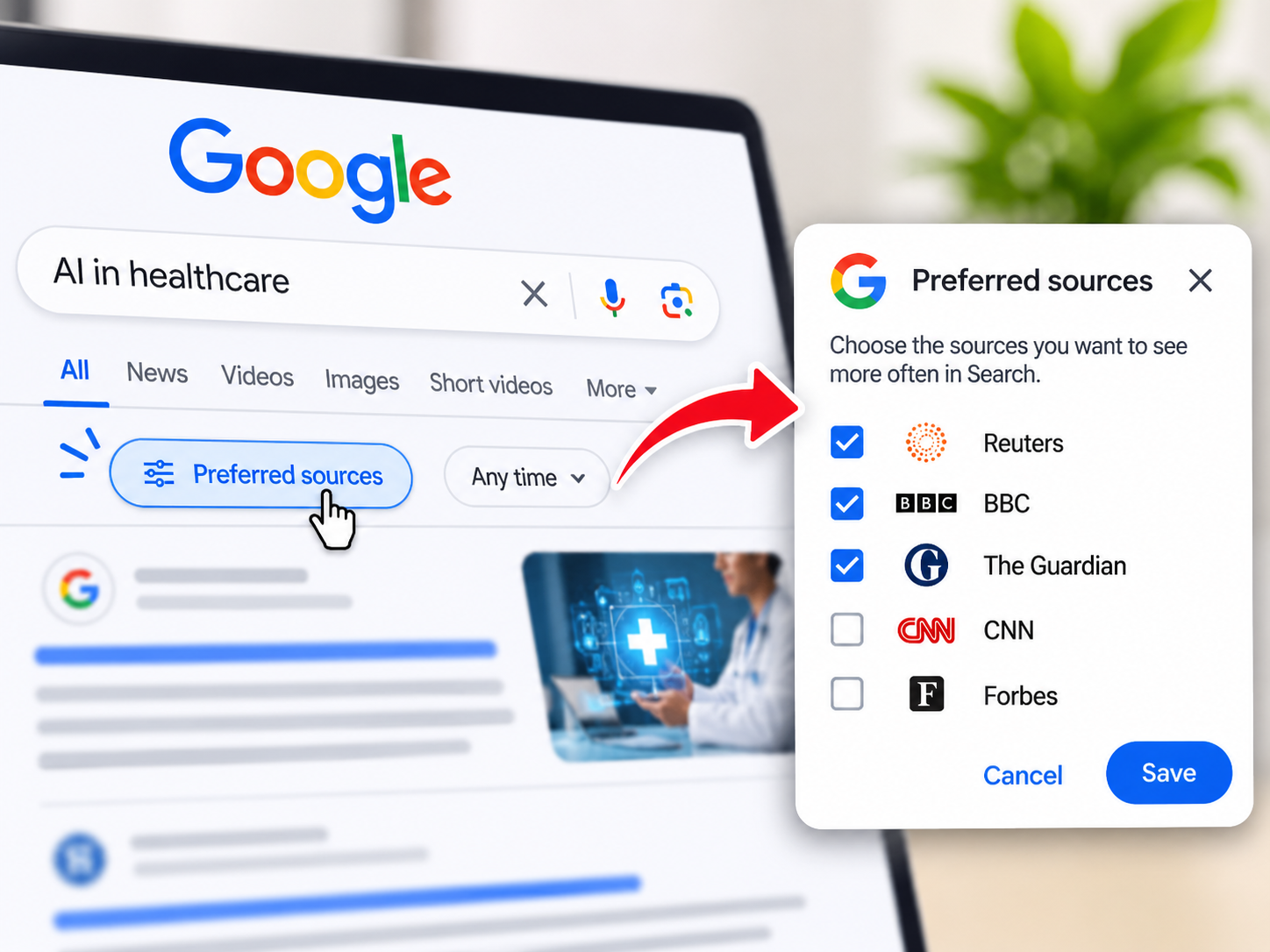
Readers can choose their favorite publications through Google's source preferences tool or an interactive button embedded on a publisher's website.
Once someone selects a source, Google may feature more of its relevant articles in personalized Top Stories results. Other publications can still appear, so the experience does not become exclusive to selected websites.
The important distinction is that Preferred Sources builds on reader choice rather than replacing Google's existing search-ranking systems.
Google Preferred Sources Eligibility for Publishers
Before promoting the feature, check whether your website appears in Google's source preferences tool.
Google's documented eligibility and availability conditions include:
-
Domain-level selection.
Readers can select an eligible domain or subdomain, but not an independent blog subdirectory. -
Global Top Stories support.
Preferred Sources is available in Top Stories across supported Google Search languages. -
AI Search availability.
Preferred-source highlighting depends on the regional availability of AI Overviews and AI Mode. -
AI participation settings.
Sites must be included in Google's generative AI Search features to qualify for corresponding preferred-source highlighting.
These conditions make eligibility checks an important starting point, especially for publishers operating multilingual websites.
Google Preferred Sources vs. Google News and Organic SEO
Preferred Sources complements existing Google discovery systems rather than replacing them.
|
Google feature |
Primary purpose |
|---|---|
|
Preferred Sources |
Personalizes relevant search experiences around reader-selected websites |
|
Google News |
Helps users discover news stories and publications |
|
Google Discover |
Recommends content based on user interests |
|
Organic Google Search |
Surfaces relevant web content through Google's search systems |
|
AI Overviews and AI Mode |
Provides AI-assisted responses with supporting web links |
Publishers should continue investing in their broader SEO strategy.
A reader's preference cannot compensate for poor content, technical problems or weak editorial credibility.
How to Build a Winning Google Preferred Sources Strategy
An effective Google Preferred Sources strategy begins before the selection button appears.
Readers need a reason to follow your publication. That reason usually comes from reliable reporting, useful analysis and a consistent editorial identity.
Once those foundations are established, publishers can encourage readers to select their website and measure whether the campaign strengthens audience relationships.
Create Original Content That Builds Reader Loyalty
Original reporting and firsthand analysis give readers a reason to return.
Publishing frequent articles is not enough if those articles merely repeat information already available elsewhere.
Instead, focus on material that offers a distinct perspective, clear evidence or useful expertise.
Strong editorial practices include.
-
Publishing accurate, original reporting with identifiable sources.
-
Providing transparent author information and editorial accountability.
-
Demonstrating consistent subject-matter expertise.
-
Updating existing articles when meaningful new information becomes available.
-
Maintaining accessible corrections and editorial policies.
Google's E-E-A-T framework Experience, Expertise, Authoritativeness and Trustworthiness offers a useful way to evaluate content credibility.
Publishers developing specialized reporting can also explore original research for AI Search visibility.
The objective is to become a source readers recognize and genuinely value.
Encourage Readers to Add Your Website as a Preferred Source
A well-placed selection prompt makes it easier for loyal readers to follow your publication through Google.
Good placements include article footers, homepage sections, newsletter confirmations and relevant editorial communications.
Keep the wording simple.
Follow our reporting on Google add us as a Preferred Source.
Explain what readers gain from making that selection. They may encounter more relevant content from your publication, but they will not necessarily see every article you publish.
Avoid intrusive pop-ups or repeated prompts that interrupt the reading experience.
Build a 30-Day Publisher Growth Campaign
A focused campaign gives publishers a practical way to test implementation and audience response.
|
Timeline |
Action |
Objective |
|---|---|---|
|
Week 1 |
Audit eligibility, content quality and baseline traffic |
Establish readiness |
|
Week 2 |
Install and test the Preferred Sources button |
Simplify selection |
|
Week 3 |
Promote through newsletters and social channels |
Increase awareness |
|
Week 4 |
Review interactions and engagement |
Improve placements |
Start with existing readers rather than trying to reach everyone at once.
Newsletter subscribers and returning visitors already have some familiarity with your publication, making them a sensible audience for the initial campaign.
A coordinated digital marketing strategy can connect these activities with broader audience-growth goals.
How to Add the Google Preferred Sources Button
Google provides an official interactive button and a direct-link alternative for publishers.
The JavaScript button offers an automatically localized interface and returns readers to the publisher's page after the selection process.
For websites with limited customization options, Google's deeplink provides a simpler alternative.
Install Google's Official JavaScript Button
Google's standard implementation uses a script and an HTML container.
First, add the following script to your website, preferably inside the head section.
Next, place the button container wherever you want it to appear
Google handles the standard button interface and language localization.
For websites using a dark design, the container can include.
Publishers can also specify a preferred display language with the data- lang attribute.
Check the official Google implementation documentation for supported customization options and current instructions.
Use a Preferred Sources Deeplink on WordPress or Other CMS Platforms.
If your website cannot support the interactive button, use Google's source-preference deeplink
Replace example.com with your publication's actual domain.
You can share this link through WordPress content blocks, newsletter templates and social media campaigns.
For publishers managing more complex websites, WordPress development support can help integrate a reusable selection component across relevant pages.
Check Mobile UX, Top Stories SEO and Technical Discoverability
Before publishing your selection prompts, test the experience on mobile and desktop.
Check whether the button loads correctly, opens the expected flow and remains accessible across different screen sizes.
Also review canonical URLs, XML sitemaps, structured data, page performance and indexability.
These technical elements support broader SEO performance. They should not be mistaken for separate Preferred Sources eligibility requirements.
Google Preferred Sources in AI Overviews and AI Mode
Google expanded Preferred Sources into AI Overviews and AI Mode in May 2026, allowing users to identify links from publications they had already selected.
This creates an additional opportunity for readers to recognize trusted websites within AI-generated search experiences.
However, Preferred Sources does not guarantee that Google's AI systems will cite a particular article.
How Preferred Sources Appear in AI-Generated Search Results
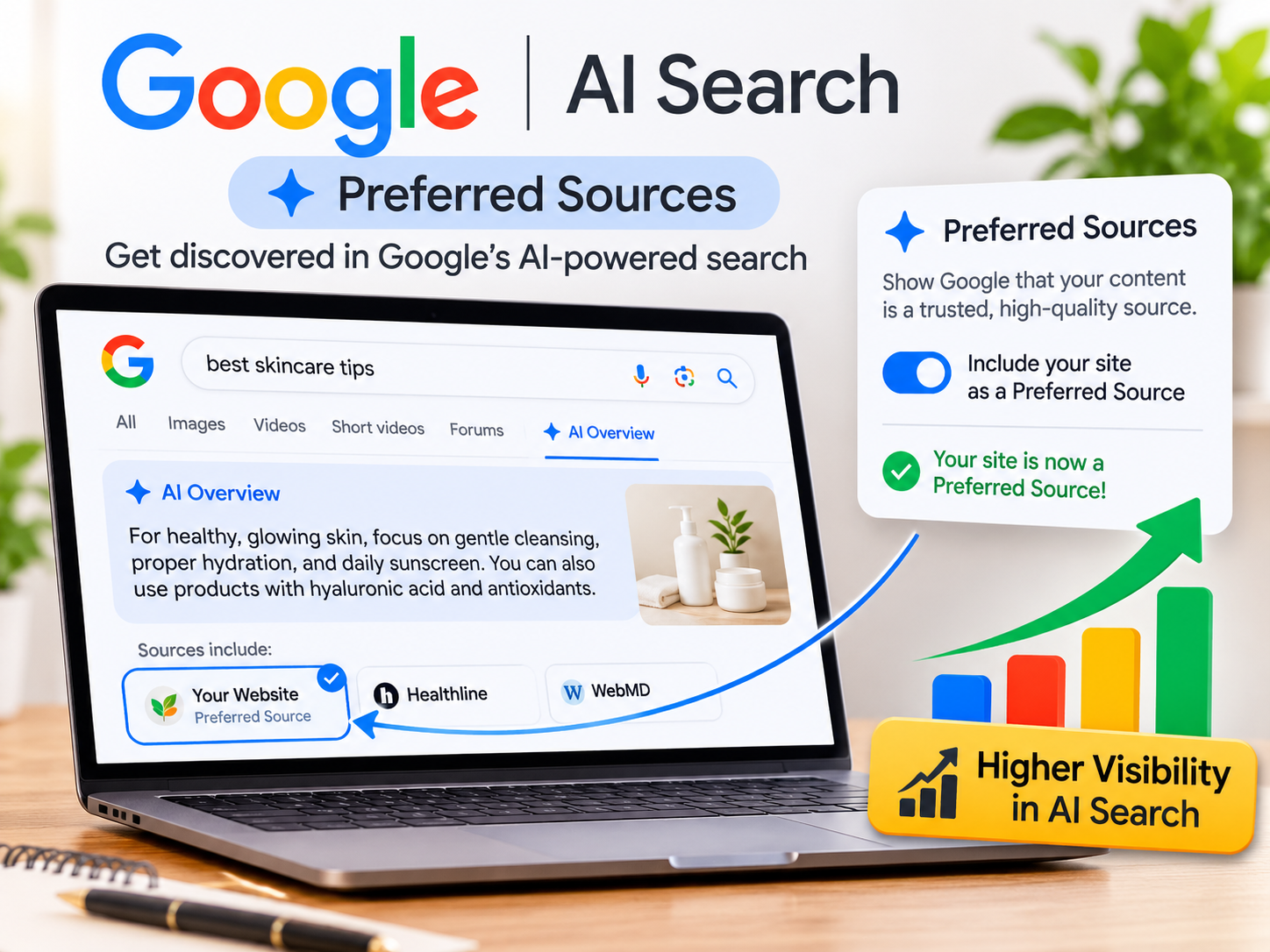
When a relevant selected website appears in a supported AI response, Google can display a Preferred label alongside its link.
This may help readers identify familiar publications among the sources provided.
It is a recognition and personalization feature, not a mechanism for forcing article inclusion.
Optimize Original Reporting for AI Search Discoverability
Content that answers readers' questions clearly is easier to understand and navigate.
For AI Search discoverability, focus on.
-
Clear answers near the beginning of relevant articles.
-
Descriptive headings reflecting genuine search intent.
-
Original research and verifiable supporting evidence.
-
Transparent authorship and trustworthy references.
-
Relevant internal links connecting related topics.
-
Accessible pages that search engines can crawl and index.
Google's guidance emphasizes that existing SEO fundamentals remain relevant for AI Search. Special keyword formulas or separate AI-only optimization tricks are not required.
A dependable web development foundation can support content accessibility, loading performance and reliable rendering.
Understand AI Citations and Publisher Control
Preferred Sources may improve recognition when a selected publication is surfaced, but it cannot guarantee inclusion in an AI-generated answer.
Google continues to evaluate content relevance and other signals within its Search experiences.
Publishers should therefore treat AI visibility as an additional opportunity, not the sole measure of editorial success.
Google Preferred Sources Strategies for the USA, UK and Germany
A Google Preferred Sources campaign should reflect the audience it serves.
Although Top Stories support is globally available, language preferences, audience habits and privacy obligations vary across regions.
USA.
American publishers can use Preferred Sources to reinforce relationships with readers interested in specialized or local coverage.
For example, a New York technology publication might promote the feature through a daily industry newsletter. A Chicago community newsroom could place selection prompts alongside local reporting.
The importance of diversifying audience relationships is reflected in the Reuters Institute's Digital News Report 2024, which found that approximately 31% of respondents across its surveyed markets used YouTube for news weekly.
Publishers should also account for applicable state privacy laws and US email marketing requirements.
UK.
UK publishers can introduce Preferred Sources through newsletters, membership journeys and editorial pages.
A London business publication might place the selection button below market analysis, while a Manchester local publisher could promote it through community updates.
Campaigns involving personal information should account for UK GDPR and applicable Privacy and Electronic Communications Regulations.
Importantly, clicking a Preferred Sources button does not automatically provide consent for marketing emails.
Germany and Wider EU.
German publishers should use messaging that feels natural to local readers rather than relying on literal English translations.
Useful terminology includes Bevorzugte Quellen.
For example.
Folge unserer Berichterstattung auf Google – füge uns als bevorzugte Quelle hinzu.
Multilingual publications serving Berlin, Paris and Amsterdam can consider localized landing pages and appropriate hreflang annotations.
Where campaigns process personal data, publishers should follow applicable GDPR requirements, known as DSGVO in Germany.
A separate German-language page can improve usability for a meaningful German-speaking audience, but it is not a mandatory Preferred Sources qualification.
How to Measure Google Preferred Sources SEO Success
Installing the button is only the beginning.
Publishers need to understand whether their campaign encourages useful engagement and supports a stronger relationship with readers.
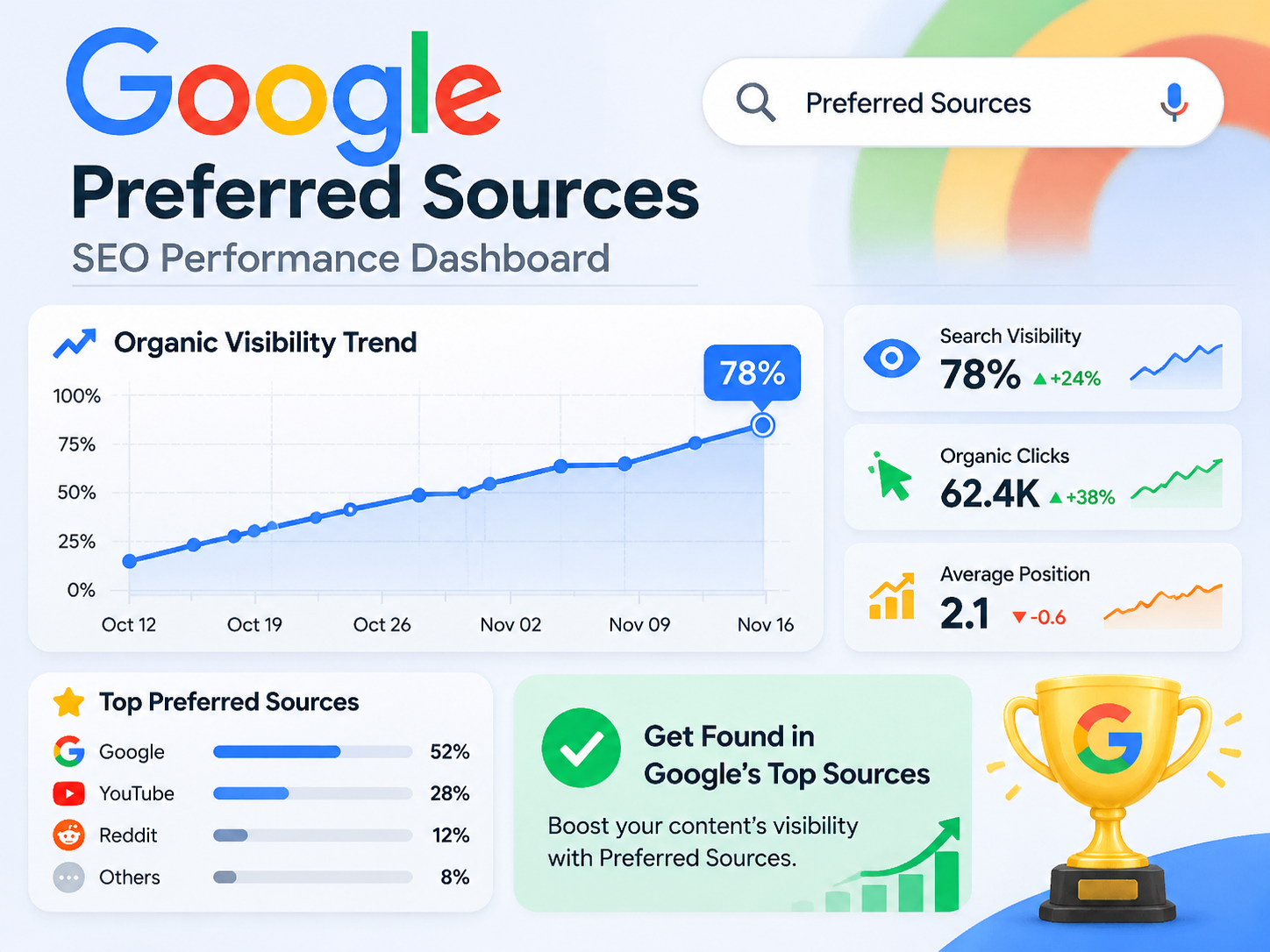
The most practical approach combines interaction tracking, Search Console reporting and returning-visitor analysis.
Track Button Engagement and Newsletter Campaign Results
Google Analytics 4 and Google Tag Manager can help publishers measure interactions with promotional elements where technically supported.
Track relevant newsletter and social campaigns using UTM parameters.
Useful measurements include button interactions, campaign referral traffic, engaged sessions and subsequent website visits.
Remember that a button click alone does not confirm that someone completed the Preferred Sources selection process.
Monitor Search Console and Returning Visitors
Google Search Console can help publishers review changes in impressions, clicks and search queries.
Compare results with publication schedules, seasonal fluctuations and other marketing activity.
Audience behavior is also changing beyond traditional search.
The Reuters Institute's Digital News Report 2025 found that social video news consumption across surveyed markets grew from 52% in 2020 to 65% in 2025.
That makes dependable reader relationships increasingly valuable, even when audiences discover news through multiple channels.
Optimize Campaign ROI and Plan the Next 30 Days
Evaluate performance against implementation and promotional costs.
Prioritize placements that attract engaged readers rather than simply generating the largest number of clicks.
Google reported in April 2026 that readers were twice as likely to click through to a website after selecting it as a Preferred Source. This reflects Google's observed user behavior, not a guaranteed traffic increase for individual publishers.
For more advanced measurement, business intelligence services can help consolidate analytics, search performance and campaign activity into actionable reports.
Concluding Remarks
Google Preferred Sources offers publishers an additional way to strengthen audience relationships and make their content more recognizable in personalized search experiences.
The best strategy is not simply to install a button and hope for more traffic.
It is to publish content worth following, make source selection convenient and evaluate performance without confusing correlation with guaranteed results.
For publishers across the USA, UK, Germany and the EU, strong technical SEO, original reporting and localized communication remain essential.
Google Search will continue to evolve. Reader trust is a foundation worth building regardless of the next platform update.
Mak It Solutions helps publishers evaluate technical SEO, content discoverability and digital audience-growth opportunities.
Whether you're improving Top Stories visibility, preparing for AI Search or building a stronger reader engagement strategy, a structured website assessment can help identify practical priorities.
Request a publisher SEO and technical audit and explore the next steps for your publication.
Key Takeaways
-
Reader choice matters.
Preferred Sources gives audiences more control over the publications they encounter.Original content drives loyalty.
Trustworthy reporting and distinct expertise encourage repeat visits. -
Implementation is accessible.
Publishers can use Google's official JavaScript button or deeplink. -
AI visibility has limits.
Preferred-source labels do not guarantee citations or rankings. -
Localization improves relevance.
Adapt campaigns to regional languages, reader expectations and privacy requirements. -
Measurement needs context.
Track engagement without assuming every traffic change was caused by Preferred Sources.
FAQs
Frequently asked questions
Quick answers related to this article.
Comments
Join the discussion. Comments are moderated.
No comments yet. Be the first to share a thought.
Building something related?
Tell us about your product goals — we’ll respond with a clear next step.
Discuss your project