


Digital Twin for Robotics: The Ultimate Testing Guide
Digital Twin for Robotics: The Ultimate Testing Guide
Digital Twin for Robotics: The Ultimate Testing Guide
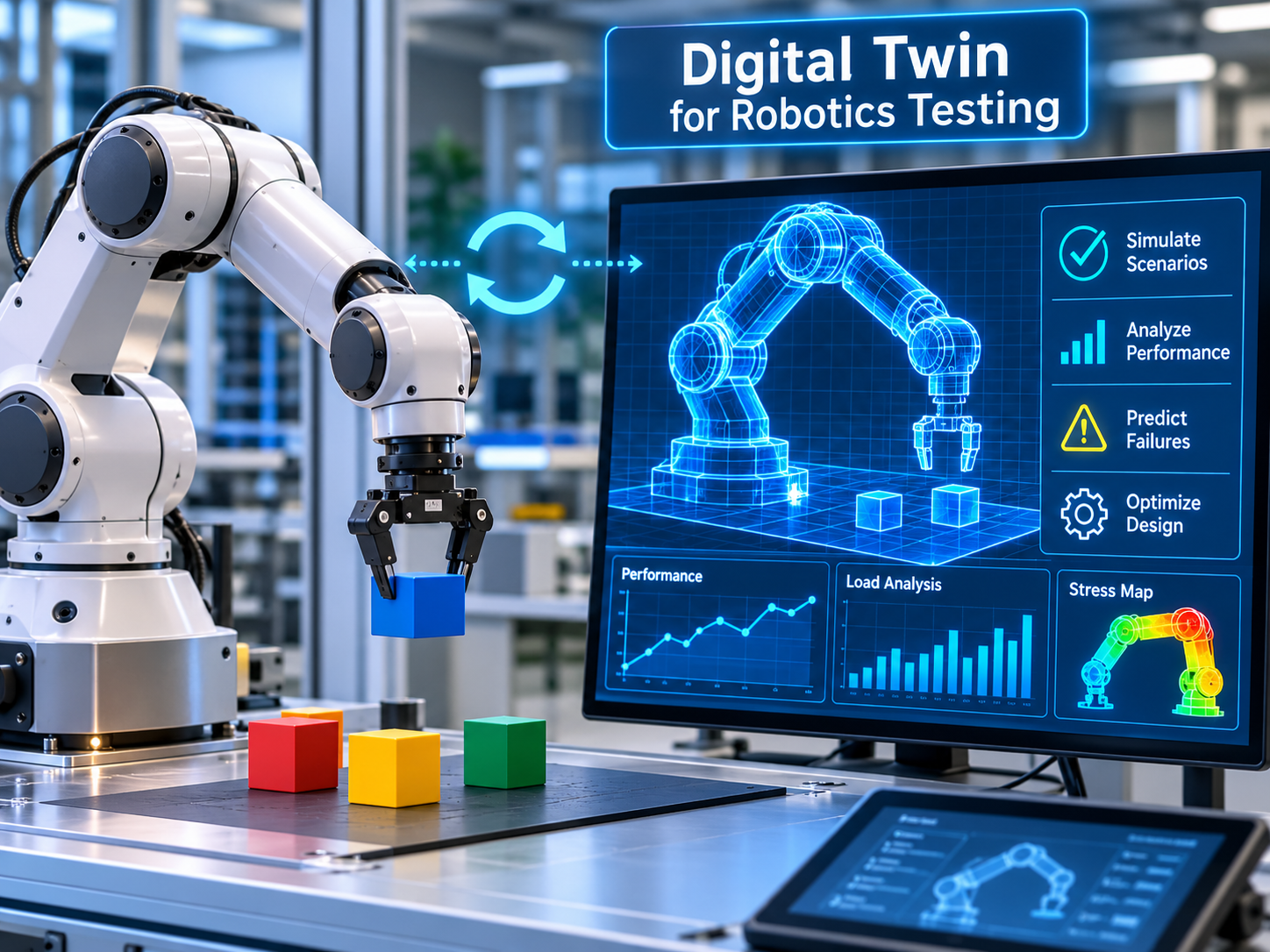
Testing robots in real-world environments is expensive, time-consuming, and sometimes risky. A digital twin for robotics helps engineers simulate robot behavior, test software, detect potential failures, and validate performance before making changes to physical equipment.
Unlike a standalone simulation, a robotics digital twin uses data from a physical system to keep its virtual model relevant. Engineers can use this connection to investigate problems, improve control systems, and make better deployment decisions.
The need for reliable testing is growing. According to the International Federation of Robotics (IFR), approximately 541,000 industrial robots were installed worldwide in 2023. Installations reached about 542,000 in 2024, while the global operational stock grew to roughly 4.66 million robots.
As more factories and warehouses depend on automation, repeatable testing becomes increasingly valuable.
What Is a Digital Twin for Robotics?
A digital twin for robotics is a virtual representation of a physical robot that uses operational data, calibration information, or synchronized state updates to reflect real-world behavior.
It brings together robot geometry, physics, sensors, controllers, and physical-system measurements. Engineers can then compare expected behavior with actual performance and refine the model when discrepancies appear.
Digital Twin vs. Traditional Robot Simulation
Simulation and digital twins are closely related, but they serve different purposes.
|
Capability |
Traditional simulation |
Robotics digital twin |
|---|---|---|
| Physical robot | Not required | Typically connected to one |
| Real-world data | Optional | Essential |
| Model updates | Often manual | Informed by physical data |
| Main purpose | Design and testing | Testing and operational insight |
| Monitoring | Limited | Can support ongoing monitoring |
A simulator becomes part of a digital twin when meaningful information from the physical system is used to maintain or validate the virtual model.
How a Robotics Digital Twin Works
A typical digital twin architecture includes.
Robot model: Geometry, mass, joints, actuators, and motion constraints.
Physics engine: Collision detection, contact forces, and motion dynamics.
Sensor models: Cameras, LiDAR, encoders, and inertial measurement units.
Controllers: Software responsible for navigation, movement, and task execution.
Data connections: Telemetry and synchronization between physical and virtual systems.
Engineers may use URDF or Open USD for robot representations and ROS 2 to connect robotic software components.
The level of synchronization depends on the application. Some digital twins require frequent updates, while others use periodic measurements and recalibration.
Benefits and Limitations
Digital twins make controlled, repeatable testing easier. Teams can simulate dangerous scenarios, investigate edge cases, and identify integration problems without exposing expensive hardware to every test.
However, virtual models are never perfect.
Friction, sensor noise, mechanical wear, lighting changes, and network delays can all cause differences between simulation and reality. Regular validation is essential, especially when the results influence safety-related decisions.
How Digital Twins Improve Robotics Testing
A digital twin allows engineers to test software, sensors, and control behavior under controlled conditions before applying changes to physical robots.
This helps teams find defects earlier, compare software versions, and reproduce scenarios that may be difficult to recreate consistently in a factory or warehouse.
Software-in-the-Loop and Hardware-in-the-Loop Testing
Software-in-the-loop (SIL) testing runs robot software against simulated hardware, sensors, and environments.
Hardware-in-the-loop (HIL) testing includes selected physical components, such as an industrial controller, while the remaining system is simulated.
SIL is useful for testing algorithms and software behavior. HIL helps evaluate interactions involving real controller hardware and timing constraints.
Neither replaces complete physical acceptance testing, but both can reduce the number of problems discovered during final integration.
Sensor Simulation, Physics and Collision Testing
Robots depend on reliable perception and motion control.
Digital twin environments can simulate camera images, LiDAR scans, inertial measurements, obstacles, and collision events. Physics engines such as NVIDIA PhysX also model rigid-body dynamics and contact interactions.
Engineers can test conditions such as unexpected object movement, changing visibility, and restricted navigation spaces.
Synthetic data is particularly useful for evaluating perception algorithms, although its accuracy must be checked against real-world measurements.
Sim-to-Real Transfer and Validation
Sim-to-real transfer means applying software, controllers, or learned policies tested in simulation to physical robots.
Domain randomization helps by varying environmental conditions such as lighting, friction, object positions, and sensor noise.
Useful validation metrics include.
Trajectory and positioning error
Collision frequency
Task completion rate
Controller latency
Differences between simulated and measured behavior
A digital twin is valuable when its predictions are accurate enough to support the engineering decisions being made.
How to Build a Digital Twin for Robotics Testing
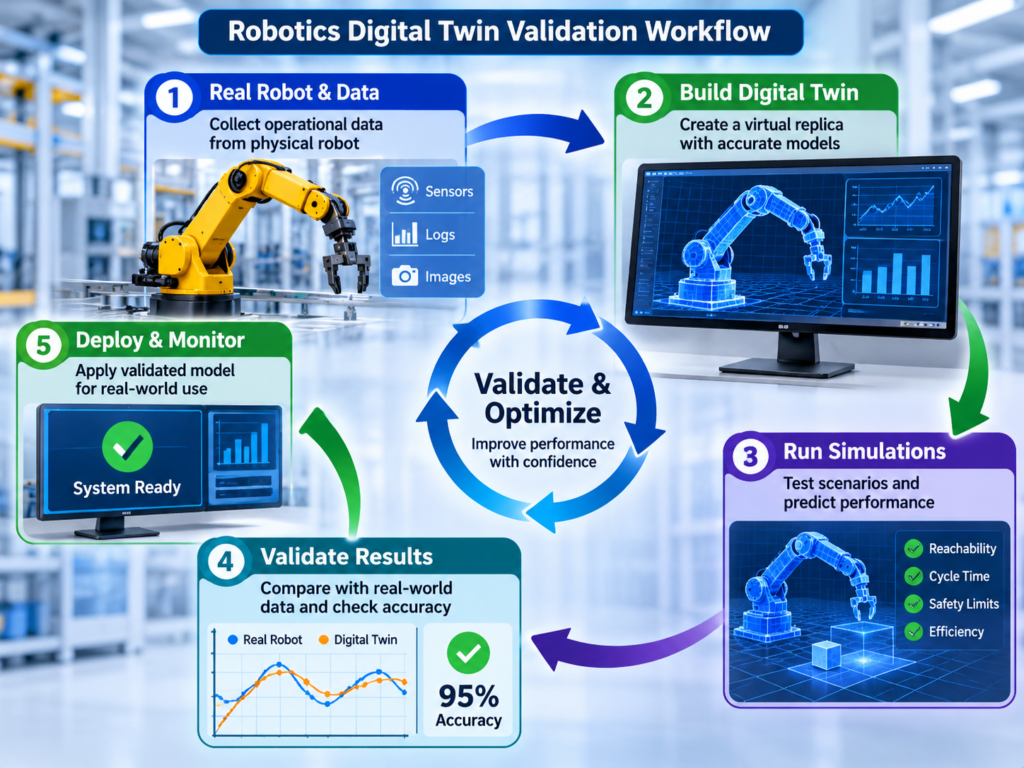
Building a digital twin for robotics testing starts with a well-defined robot, environment, and validation objective.
A practical approach involves modelling the system, connecting its software and data, and comparing simulation results with physical measurements.
Model Robot Geometry and Environment
Import the robot from CAD, URDF, or Open USD assets. Define joint limits, mass, inertia, collision meshes, actuators, and relevant environmental properties.
For a warehouse robot, the model might include shelving, aisle widths, wheels, and floor characteristics
Connect ROS 2, Sensors and Controllers
Configure the ROS 2 interfaces, simulated sensors, controller connections, and telemetry required for testing.
Secure data connections should be established wherever physical-system synchronization is necessary.
Custom Python development services can support telemetry processing and automated testing.
Establish measurable acceptance criteria and run repeatable scenarios.
Compare simulation outputs with physical robot measurements, investigate differences, and update model parameters when results exceed agreed tolerances.
Example: Warehouse Robot Validation
Consider an illustrative pilot involving a differential-drive robot moving through a 20-metre warehouse aisle.
The engineering team might define these acceptance targets.
|
Metric |
Example target |
|---|---|
| Positioning error | Below 10 cm |
| Collision performance | Zero collisions in 100 defined trials |
| Task completion rate | Above 95% |
These values are illustrative project targets, not measured results or universal robotics safety requirements.
The team should first establish whether the simulated environment reflects actual robot behavior closely enough for these tests to be meaningful.
Best Digital Twin Robotics Software and Tools
Choosing software depends on the robot type, control architecture, sensor requirements, simulation complexity, and available engineering resources.
Several established tools support robotics simulation and digital twin workflows.
NVIDIA Isaac Sim vs. Gazebo
NVIDIA Isaac Sim supports GPU-accelerated robotics simulation, perception testing, and synthetic data generation. It is relevant to robotics AI development and visually complex environments.
Gazebo is an open-source simulator commonly used with ROS-based robotic systems. It supports physics modelling, sensors, and general robotics testing.
Isaac Sim can be attractive for perception-intensive applications, while Gazebo is often a practical choice for ROS-focused testing and research.
ROS 2, MuJoCo and MATLAB/Simulink
ROS 2 is robotics middleware rather than a standalone physics simulator. It connects robotic software components and supports communication across distributed systems.
MuJoCo focuses on physics simulation and articulated-system dynamics.
MATLAB/Simulink supports mathematical modelling, control development, and model-based verification.
For organizations integrating multiple simulation services, back-end development services may help connect telemetry pipelines, control interfaces, and enterprise systems.
Industrial Simulation Platforms
Siemens Tecnomatix, ABB Robot Studio, and Robo DK are also relevant to industrial robotics workflows.
Siemens platforms support manufacturing process simulation and virtual commissioning. ABB Robot Studio provides programming and simulation capabilities for ABB robots, while Robo DK supports offline programming for compatible robot brands.
|
Platform |
Primary application |
Licensing |
|---|---|---|
| NVIDIA Isaac Sim | AI robotics and perception | Check current terms |
| Gazebo | General robotics simulation | Open source |
| MuJoCo | Dynamics and control research | Open source |
| MATLAB/Simulink | Control modelling and validation | Commercial |
| Industrial platforms | Robot cells and commissioning | Vendor-dependent |
Compatibility, hardware requirements, integration support, and licensing should be checked for the exact software version before selection.
Industrial Robotics and Virtual Commissioning
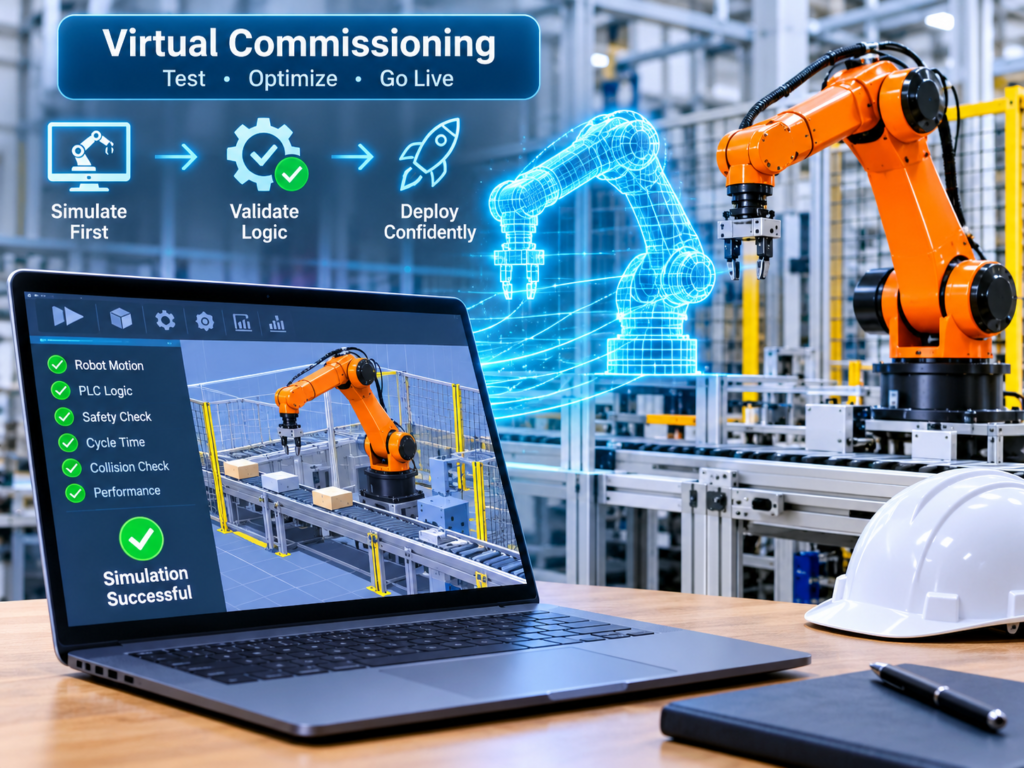
Virtual commissioning enables engineers to test automation logic and robotic operations before physical production startup.
It can uncover layout conflicts, controller integration problems, and unexpected process interactions earlier in a project.
Manufacturing and Robotic Work cells
Automotive manufacturers can simulate welding, assembly, material handling, and robot motion within industrial workcells.
Testing different equipment layouts and movement sequences virtually may reduce rework during physical commissioning.
However, actual machinery still requires appropriate safety assessment and on-site validation.
Warehouse Robotics and Fleet Testing
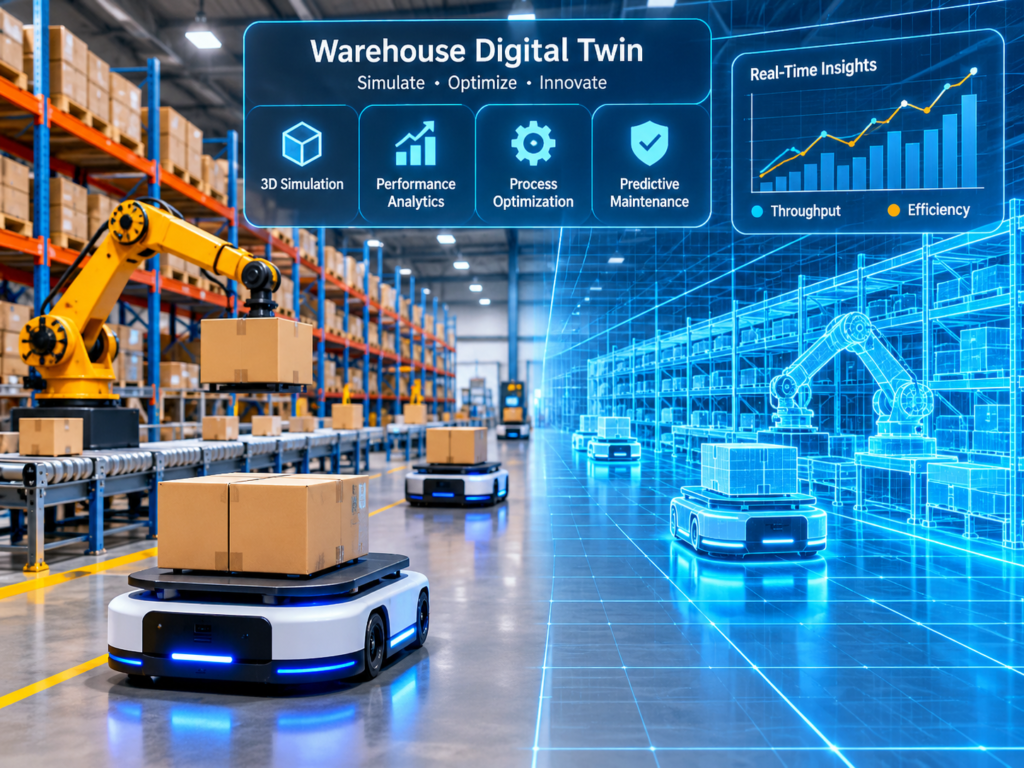
Warehouse digital twins can simulate autonomous mobile robots, routing conflicts, congestion, and fleet scheduling.
Engineers can evaluate how robot behavior changes as traffic patterns or environmental conditions vary.
A business intelligence solution may also help present simulation results, operational telemetry, and performance trends in accessible dashboards.
Costs and Business Value
Digital twin implementation expenses may include software licensing, computing infrastructure, engineering hours, controller interfaces, and model maintenance.
Potential business value comes from reduced rework, fewer unnecessary physical tests, improved commissioning efficiency, and better fault investigation.
These benefits should be measured against a documented baseline rather than assumed in advance.
Robotics Digital Twins in the USA, UK, Germany and EU
Robotics digital twin adoption takes different forms depending on local industries, existing infrastructure, and regulatory requirements.
USA.
The United States has established robotics research and industrial automation communities.
Boston and Pittsburgh are important robotics research environments, while Detroit provides a strong manufacturing context.
US engineering teams may apply digital twins to warehouse navigation, autonomous systems research, robotic work cells, and AI testing.
UK.
Manufacturers in industrial centers such as Birmingham and Sheffield may use virtual commissioning to evaluate automation changes before modifying production equipment.
Robotic systems involving cameras, employee-related telemetry, or identifiable personal information should also consider applicable UK data protection obligations.
The UK Information Commissioner’s Office provides guidance on UK GDPR requirements.
Germany and EU.
Germany’s manufacturing ecosystem makes robotics digital twins particularly relevant to factory integration and industrial automation.
Engineering centers such as Stuttgart and Munich have strong connections to automotive production and manufacturing technology.
In Industry 4.0 projects, concepts such as Digitalis Zwilling and virtually Inbetriebnahme describe digital twins and virtual commissioning.
EU projects should assess applicable machinery safety standards and data protection requirements, including ISO 10218, ISO 3691-4, and GDPR where relevant.
The EU Machinery Regulation (EU) 2023/1230 generally becomes applicable on 20 January 2027, with certain provisions applying earlier. Until the transition, the existing Machinery Directive remains relevant to machinery placed on the EU market.
Regulatory requirements depend on the equipment and its intended use. Digital twin testing does not replace mandatory conformity assessment.
Choosing and Deploying a Robotics Digital Twin
A successful deployment should begin with a specific engineering problem rather than an unnecessarily complex digital model.
For example, a warehouse operator might first investigate navigation accuracy, while a manufacturer could focus on robotic work cell collisions or controller integration.
Essential Features and Security Checklist
Before selecting a platform, evaluate.
Simulation fidelity and reproducibility
ROS 2 and controller compatibility
Sensor and telemetry integration
Data synchronization requirements
Access controls and cybersecurity
Maintenance effort and total lifecycle cost
Connected robotic infrastructure can introduce security risks, particularly where simulation platforms communicate with production equipment.
Our robot security guide discusses relevant cybersecurity considerations.
Pilot Deployment and ROI
Start with one robot, a defined environment, and a limited collection of scenarios.
Measure validation accuracy, engineering effort, software expenses, and avoidable physical testing time.
Expand the digital twin only after the pilot demonstrates useful and reliable results.
When Specialist Support Makes Sense
Complex robotics deployments may involve PLC integration, custom sensors, distributed telemetry, dashboards, and enterprise applications.
Specialist software engineering support may help connect these components securely and maintainable.
Relevant services include Node.js development and custom web application development.
Concluding Remarks
A digital twin for robotics can improve testing, support better engineering decisions, and help teams identify problems before modifying real equipment.
Its value depends less on visual sophistication and more on model accuracy, useful operational data, repeatable validation, and clear acceptance criteria.
For organizations planning robotics simulation or virtual commissioning, starting with a focused testing problem is often the most practical approach.
Mak It Solutions can discuss the software integration, telemetry, and analytics requirements involved in developing a connected robotics testing workflow. Contact Mak It Solutions to discuss a scoped technical consultation.
Key Takeaways
A robotics digital twin uses physical-system data to keep a virtual model relevant.
SIL and HIL testing help expose software and integration problems before full deployment.
Physics models and synthetic sensors support repeatable tests but require physical validation.
Isaac Sim, Gazebo, MuJoCo, and industrial platforms address different engineering needs.
A focused pilot helps evaluate accuracy, complexity, and return on investment.
Cybersecurity, data protection, and machinery safety remain essential deployment considerations.
FAQs
Q : Can a robotics digital twin work without continuous internet access?
A : Yes. A digital twin can run locally if its simulation software, models, controllers, and data storage are available on-premises. When physical-system connectivity is interrupted, engineers should distinguish live measurements from previously synchronized data.
Q : What sensor data does a robot digital twin need?
A : Data requirements depend on the robot and testing objectives. Common inputs include joint encoders, wheel odometry, IMU measurements, cameras, LiDAR, motor feedback, and controller status. Accurate timestamps and calibration are essential for reliable comparisons.
Q : Does a digital twin for robotics require an expensive GPU?
A : Not necessarily. Basic kinematics, control simulations, and lightweight environments can run on conventional computers. Photorealistic rendering, synthetic perception data, and large-scale AI training may require more powerful GPU infrastructure.
Q : How often should a robotics digital twin be recalibrated?
A : There is no universal interval. Recalibration depends on sensor stability, equipment wear, environmental changes, and acceptable error limits. Significant maintenance, sensor replacement, or unexpected model drift should trigger additional validation.
Q : Can existing industrial robots connect to digital twins without controller replacement?
A : Often, yes. Supported manufacturer APIs, industrial protocols, gateways, or read-only telemetry connections may allow integration. Older controllers can impose limitations, so monitoring and offline simulation may be more practical than direct real-time control.