

Geopatriation: The New Rules of Tech Sovereignty
Geopatriation: The New Rules of Tech Sovereignty
Geopatriation: The New Rules of Tech Sovereignty
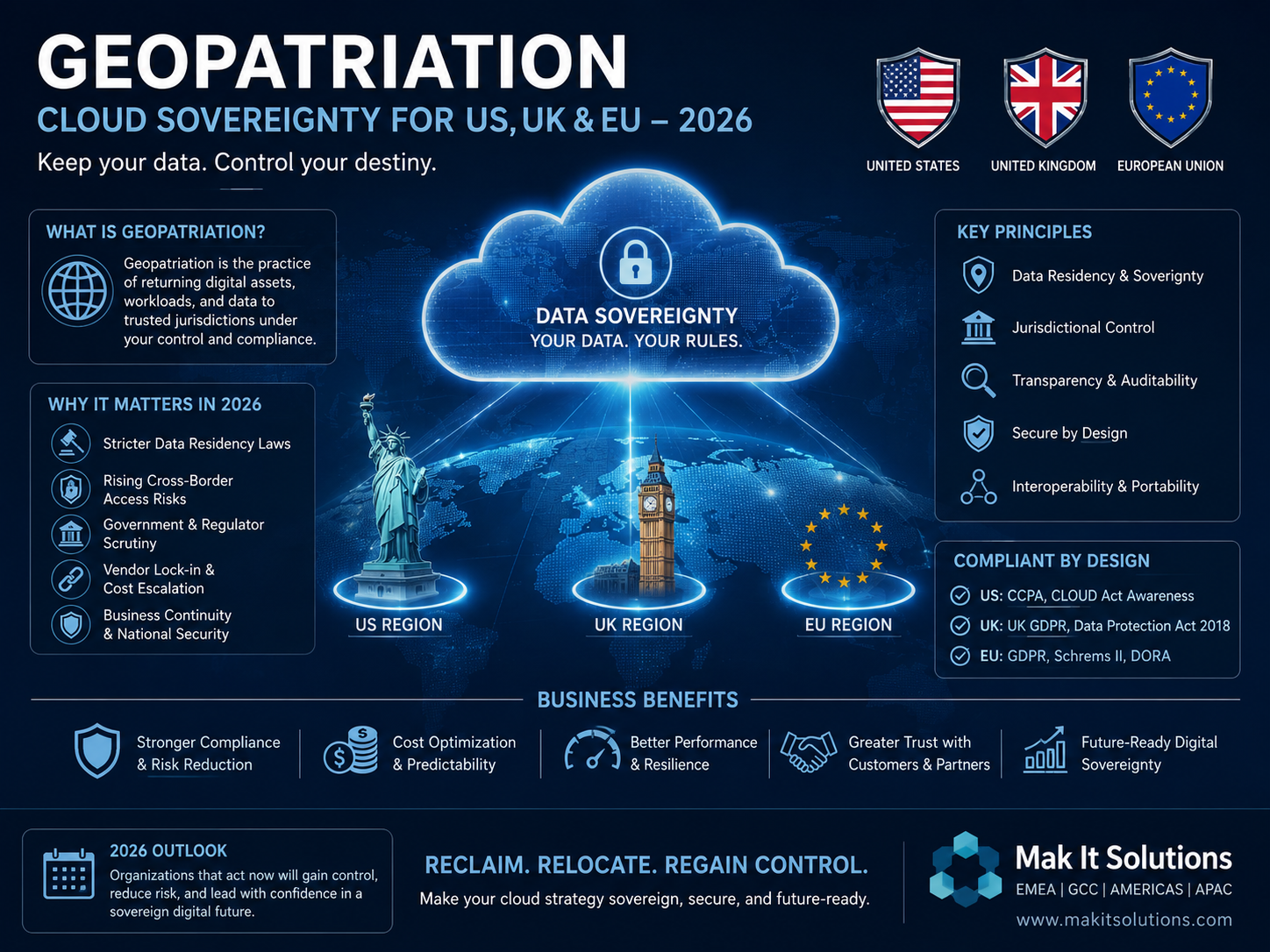
Geopatriation is changing how enterprises think about cloud architecture, AI infrastructure and digital sovereignty. Instead of choosing technology only for scale, price or convenience, organizations are increasingly asking a harder question: who legally, technically and operationally controls the systems the business cannot afford to lose?
In practical terms, geopatriation means selectively moving or restructuring data, applications and technology dependencies toward sovereign, regional or domestic environments to reduce geopolitical and jurisdictional risk. Gartner identifies geopatriation as a top strategic technology trend for 2026, describing the movement of workloads away from global public clouds toward sovereign clouds, regional providers or on-premises infrastructure when geopolitical exposure becomes material.
The key word is selectively. Geopatriation is not a reason to abandon global cloud platforms. It is a framework for deciding which technology dependencies need stronger control.
What Is Geopatriation in Cloud Computing?
Geopatriation in cloud computing is the selective relocation or restructuring of workloads to reduce exposure to foreign jurisdictions, geopolitical disruption and strategically important cloud dependencies.
An organization might use sovereign cloud services, regional providers, private infrastructure or carefully segmented hyperscaler environments depending on the sensitivity of each workload.
Why Geopatriation Is Emerging
Cloud resilience used to focus heavily on availability, backups and disaster recovery. Those concerns remain important, but technology leaders increasingly need to consider jurisdiction, provider concentration, foreign access, supply-chain exposure and operational dependency as well.
The scale of public cloud makes the issue strategically significant. Gartner forecast worldwide public-cloud end-user spending at approximately $723.4 billion in 2025, compared with $595.7 billion in 2024.
Global hyperscalers still provide enormous advantages in scale, tooling and innovation. The question is not whether AWS, Microsoft Azure or Google Cloud are useful. It is whether every critical workload should depend on the same small group of global providers without a realistic alternative.
Geopatriation vs Cloud Repatriation
Cloud repatriation normally means moving workloads away from public cloud because of cost, performance, predictability or operational-control concerns.
Geopatriation has a different primary motivation: geopolitical exposure, sovereignty and jurisdictional control.
Put simply.
Cloud repatriation.
Where can this workload run most effectively?
Geopatriation.
Under whose jurisdiction and operational control should this workload run?
The strategies can overlap. A company could move an application from a hyperscaler to private infrastructure for both cost and sovereignty reasons, for example. But the business case behind each decision is different.
Why Geopolitical Risk Is Changing Cloud Strategy
Trade restrictions, sanctions, foreign disclosure requirements, technology concentration and cross-border disruption can all affect infrastructure decisions.
That does not mean every application belongs in a domestic data center. For most organizations, a governed multi-cloud strategy is more realistic: classify workloads according to sensitivity, jurisdiction and dependency risk, then apply stronger sovereignty controls only where they are justified.
How Geopatriation Changes Data and Cloud Sovereignty
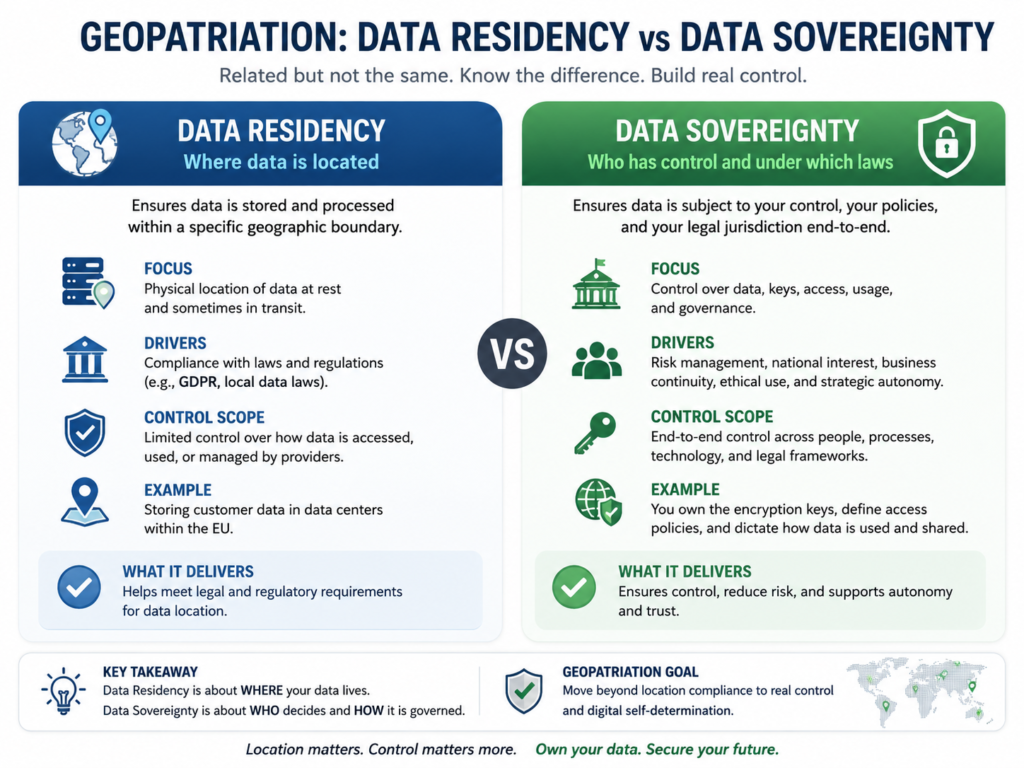
Geopatriation matters because storing data locally is not the same as controlling it.
A server may physically sit inside the required country while encryption keys, privileged administration, software control planes, support teams or legal authority remain elsewhere.
Data Residency vs Data Sovereignty vs Data Localization
These terms are related but should not be treated as interchangeable:
Data residency describes where data is physically stored.
Data localization refers to legal or policy requirements for certain data to remain within a defined geography.
Data sovereignty concerns the laws, authorities and operational controls governing that data.
A Frankfurt data-center address, therefore, does not automatically create Datensouveränität.
The Mak It Solutions sovereign cloud and data residency guide explores the same distinction from another regulatory-market perspective.
What Makes a Cloud Truly Sovereign?
A meaningful sovereign-cloud assessment should look beyond the region listed on a vendor’s website.
Evaluate.
Storage and processing location
Provider ownership and legal jurisdiction
Encryption-key ownership and control
Privileged administrator access
Support-personnel location
Identity and management-plane dependencies
Software-update authority
Workload portability
Backup and recovery independence
Practical exit options
Vendor lock-in becomes particularly important here. A workload can comply with a residency requirement while remaining almost impossible to operate independently of a foreign identity service, proprietary database or provider-controlled management plane.
Germany’s BSI now provides C3A criteria specifically designed to assess whether cloud services support autonomous, self-determined use, reinforcing the idea that sovereignty involves more than physical hosting location.
Compliance Is Necessary, but It Is Not Sovereignty
GDPR, UK GDPR, DORA, NIS2, the EU AI Act and sector-specific requirements can all influence technology architecture. Compliance, however, answers a different question from sovereignty.
Compliance asks whether defined regulatory obligations are being met.
Sovereignty asks: who ultimately controls the technology and the dependencies required to operate it?
This distinction is particularly important with global cloud providers. UK ICO guidance advises organizations to understand which legal entity they contract with and how personal information may move through a cloud provider’s global processor network.
A compliant architecture can still contain strategic dependencies that would be difficult to replace.
Why Sovereign AI Makes Compute a Geopatriation Issue
Sovereign AI extends geopatriation beyond traditional cloud infrastructure into training data, models, GPUs, deployment environments and AI operations.
An organization cannot have meaningful control over an AI system if it controls the dataset but has no practical control over the compute or platform needed to run it.

What Is Sovereign AI Infrastructure?
Sovereign AI infrastructure gives an organization, region or jurisdiction meaningful authority over the data, models, compute resources and operating environment behind AI workloads.
Depending on the use case, that could include.
Regional or domestic GPU capacity
Sovereign-cloud AI environments
Private model deployment
Customer-controlled data pipelines
Restricted administrative access
Policies preventing sensitive prompts or proprietary datasets from leaving approved environments
The correct architecture depends heavily on risk.
A public marketing assistant does not normally require the same controls as a clinical AI system, critical-infrastructure model or sensitive government workload.
GPU Capacity and Compute Sovereignty
AI sovereignty has a physical layer. Training and operating advanced models requires GPUs, networking, power, cooling and reliable semiconductor supply.
Europe is investing directly in this capacity. The European Commission says planned AI Gigafactories are expected to combine more than 100,000 advanced AI processors with substantial power, networking and supply-chain infrastructure.
Meanwhile, Gartner reported that the worldwide IaaS market reached approximately $171.8 billion in 2024, growing 22.5% year over year.
For enterprises operating from cities such as Frankfurt, London, Paris or Amsterdam, access to compute can therefore become a strategic dependency rather than simply a procurement decision.
When Sovereign AI Makes Sense
Sovereign AI is most relevant where the cost of losing jurisdictional, operational or intellectual-property control is unusually high.
Typical candidates include.
Government systems
Defense workloads
Healthcare environments
Critical infrastructure
Regulated financial operations
Highly sensitive enterprise models
Proprietary datasets or algorithms with significant strategic value
For ordinary low-risk workloads, imposing maximum sovereignty controls may add expense and complexity without producing equivalent business value.
The better approach is classification, not blanket migration.
The Missing Layer.
Data and compute alone do not make a technology estate sovereign.
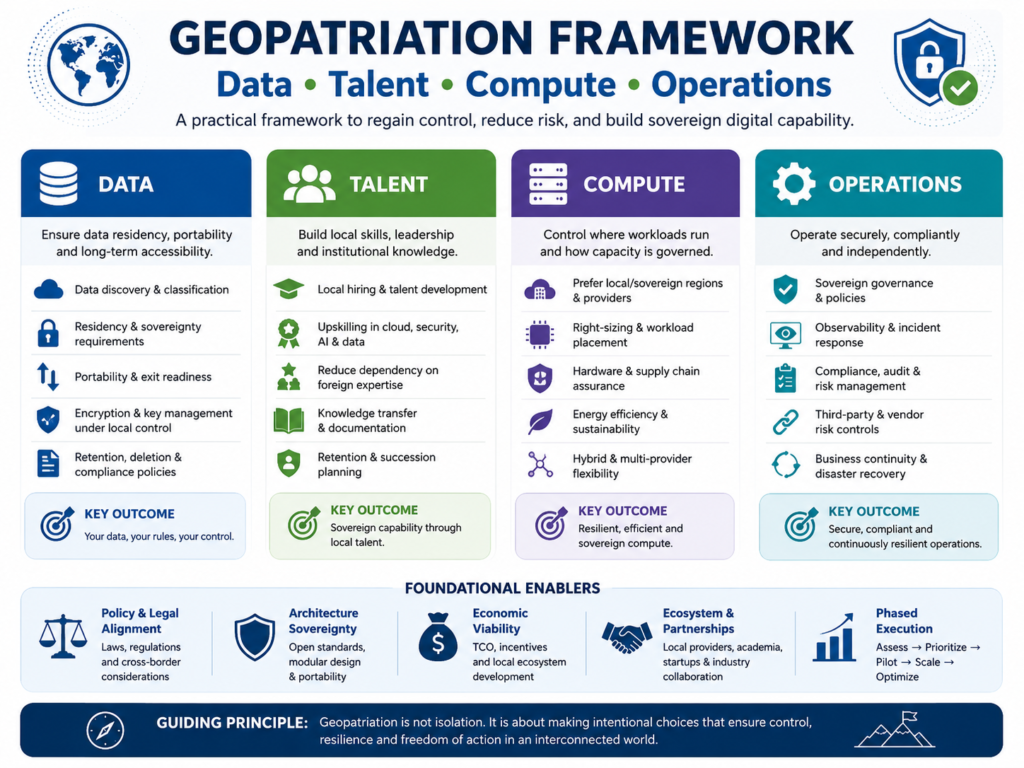
A useful way to think about geopatriation is through four connected dimensions:
Data → Talent → Compute → Operations
If one pillar remains completely dependent on a provider or jurisdiction the organization cannot replace, overall sovereignty may still be weak.
AI Talent Sovereignty and Digital Skills
Talent sovereignty means retaining enough internal, domestic or regional expertise to build, secure, maintain and recover strategically important systems.
That includes people such as.
AI engineers
Cybersecurity specialists
Platform engineers
Data architects
Cloud professionals
Infrastructure and networking specialists
Owning local GPU infrastructure has limited strategic value if no one within the approved operating model can maintain it without unrestricted dependence on an external party.
Organizations building internal capability can combine platform investment with business intelligence and analytics expertise and governed AI workflows instead of allowing one vendor to become the sole source of technology and operational knowledge.
Operational Sovereignty and Control-Plane Independence
Operational sovereignty asks practical questions.
Who can create administrator accounts? Who can rotate encryption keys? Who deploys updates? Who has emergency access? Can the company restore the system without contacting personnel in another jurisdiction?
These details often expose sovereignty gaps that are invisible on an infrastructure diagram.
A locally hosted system can still be operationally foreign-dependent if its identity platform, updates, support processes or management plane remain externally controlled.
Geopatriation in the USA, UK, Germany and EU
Geopatriation will not look identical in every market. Legal requirements, government priorities, risk tolerance and available infrastructure differ substantially.
USA.
In the United States, geopatriation is often more relevant as a resilience, sector-risk and concentration discussion than as a universal requirement to host every workload domestically.
Healthcare, payments, government and critical infrastructure each face different compliance and continuity requirements. The key architectural question is whether critical systems can remain secure and operational if a major provider, supply route or technology dependency becomes unavailable.
UK.
For UK organizations, sovereignty decisions intersect with UK GDPR, financial services, healthcare, public-sector procurement and international-transfer requirements.
A British cloud region alone does not answer the sovereignty question. Organizations also need visibility into the contracting entity, administrator access, sub-processors, support operations and onward transfers. The ICO specifically directs cloud customers to consider these issues when evaluating international transfers.
Germany and the EU.
Germany and the wider EU increasingly frame the issue through concepts such as digitale Souveränität, Datensouveränität, souveräne Cloud and KI-Souveränität.
NIS2, for example, establishes an EU-wide cybersecurity framework covering 18 critical sectors, while European initiatives around AI infrastructure are intended to expand regional compute capacity.
The strategic objective therefore goes beyond putting servers in Frankfurt or Berlin. It is about building enough technological, operational and human capability to avoid unacceptable dependence.
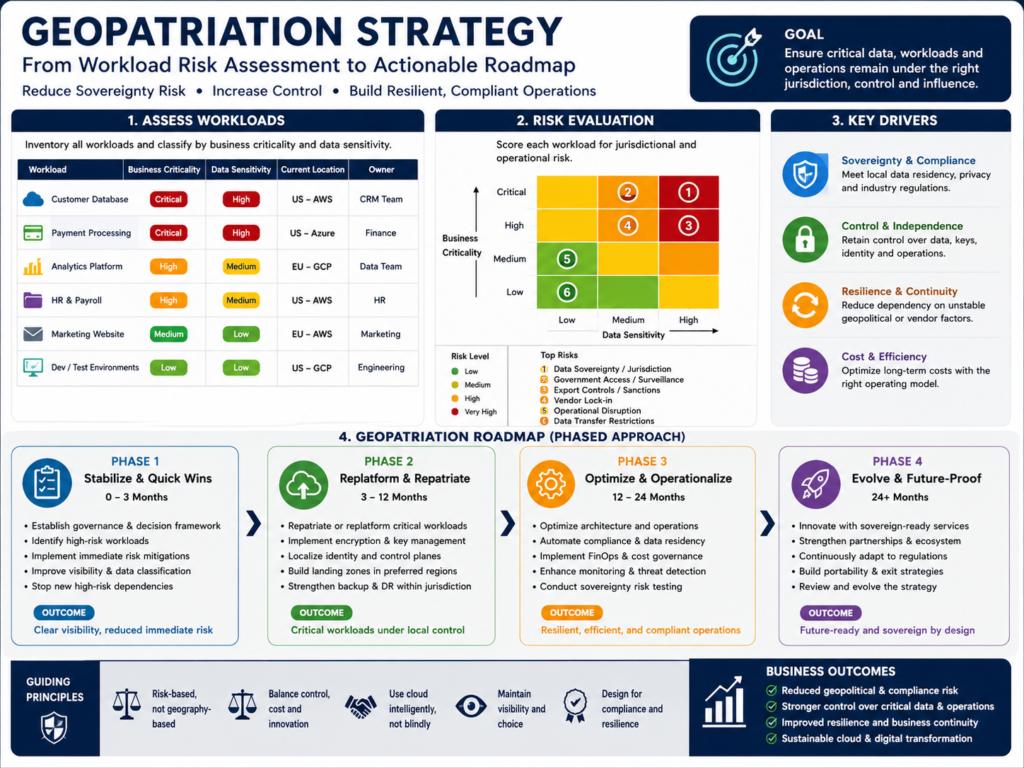
How to Build a Practical Geopatriation Strategy
A useful geopatriation strategy begins with workloads, not vendors.
The goal is to apply the least restrictive architecture that still gives the organization sufficient control over material business risk.
Classify Workloads by Sovereignty Risk
Separate applications into practical categories.
Global-ready.
Low-sensitivity systems that benefit from hyperscale reach and standard cloud economics.
Regional-control.
Workloads requiring stronger residency, resilience or governance controls.
Sovereign-required.
Highly regulated or strategically critical systems requiring strict jurisdictional and operational control.
Consider data sensitivity, business criticality, regulation, intellectual property and dependency concentration rather than classification by application name alone.
Evaluate Data, Talent, Compute and Operations Together
Assess every critical workload across the four sovereignty pillars.
Data: location, jurisdiction, access and encryption keys
Talent: expertise and privileged personnel
Compute: cloud, GPU and infrastructure dependencies
Operations: identity, updates, management planes, recovery and support
Security should be reviewed at the same time. The Mak It Solutions guide to cloud security misconfigurations can help identify technical weaknesses before architectural changes are made.
Choose the Appropriate Architecture
Compare available models instead of assuming that “sovereign” automatically means “private cloud.”
Options may include.
Global hyper scalers
Regional cloud providers
Sovereign cloud services
Private cloud
On-premises infrastructure
Hybrid environments
For many enterprises, the answer will be a combination.
A sensitive AI-training environment might require strong sovereign controls while a customer-facing website continues to run globally.
Before migration, conduct a sovereignty-readiness assessment and determine whether the organization has a credible exit path if its preferred provider becomes unsuitable.
The Future of Geopatriation and Digital Sovereignty
The sovereignty discussion is moving beyond one question “Where is our data?” toward a much broader one:
Which dependencies could stop us from controlling, securing or operating this system?
That means mapping applications, infrastructure, AI models, people, identities, management planes and technology supply chains together.
Will Geopatriation Replace Global Cloud?
No.
Geopatriation is more likely to create segmented technology estates than eliminate global cloud computing.
Global-ready applications can continue benefiting from hyper scaler economics and innovation. Strategically sensitive workloads can move toward sovereign, regional or more portable architectures.
This makes interoperability, open standards and realistic workload portability increasingly valuable.
What Technology Leaders Should Do Next
Start with visibility.
Audit jurisdictional dependencies. Map critical cloud and AI workloads. Identify provider concentration. Determine who controls encryption keys, administrator access, identity systems and management planes. Then test whether your supposed exit strategy would actually work.
The goal is not maximum sovereignty at any cost. It is enough sovereignty for the risk involved.
Mak It Solutions’ AI governance guidance and AI policy-as-code approach offer adjacent frameworks for converting governance requirements into operational controls.
Concluding Remarks
Geopatriation does not have to begin with an expensive migration.
Start by identifying where your most critical systems depend on jurisdictions, providers, people or control planes that would be difficult to replace. From there, you can prioritize the few dependencies that genuinely create material risk.
Mak It Solutions can help assess your geopatriation and sovereignty readiness, review cloud architecture and develop a phased roadmap around practical business priorities. Contact the team to discuss a scoped assessment.
Key Takeaways
Geopatriation is broader than data residency. It involves data, talent, compute and operational control.
Not every workload needs sovereign infrastructure; classify applications according to business and jurisdictional risk.
Compliance does not automatically create technology sovereignty.
Sovereign AI makes GPU capacity, model control and compute availability strategic concerns.
Hybrid architectures can preserve hyper scaler advantages while isolating sensitive workloads.
Provider assessments should consider encryption keys, administrator access, control planes, portability and credible exit options.
FAQs
Q : Does using a local cloud region guarantee data sovereignty?
A : No. A local region primarily addresses physical data residency. Sovereignty also depends on legal jurisdiction, administrator access, encryption keys, support operations, identity systems and management planes.
Q : Can a US hyper scaler provide sovereign cloud services in Europe?
A : Potentially, yes. A provider can design services with stronger local governance, operational separation and jurisdictional controls. Enterprises should still examine the actual contracting entities, personnel access, key-management model, software dependencies and control planes rather than relying on a “sovereign” product label alone.
Q : What workloads should an enterprise geopatriate first?
A : Start with workloads combining high sensitivity, significant regulatory exposure, operational criticality and difficult-to-replace external dependencies. Government, healthcare, payment, critical-infrastructure and proprietary AI systems are common candidates.
Q : Does geopatriation increase cloud and AI costs?
A : It can. Dedicated infrastructure, regional capacity, duplicated environments and specialized operating models may be more expensive than standardized hyperscale services.
Cost analysis should therefore include not only infrastructure spending but also concentration risk, regulatory exposure, migration difficulty, business interruption and provider-exit risk.
Q : How can a company measure hyper scaler dependency?
A : Map critical dependencies on proprietary databases, identity platforms, APIs, AI services, networking components and deployment pipelines. Then estimate the skills, effort and operational changes required to reproduce those workloads somewhere else.
A cloud exit plan is credible only when the organization has a realistic way to execute it—not when portability exists merely on paper.