


Microservices vs Monolith for Scaling Teams
Microservices vs Monolith for Scaling Teams
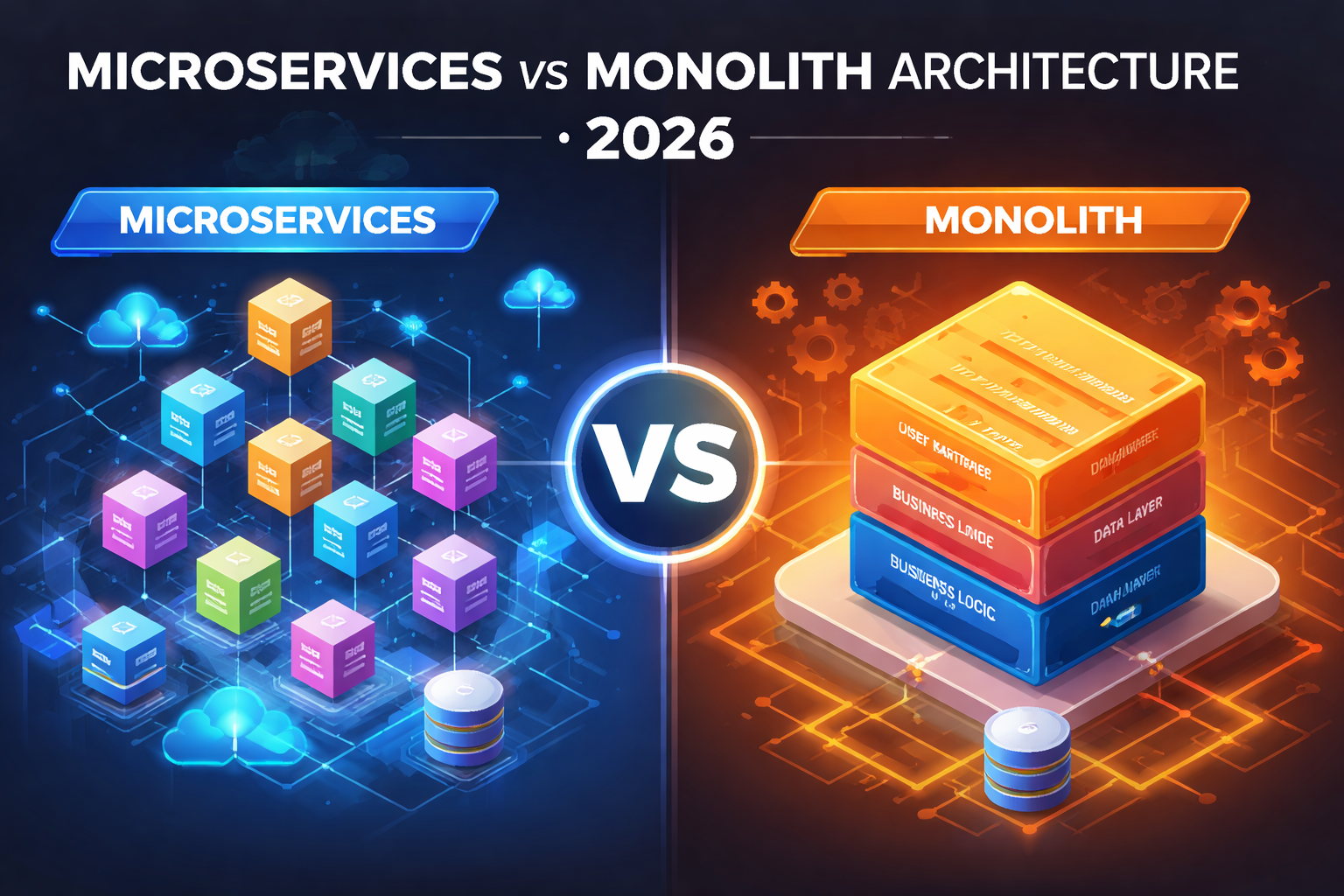
Microservices vs Monolith for Scaling Teams
Choosing between microservices vs monolith is not really about following trends. It is about picking the architecture your team can build, ship, secure, and operate without slowing the business down.
Here is the practical answer: a monolith is usually the better fit for smaller teams, earlier-stage products, and companies that need speed with less operational overhead. Microservices make more sense when multiple teams need autonomy, parts of the system scale differently, and the organization already has the engineering maturity to handle distributed systems. CNCF’s 2024 survey found cloud-native adoption remains high, while Flexera’s 2025 State of the Cloud reporting shows cloud spend control is still a major challenge, which is exactly why architecture decisions need to balance ambition with operating cost.
For SaaS founders, CTOs, and engineering managers in the US, UK, and EU, this decision affects release speed, hiring, platform complexity, compliance design, and long-term cost. Teams in New York, London, Berlin, and Frankfurt may face different regulatory pressures, but the core question stays the same: do you need simplicity right now, or do you genuinely need separation?
Microservices vs Monolith: The Fast Answer
What is a monolith?
A monolith is a single application deployed as one unit. That does not mean it is old-fashioned. A well-built monolith can still use modern CI/CD, containers, modular code, managed cloud services, and strong observability.
What are microservices?
Microservices split an application into smaller services, each responsible for a specific business capability. Those services are typically deployed independently and communicate through APIs or events.
Which one fits most teams in 2026?
For most teams, the answer is still straightforward.
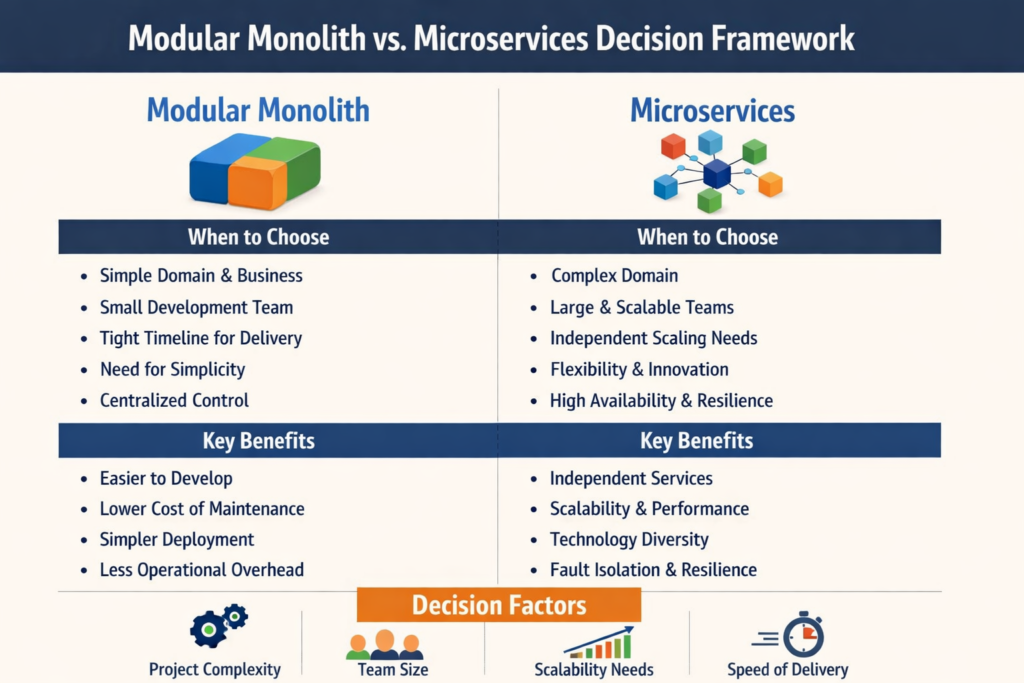
Choose a monolith when speed, focus, and lower ops overhead matter most.
Choose microservices when team boundaries are clear, independent deployment matters, and scaling patterns differ across domains.
Choose a modular monolith when you want cleaner boundaries now without taking on full distributed-system complexity yet.
Core Differences Between Microservices and Monoliths
The biggest difference in the microservices vs monolith debate is not code style. It is operational reality.
In a monolith, most of the application moves through one deployment path. Testing is usually more centralized, onboarding is simpler, and debugging is easier because fewer moving parts are involved.
In microservices, teams can own domains more cleanly. Billing can evolve without blocking identity. Reporting can scale separately from checkout. That independence is valuable, but it comes with more runtime components, more APIs, more monitoring, and more coordination around contracts and incidents.
Where monoliths win
Monoliths usually work better when.
One team owns most of the product
Product requirements are changing quickly
The company is still validating product-market fit
Cloud budgets are under pressure
Platform engineering capacity is limited
A lot of teams underestimate how far a good monolith can go. With caching, queues, read replicas, and horizontal scaling, one deployable application can serve a surprisingly large business.
Where microservices win
Microservices tend to win when.
Several teams ship to production frequently
One workload grows much faster than the rest
Fault isolation matters at the domain level
Release cycles differ significantly between parts of the platform
Compliance controls benefit from stronger workload separation
That does not mean microservices are automatically faster. Independent deployment only pays off when automation, service boundaries, and observability are already mature.
Why Independent Deployment Changes Everything
Independent deployment sounds like pure upside. In practice, it changes how engineering works day to day.
Once services are split, you need to think harder about.
Versioning between services
Rollback strategy
Service discovery
Secrets management
Tracing across requests
Contract testing
Incident ownership
That is one reason microservices are often paired with Kubernetes, service meshes, and richer observability stacks. But infrastructure maturity does not erase complexity. It simply gives you better tools to manage it. Cloud-native adoption may be broad, but that does not reduce the need for disciplined operations.
When to Choose Microservices vs Monolith
Startups and smaller SaaS teams
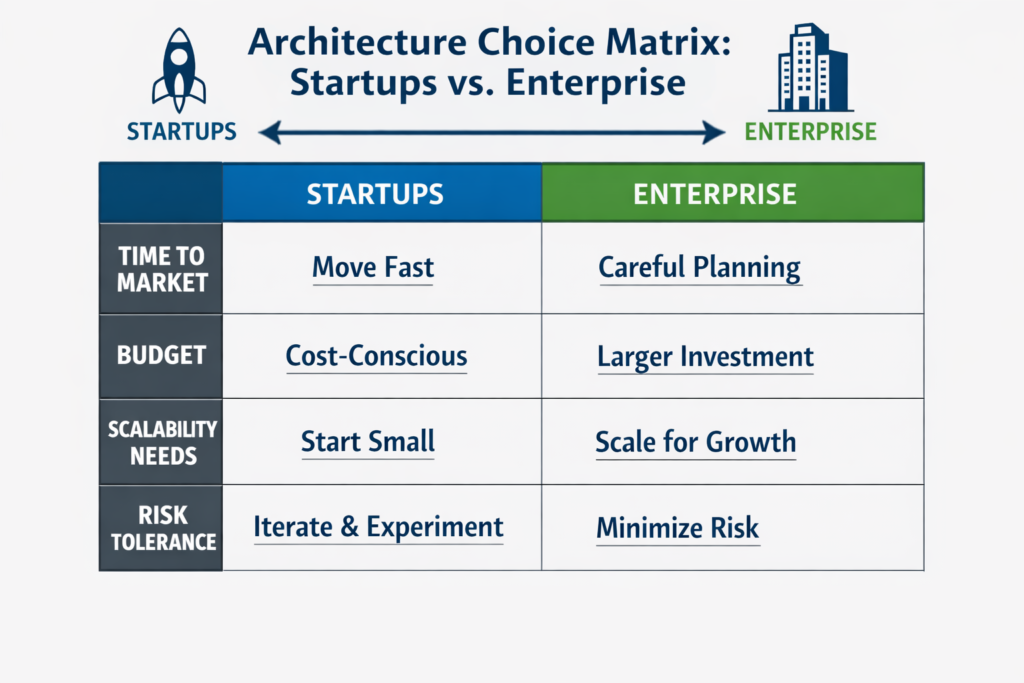
If you have a lean engineering team and you are still shipping fast, a monolith is usually the right default.
For a startup in Austin or San Francisco, the real risk is often not “we are too monolithic.” It is “we built too much architecture before we proved the product.” A single codebase is easier to reason about, easier to change, and usually cheaper to run in the first phase of growth.
Larger teams and multi-domain products
Microservices become more compelling when the company has multiple squads, stable domain ownership, and enough platform maturity to support them.
A fintech team in London, for example, may separate onboarding, payments, fraud, and reporting because those areas have different release cadences, scaling needs, and control requirements. That is a real business reason to split services. Fashionable architecture is not.
A better decision framework for 2026
Ask these five questions before choosing.
How many teams need to change the system every week?
Which parts of the platform scale differently?
Where do failures need stronger isolation?
Do we have the tooling and people to operate distributed systems well?
Is our real problem code structure, or cross-team coordination?
If your pain is mostly speed and uncertainty, a monolith is often enough. If your pain is mostly coordination, ownership, and asymmetrical scaling, microservices deserve a closer look.
The Middle Ground: Modular Monolith vs Microservices
A modular monolith gives many teams the best balance.
It keeps one deployable application while enforcing strong internal boundaries. Billing, notifications, user management, and reporting can each live in separate modules with clear interfaces and ownership.
That matters because many companies do not need distributed services yet. They need better boundaries.
Why modular monoliths are getting more attention
For Series A and Series B SaaS companies, a modular monolith often solves the real problem.
Cleaner code organization
Less accidental coupling
Simpler deployment
Lower infrastructure overhead
Easier future extraction of services
In practice, this is often the smartest route. You keep delivery speed today while preparing for selective decomposition later.
Cost, Complexity, and Scalability in Real Teams
The hidden side of the microservices vs monolith decision is cost.
Microservices usually increase.
Infrastructure count
CI/CD pipeline count
Dashboards and alerts
Security surfaces
Engineering time spent on platform work
That matters because cost control is not a small issue anymore. Flexera’s 2025 State of the Cloud coverage says 84% of organizations see managing cloud spend as a top challenge. Service sprawl can make that worse when tagging, rightsizing, and ownership are weak.
A monolith, on the other hand, concentrates change into one deployment path. That can become a bottleneck eventually, but it also avoids many distributed-system problems: network latency, retries, partial failure, and harder debugging.
From a business point of view, the wrong architecture is often the one your team cannot run efficiently.
Migration Paths: Moving from Monolith to Microservices Safely
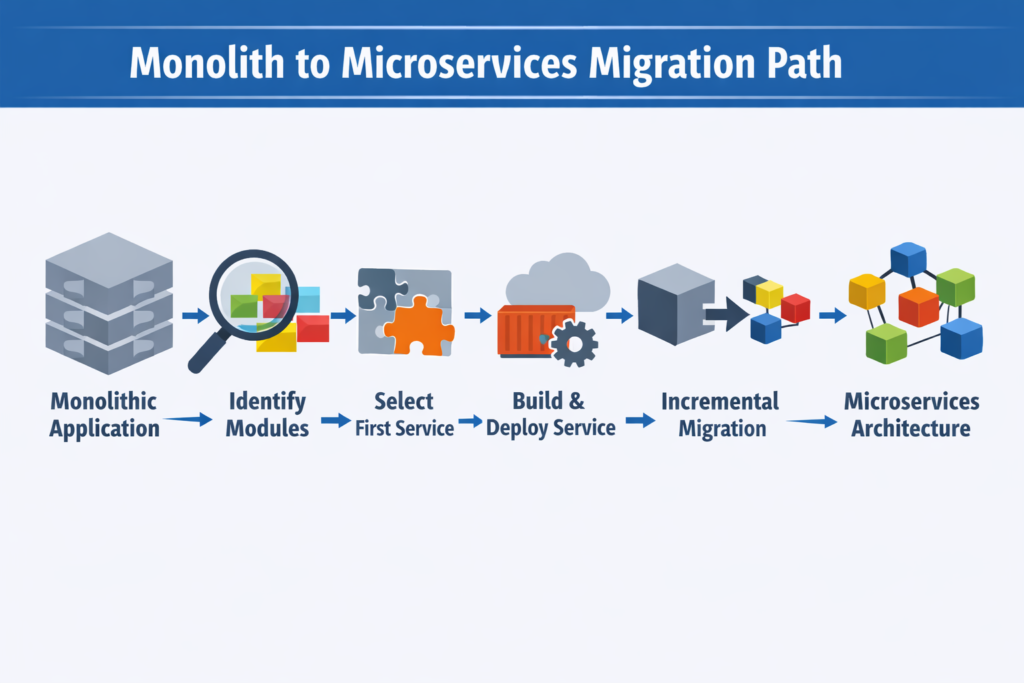
Most teams should not rewrite everything at once.
The safer route is incremental extraction. Look for one domain that is high-change, high-scale, or high-friction. Put a boundary around it. Move it behind an interface. Shift traffic gradually. Then learn from the result before extracting more.
Signs your monolith is becoming a bottleneck
Watch for signs like.
Long release trains
Fragile deployments
Recurring merge conflicts
Too many unrelated changes in one release
Teams waiting on each other to ship
One domain repeatedly blocking the rest of the product
Those are often boundary problems before they are “microservices problems.”
The biggest migration mistake
The most common mistake is splitting too early and splitting badly.
Teams often break systems apart by technical layer instead of business domain. That creates chatty services, unclear ownership, and expensive operational overhead. A better path is to extract one meaningful business capability first and prove that the new boundary creates measurable value.
US, UK, and Germany/EU Decision Factors
Architecture choices are not only technical. They also shape how teams handle compliance and operational risk.
US teams
For healthcare and payments products, workload separation can support better governance, but only if the controls are consistent. HHS says the HIPAA Security Rule requires administrative, physical, and technical safeguards for electronic protected health information, while PCI DSS provides baseline technical and operational requirements to protect payment account data.
UK teams
UK fintech and health-tech teams often need to think about resilience and supplier risk as part of architecture planning. The FCA says firms must manage outsourcing and third-party arrangements in a way that reduces operational disruption, and the NHS Data Security and Protection Tool kit is required for organizations with access to NHS patient data and systems.
Germany and the wider EU
In Germany and across the EU, architecture decisions often intersect with GDPR security expectations, auditability, and cloud oversight. EUR-Lex’s GDPR materials emphasize appropriate technical and organisational measures for protecting personal data, and BaFin states that cloud computing and cloud services are very significant from a supervisory perspective.
For teams in Berlin, Munich, or Frankfurt, that usually means the best architecture is the one that makes accountability and control easier to demonstrate, not the one that sounds most modern.

Best Architecture by Business Scenario
Best fit for startups and product-led SaaS
Choose a monolith or modular monolith when.
The team is small
Product direction is still shifting
Speed matters more than service autonomy
Cloud cost needs tighter control
Best fit for enterprise platforms and regulated products
Choose microservices when
Domain ownership is stable
Platform tooling is already mature
Independent release cycles create real value
Fault isolation is business-critical
Segmentation helps with governance and risk management
A practical recommendation matrix
| Scenario | Best Default Choice | Why |
|---|---|---|
| Early-stage startup | Monolith | Fastest path to shipping and learning |
| Series A/B SaaS | Modular monolith | Better structure without distributed overhead |
| Multi-team enterprise platform | Microservices | Clearer ownership and independent delivery |
| Regulated product with strong platform maturity | Microservices | Better segmentation and domain-level controls |
| Regulated product with a small team | Modular monolith | Easier governance without service sprawl |
To Sum Up
Choosing between microservices and a monolith in 2026 comes down to fit, not fashion. A monolith often works best for startups and lean SaaS teams that need speed, simplicity, and lower operational overhead. Microservices become valuable when multiple teams need autonomy, domains scale differently, and the business can support the added complexity of distributed systems.
For many companies, the smartest path is not extreme. A modular monolith can provide cleaner boundaries today while keeping future migration options open. The best architecture is the one your team can build, run, secure, and improve consistently as the product and organization mature.( Click Here’s )
Key Takeaways
The best answer to microservices vs monolith in 2026 is rarely ideological.
A monolith is still the smartest choice for many teams. Microservices are powerful, but only when the business and the organization are ready for them. And for a large number of SaaS companies, the real sweet spot is a modular monolith that improves boundaries now and leaves room for selective extraction later.
If your team is deciding between microservices vs monolith, start with the architecture you can operate confidently, secure consistently, and evolve without drama. That is usually the architecture that creates the most business value.
FAQs
Q : Is a monolith outdated in 2026?
A : No. A monolith is not outdated if it is well-structured, tested, and deployable with confidence. Many modern SaaS products still run successfully on monoliths because simplicity can be a real competitive advantage.
Q : Can a monolith still be cloud-native?
A : Yes. A monolith can still use containers, CI/CD, autoscaling, managed services, and modern observability. Cloud-native practice is about how you build and operate software, not just how many services you split it into.
Q : How many engineers do you need before microservices make sense?
A : There is no universal number. What matters more is whether you have multiple teams with distinct domains, different release cycles, and enough platform maturity to support the added operational load.
Q : Do microservices automatically improve compliance?
A : No. They can improve segmentation and isolation, but they also increase the number of components, APIs, logs, and configurations that need governance. Compliance gets better only when architecture and operating controls mature together.
Q : What is the safest way to move from a monolith to microservices?
A : Usually, it is a gradual migration. Extract one meaningful domain at a time, validate the boundary in production, and expand only when the gains are clear.
[…] best developer productivity metrics in 2026 sit across three areas: delivery, quality, and developer […]