


Semantic Topic Clusters for Smarter SEO Growth
Semantic Topic Clusters for Smarter SEO Growth

Semantic Topic Clusters for Smarter SEO Growth
Semantic topic clusters help websites organize content around meaning, entities, user intent, and internal links instead of isolated keywords. They make it easier for Google, AI Overviews, Chat GPT, Gemini, and other answer engines to understand what your brand knows and which pages support that expertise.
For SEO teams, the practical goal is simple: turn scattered pages into a connected content hub. A strong semantic cluster connects pillar pages, supporting articles, service pages, schema markup, regional context, and trust signals so both humans and machines can follow the logic.
Why Semantic Topic Clusters Matter in 2026
Search has moved beyond exact-match keywords. Keywords still matter, but modern SEO depends heavily on context, entities, relationships, and usefulness.
That shift matters for B2B SaaS, healthcare, fintech, ecommerce, agencies, and enterprise websites across the United States, United Kingdom, Germany, and the wider European Union. Google AI Overviews began rolling out broadly in the U.S. in May 2024, and Google describes them as AI-generated snapshots with links for deeper exploration.
Global internet usage reached 5.56 billion people at the start of 2025, according to DataReportal. That scale makes clear content architecture more important than ever: your website must help readers, search engines, and AI systems quickly understand your expertise.
From keyword SEO to entity-based visibility
Traditional SEO often starts with keywords. Semantic SEO starts with meaning.
Instead of only targeting phrases like “SEO tools” or “best SEO software,” semantic clustering connects related ideas such as.
Technical SEO
Schema markup
Internal linking
Content hubs
Search intent
AI Overviews
Topical authority
Local and regional SEO
This creates a clearer knowledge map around the subject.
How semantic topic clusters support answer engines
Semantic topic clusters make every page’s role easier to understand. Pillar pages explain broad topics. Cluster pages answer specific questions. Service pages show commercial relevance. Internal links connect the full journey.
In simple terms, semantic clusters turn a website from a list of blog posts into a mapped knowledge system.
What Are Semantic Topic Clusters?
Semantic topic clusters are groups of connected pages organized by meaning, entities, and search intent. In SEO, they help search engines understand how deep, useful, and structured your expertise is.
A basic keyword cluster might group “SEO tools,” “best SEO tools,” and “SEO software.” A semantic topic cluster goes further by connecting those phrases to technical SEO, structured data, content strategy, AI search visibility, analytics, and user intent.
For service businesses, this approach can connect strategy, content, analytics, and implementation pages. For example, Mak It Solutions’ SEO services can be supported by articles around semantic SEO, technical optimization, local visibility, and AI search readiness.
Semantic topic clusters vs keyword clusters
| Area | Keyword Clusters | Semantic Topic Clusters |
|---|---|---|
| Main focus | Similar search terms | Meaning, entities, and intent |
| Structure | Keyword groups | Pillar pages, cluster pages, links |
| SEO value | Search demand mapping | Topical authority and AI visibility |
| Best use | Content planning | Full content architecture |
Keyword clusters are still useful. They show demand. But semantic topic clusters show relationships, context, and depth.
What are semantic topic clusters?
Semantic topic clusters are connected content groups built around meaning, not just matching keywords. They help search engines and AI answer engines understand how your pages relate to a topic, a user need, and a broader area of expertise.
Semantic SEO Foundations for Topic Clustering
Semantic SEO is the practice of helping search engines understand context, relationships, and real-world meaning. Google says structured data helps it understand page content and gather information about entities such as people, organizations, products, and other items on the web.
This is where semantic keyword mapping becomes useful. You are not just collecting synonyms. You are identifying the wider vocabulary around the topic.
That may include.
Entity-based content strategy
Pillar page and cluster models
Internal linking architecture
Topical authority building
Schema markup
Content hubs
AI search visibility
Regional search intent
Entity-based SEO and search context
For a fintech website, the entity map may include Open Banking, FCA, BaFin, PCI DSS, fraud detection, customer onboarding, and data residency.
For healthcare, it may include HIPAA, NHS, patient portals, clinical workflows, accessibility, and secure cloud hosting.
For ecommerce, it may include product categories, buyer questions, shipping regions, returns, reviews, and seasonal demand.
USA, UK, Germany, and EU
A U.S. SaaS company in Austin may need HIPAA or SOC 2 content. A London agency may need UK-GDPR and FCA context. A Berlin fintech may need BaFin, GDPR/DSGVO, and EU data residency pages.
Small details like spelling, regulations, locations, and proof points help semantic clusters feel locally relevant.
Topic Clusters, Pillar Pages, and Content Hub Architecture
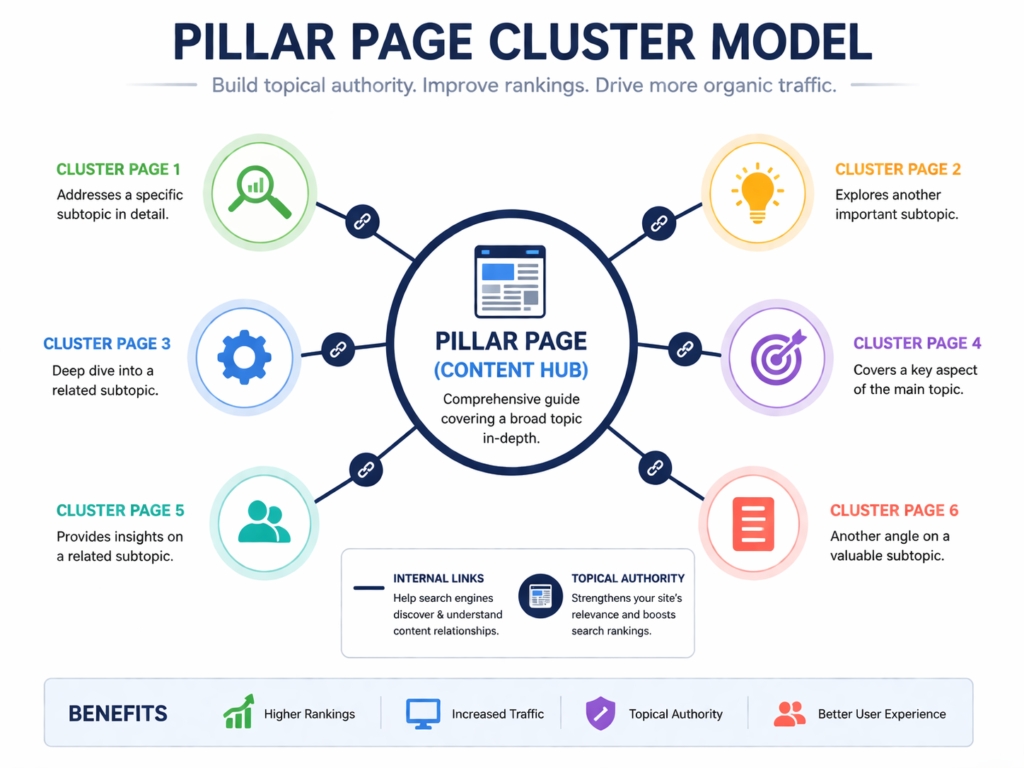
A pillar page covers the broad topic. Cluster pages answer specific subtopics in depth. Together, they create a content hub that signals expertise and gives users a clear path from learning to decision-making.
For example, a pillar page on “AI workflow automation” may link to cluster pages about human review queues, governance, data pipelines, compliance, and analytics. Mak It Solutions already has relevant content such as human-in-the-loop AI workflows and broader services that can support a cluster model.
How to structure a pillar page
A strong pillar page should include.
A clear definition of the main topic
A direct answer near the top
Subsections for major related entities
Links to deeper cluster pages
Relevant service or conversion paths
Trust signals, examples, and schema markup
The pillar page should not try to answer every question in full. Its job is to organize the topic and guide readers to the right supporting pages.
Internal linking for topic clusters
Internal links should explain relationships. Use descriptive anchors like “cloud cost governance,” “mobile app development roadmap,” or “business intelligence dashboards” instead of repeating the same exact keyword again and again.
Relevant supporting pages may include mobile app development services, front-end development services, and back-end development services.
What is the pillar page and cluster model?
The pillar page and cluster model is an SEO structure where one broad page introduces a topic, while supporting pages answer specific questions in more detail. Internal links connect the pages so users, crawlers, and answer engines can understand the full topic relationship.
Knowledge Graph SEO and Entity Relationships
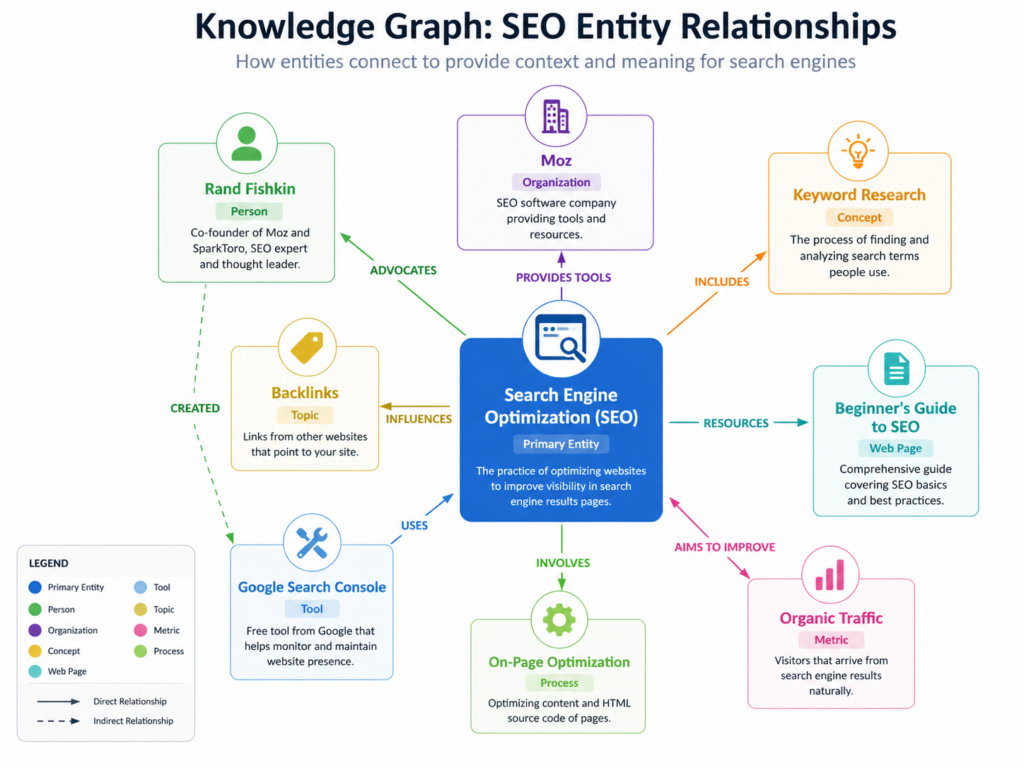
Knowledge Graph SEO is about making relationships clear: who you are, what you offer, where you operate, which industries you serve, and which standards matter.
Semantic topic clusters support this by connecting brand pages, service pages, industry pages, location examples, author signals, and structured data.
How knowledge graphs connect your content
A content hub can connect Mak It Solutions to software development, SEO, cloud, AI, mobile apps, business intelligence, SaaS, ecommerce, and international markets such as New York, San Francisco, London, Manchester, Berlin, Munich, Paris, Amsterdam, Madrid, Milan, and Dublin.
A simple entity path may look like this:
Mak It Solutions → SEO services → fintech SaaS → London and Berlin → UK-GDPR, BaFin, GDPR, PCI DSS
That chain gives search systems more context than a standalone blog post ever could.
Schema markup for semantic SEO
Schema markup does not guarantee rankings, but it helps search engines interpret your content more clearly. Google explains that structured data can make content eligible for rich results in Search when it follows the required guidelines.
Useful schema types may include.
Organization
Article
FAQ Page
How To
Service
Breadcrumb List
Person
Local Business, where relevant
Use schema to clarify what already exists on the page. Do not use it to claim things the content does not support.
How Semantic Topic Clusters Build Topical Authority
Semantic clusters build topical authority by proving complete subject coverage across connected pages. A website becomes more credible when it answers beginner, intermediate, technical, commercial, and compliance questions around the same theme.
This is especially useful for complex B2B topics.
A New York SaaS vendor may need content on onboarding, integrations, cloud hosting, SOC 2, and analytics. A Manchester healthcare platform may need NHS procurement, UK-GDPR, accessibility, and secure patient data workflows.
Why topical authority depends on depth and links
Depth shows expertise. Internal links show structure.
Together, they help users and crawlers see that your website is not answering one isolated query. It is covering a full topic area with context, examples, and next steps.
Finding content gaps with semantic keyword mapping
Start by mapping your existing pages against.
Main entities
Related subtopics
Search intent stages
Regional needs
Industry use cases
Compliance terms
Buyer questions
Internal link opportunities
The gaps become your next content opportunities.
How do semantic clusters improve topical authority?
Semantic clusters improve topical authority by showing complete coverage of a topic across connected pages. They help search engines and answer engines understand that your site has depth, structure, and useful context around the subject.
AI Search, AEO, and GEO Visibility Across the USA, UK, Germany, and EU
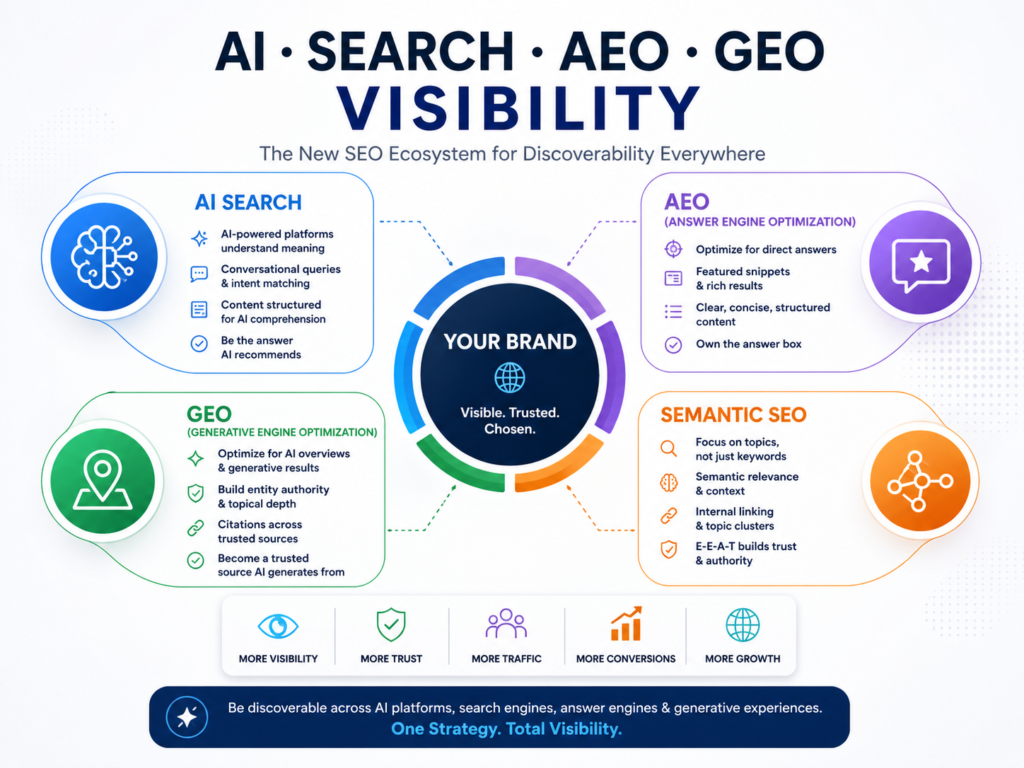
Semantic topic clusters help AI search systems because they package expertise into clear, connected answers. AI Overviews, Chat GPT, Gemini, and other answer engines need concise explanations, trustworthy sources, and entity clarity.
Google says AI Overviews are available in more than 120 countries and territories and 11 languages.
For EU-facing websites, trust signals are becoming even more important. The EU AI Act entered into force on August 1, 2024, and the European Commission says it becomes fully applicable on August 2, 2026, with some exceptions and phased obligations.
How semantic clusters help AI search
Clusters make your answers easier to extract. Each page should answer the main question early, then provide context, examples, internal links, and next steps.
That structure supports.
AI Overviews
Featured snippets
Voice search
ChatGPT-style answers
Gemini-style search experiences
Multilingual and regional discovery
GEO examples for international SEO
A New York SaaS company might build clusters around customer onboarding, analytics, SOC 2, and integrations.
A London agency might build clusters around ecommerce SEO, content strategy, UK-GDPR, and FCA-related trust signals.
A Berlin fintech might connect BaFin, Open Banking, PCI DSS, cloud hosting, multilingual content, and EU data residency.
Compliance and trust signals
For regulated or high-trust industries, include the right trust context naturally. That may involve GDPR/DSGVO, UK-GDPR, CCPA/CPRA, HIPAA, PCI DSS, SOC 2, FCA, BaFin, or industry-specific procurement requirements.
Do not overstate compliance. Use accurate, careful language and link to relevant official sources where needed.
How to Build Semantic Topic Clusters Step by Step
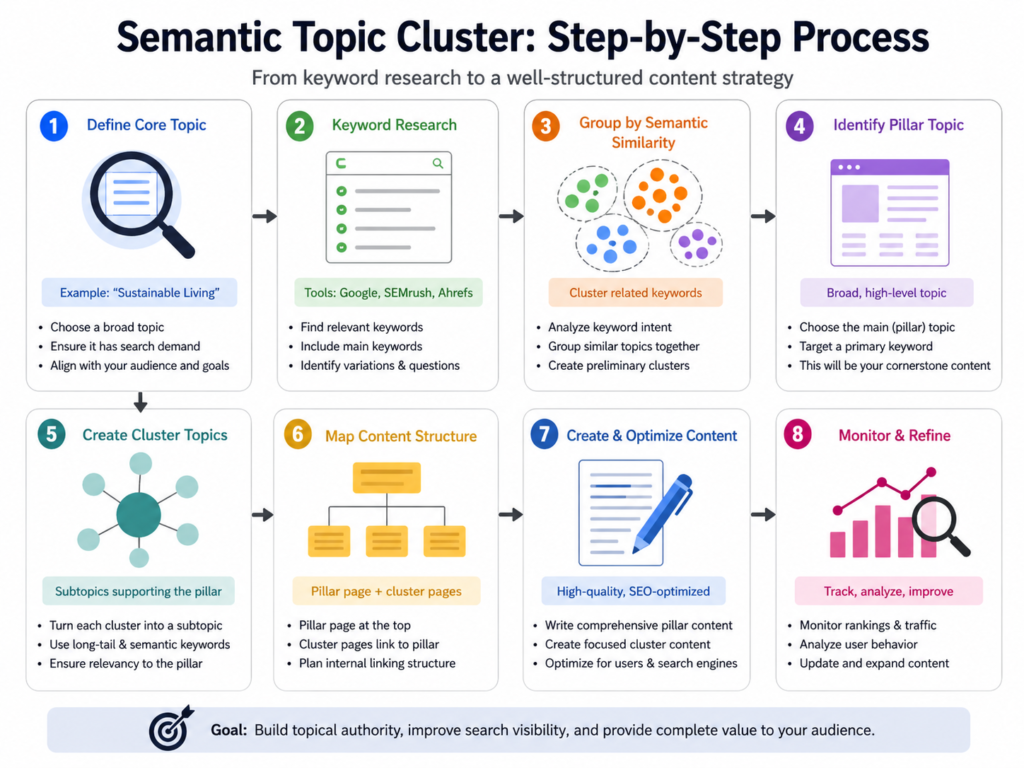
To build a topic cluster like a knowledge graph, start with the main entity, map related entities, then connect pages through internal links, schema, and regional variations.
The goal is to make your website’s expertise visible as a connected system.
Choose the pillar topic and define the primary entity
Pick a topic broad enough to support many pages, such as
Semantic SEO
Cloud cost optimization
Mobile app development
Business intelligence
AI workflow automation
Ecommerce SEO
Then define the main entity, audience, buying stage, and geographic market.
Map related entities, subtopics, and questions
List the ideas that naturally belong to the topic. Include FAQs, comparison topics, compliance terms, tools, industries, cities, and long-tail searches.
For semantic topic clusters, long-tail examples may include.
How to build semantic topic clusters for SEO in the USA
Semantic topic clusters for UK SEO strategy
Semantic topic clusters SEO Germany
Entity-based SEO for EU websites
Pillar page and cluster model for B2B SaaS
Create the pillar page
Build a strong central page that explains the topic clearly. Add a direct answer near the top, then organize the content into logical sections.
The pillar page should act like the main map, not the entire library.
Publish supporting cluster pages
Create supporting pages for definitions, comparisons, use cases, implementation steps, pricing questions, compliance risks, and regional examples.
Each page should have one clear job.
Build internal links and schema
Connect pillar and cluster pages with contextual links. Add FAQ schema where useful, HowTo schema for real processes, and regional examples for the USA, UK, Germany, France, Netherlands, Spain, Italy, and the wider EU.
For technical implementation, teams can connect SEO strategy with PHP web development, business intelligence and analytics services, and cloud-related resources such as FinOps cloud cost optimization.
Final Take
Semantic topic clusters give your content strategy a structure that search engines, AI systems, and buyers can understand. They connect entities, pillar pages, internal links, schema, and GEO trust signals into one coherent authority system.
The winning pattern is clear: define the topic, map the entities, publish the pillar, build supporting pages, link them clearly, and add regional trust signals.
Need a semantic SEO strategy that connects content, technical SEO, analytics, and regional trust signals? Mak It Solutions can help you map your semantic topic clusters, improve internal linking, and build a publishable roadmap for organic and AI search visibility.
Start with a scoped SEO consultation through the Mak It Solutions contact page and turn your website into a structured authority hub.
Key Takeaways
Semantic topic clusters organize content by meaning, entities, and intent. Pillar pages explain broad topics, while cluster pages answer specific questions.
Internal linking architecture is essential for topical authority.
GEO signals help adapt content for the USA, UK, Germany, and EU markets.
Schema markup improves clarity for search engines and answer systems.
Compliance references such as GDPR, UK-GDPR, HIPAA, PCI DSS, FCA, and BaFin can strengthen trust when used accurately.
FAQs
Q : Are semantic topic clusters better than keyword clusters?
A : Yes, semantic topic clusters are usually stronger than basic keyword clusters because they organize content around meaning, intent, entities, and relationships. Keyword clusters are still useful for mapping search demand, but semantic clusters go further by connecting pillar pages, subtopics, FAQs, internal links, schema, industry examples, and regional variations.
Q : How many pages should a semantic topic cluster include?
A : A useful semantic topic cluster often starts with one pillar page and 6–12 supporting pages. Competitive industries may need 20 or more pages over time. The right number depends on search intent, audience complexity, compliance needs, and how many meaningful subtopics exist.
Q : Do semantic topic clusters help with Google AI Overviews?
A : Yes, semantic topic clusters can help content become easier for AI systems to interpret because they provide direct answers, clear context, and supporting relationships. They do not guarantee inclusion in AI Overviews, but they improve clarity, topical authority, and source usefulness.
Q : What tools can help map entities for semantic SEO?
A : Useful tools include Google Search Console, keyword research platforms, entity extraction tools, site crawlers, internal link analysis tools, and structured data validators. The tool matters less than the strategy: connect entities, pages, questions, and user intent in a way that makes sense.
Q : How should international websites adapt topic clusters for the USA, UK, Germany, and EU?
A : International websites should localize examples, regulations, spellings, service language, and proof points. A U.S. page may reference HIPAA, CCPA/CPRA, New York, Austin, or San Francisco. A UK page may reference London, Manchester, UK-GDPR, NHS, or FCA. A German or EU page may reference Berlin, Munich, BaFin, GDPR/DSGVO, the EU AI Act, and data residency.