
Single Agent vs Multi Agent: AI Architecture Guide
Single Agent vs Multi Agent: AI Architecture Guide

Single Agent vs Multi Agent: AI Architecture Guide
Single agent vs multi agent is no longer just an AI buzzword. It is a real architecture decision that affects cost, latency, governance, reliability, and how safely your AI system can act inside a business workflow.
A single-agent AI system is usually best for narrow, predictable tasks where one agent can understand the request, use approved tools, and return a reliable answer. A multi-agent AI system makes more sense when the workflow needs specialist roles, checks, approvals, or multi-step execution across systems.
McKinsey’s 2025 global AI survey found that 23% of respondents were scaling agentic AI somewhere in their enterprise, while another 39% had started experimenting with AI agents. That is a strong signal, but it also proves one thing: the winners will not be the teams with the most agents. They will be the teams with the clearest architecture.
Single Agent vs Multi Agent.
The main difference is control.
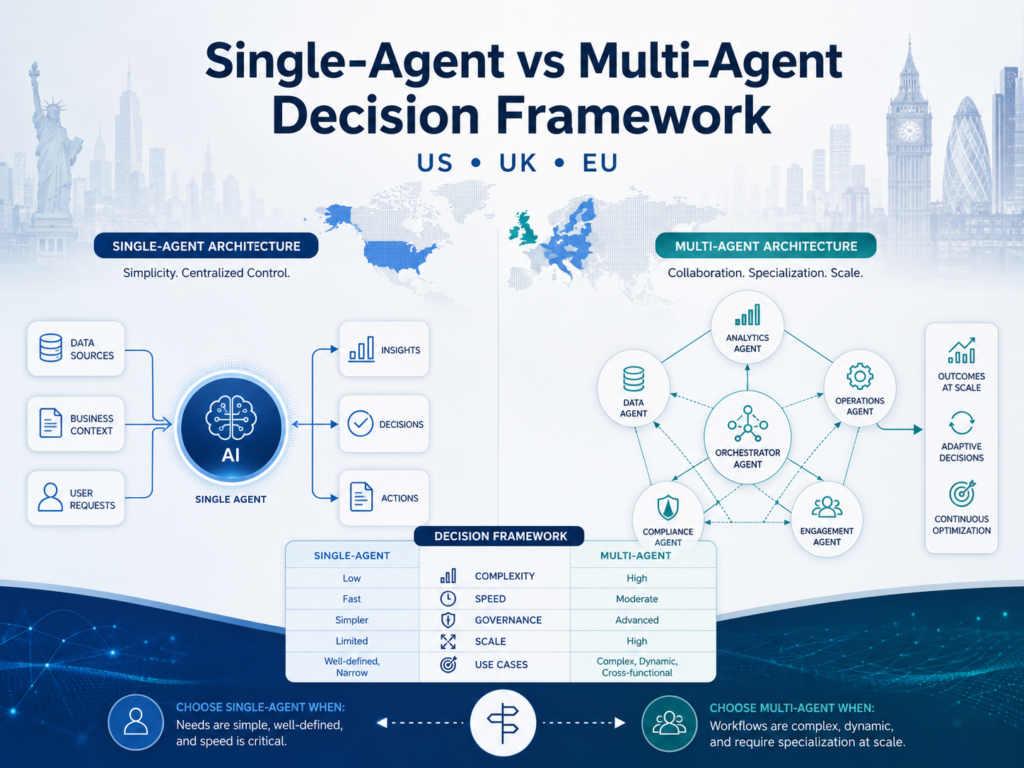
A single-agent system centralizes planning, tool use, and response generation inside one agent. A multi-agent system distributes work across multiple agents, usually with an orchestrator or supervisor managing handoffs.
In simple terms:
| Factor | Single-Agent AI | Multi-Agent AI |
|---|---|---|
| Complexity | Lower | Higher |
| Cost | Usually lower | Often higher |
| Latency | Usually faster | Often slower |
| Debugging | Easier to trace | More failure paths |
| Governance | Simpler logs | Needs stronger audit trails |
| Best fit | Focused workflows | Specialized, multi-step workflows |
What Is a Single-Agent AI System?
A single-agent AI system uses one agent to understand the request, plan the next step, retrieve data, call tools, and produce the final output.
It works well for internal FAQ assistants, document search, ticket classification, SaaS copilots, and support bots connected to approved knowledge bases.
For example, a New York SaaS company might use one agent to answer billing-policy questions from a customer success portal built on secure back-end development services.
What Is a Multi-Agent AI System?
A multi-agent AI system uses several specialized agents that work together. One agent may research, another may validate, another may write code, and another may check compliance before the final answer is delivered.
This pattern fits agentic AI architecture where workflows need role separation, shared context, human approval, or connections to CRM, ERP, DevOps, data, and ticketing systems.
When to Use Single Agent, Multi Agent, or Hybrid AI Architecture
Use single-agent AI for simple workflows, multi-agent AI for complex specialized workflows, and hybrid AI agent architecture when you need controlled scale.
The right starting point is not “How many agents can we build?” It is “How complex is the workflow, and what can go wrong?”
Use Single-Agent Architecture for Simple Workflows
Choose a single-agent architecture when the journey is predictable and the risk is manageable.
Good examples include.
Internal knowledge search
Meeting summaries
Ticket classification
Basic reporting
Customer support FAQ bots
Lightweight SaaS copilots
For mobile or web products, a single agent can often support MVP delivery faster, especially when paired with mobile app development services or React Native development services.
Use Multi-Agent Architecture for Complex Workflows
Choose multi-agent architecture when one agent cannot reliably handle every subtask, policy, data source, and decision path.
This includes.
Compliance review
Procurement automation
Legal document review
AI coding assistants
Enterprise workflow automation
Research and validation workflows
A London fintech, for example, may need one agent for user intent, another for Open Banking data retrieval, another for risk checks, and a human approval step before execution.
Use Hybrid AI Agent Architecture for Controlled Scale
A hybrid model uses one primary agent with limited sub-agents for retrieval, validation, or approval. In practice, this is often the safest enterprise starting point.
For example, a Berlin SaaS team could use one main customer-support agent plus a GDPR/DSGVO validation agent for sensitive personal-data requests.
Cost, Latency, Reliability, and Governance Trade-Offs
Multi-agent systems can improve specialization, but they also increase production complexity. Extra agents usually mean extra model calls, tool calls, retrieval steps, traces, memory updates, and failure handling.
Gartner forecast worldwide GenAI spending to reach $644 billion in 2025, up 76.4% from 2024. That is why teams should model total cost per completed workflow, not just cost per prompt.
Why Multi-Agent Systems Can Cost More
Every agent may trigger its own prompt, retrieval query, tool execution, validation step, and memory update.
That cost may be justified for regulated or complex workflows. But for simple tasks, adding more agents often creates overhead without improving the final result.
Why Single-Agent Systems Are Usually Faster
Single-agent systems usually have one reasoning loop. Multi-agent systems add handoffs, critique loops, voting, validation, retrieval, and approvals.
For customer-facing SaaS, latency matters. A support answer can tolerate a short delay. A checkout decision, fraud check, or trading workflow may not.
Why Multi-Agent Reliability Needs Extra Attention
Multi-agent AI can fail through cascading errors, conflicting outputs, unclear ownership, tool misuse, or memory drift.
Observability is not optional. Teams building AI-assisted secure delivery should connect agents to review queues, CI/CD evidence, and remediation workflows, similar to an AI vulnerability detection workflow.
AI Agent Architecture Patterns and Frameworks
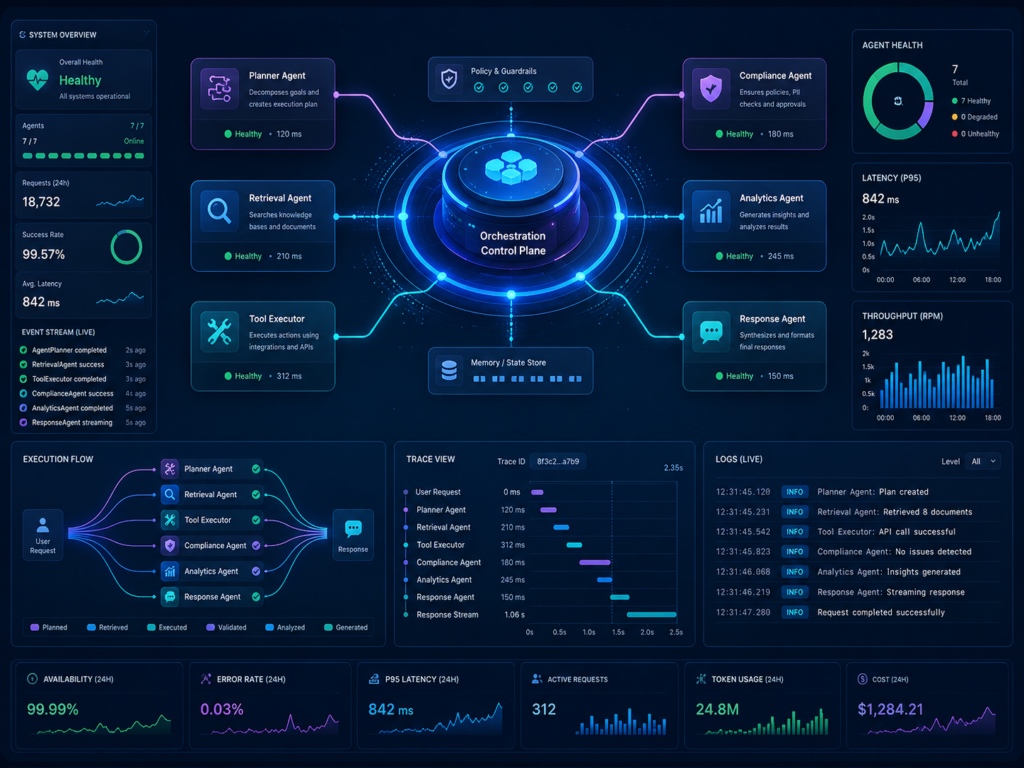
A strong AI agent architecture needs orchestration, observability, guardrails, access control, and evaluation. Multiple agents alone do not make a system intelligent or safe.
Before implementation, define.
Agent roles
Tool permissions
Memory boundaries
Escalation rules
Human approval points
Audit and rollback controls
Common AI Agent Architecture Patterns
Common patterns include planner-executor, supervisor-worker, router, critic, debate, tool-using agent, and human-in-the-loop review.
For regulated use cases, human-in-the-loop AI is often the difference between useful automation and unmanaged risk. Mak It Solutions has covered this control layer in human-in-the-loop AI workflows.
Frameworks for Multi-Agent AI Architecture
Popular frameworks and platforms include Lang Graph, Crew AI, Auto Gen, Microsoft Agent Framework, Open AI Agents SDK, Google ADK, Claude Agent SDK, and cloud-native agent ecosystems.
OpenAI describes agents as applications that can plan, call tools, collaborate across specialists, and keep enough state to complete multi-step work. Microsoft Agent Framework supports single-agent and multi-agent patterns, while Google ADK is designed to help teams build, debug, and deploy agents at enterprise scale.
For Python-heavy teams, Python development services can support custom orchestration, API integrations, evaluation pipelines, and data workflows.
Enterprise Use Cases for Single and Multi-Agent Systems
Enterprises should choose multi-agent systems when workflows require specialist agents for research, validation, compliance, execution, and human approval. Simpler workflows should stay single-agent until complexity proves otherwise.
Customer Support, Sales, and SaaS Automation
A single bot can answer FAQs, summarize tickets, and retrieve product docs.
Multi-agent routing becomes useful when the workflow touches CRM updates, refunds, onboarding, sales qualification, support escalation, or knowledge-base updates.
For growth teams, AI agent outputs can also connect to dashboards through business intelligence services.
Healthcare, Finance, and Regulated Workflows
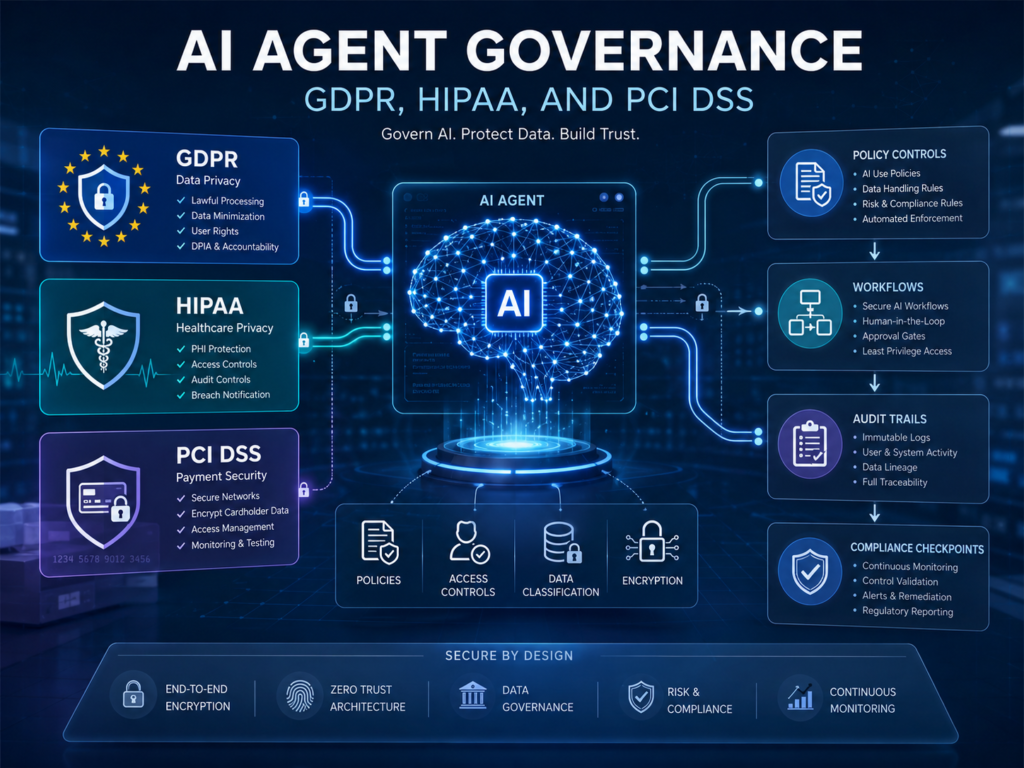
Healthcare, finance, and payment workflows need stronger controls.
In the US, HIPAA sets national standards for protecting medical records and individually identifiable health information. PCI DSS provides technical and operational requirements for protecting payment account data.
In the UK, ICO guidance explains how UK GDPR principles apply to AI systems and AI-assisted decisions. In Germany and the EU, GDPR/DSGVO, data residency, BaFin-facing expectations, and the EU AI Act make auditability central. The EU AI Act entered into force on 1 August 2024 and applies in phases, so teams should check the latest official timeline before deployment.
Industrial, Legal, and Internal Operations
Industrial operations, legal review, procurement, HR automation, internal IT helpdesks, and finance operations are strong multi-agent candidates.
These workflows involve documents, approvals, system updates, exceptions, and audit trails. Stanford HAI’s 2025 AI Index reported that 78% of organizations used AI in 2024, up from 55% in 2023, which shows how quickly AI is moving from experimentation into everyday business operations.
GEO Considerations for USA, UK, Germany, and EU Teams
US, UK, Germany, and EU teams should design AI agent systems around local compliance exposure, not just technical convenience.
USA.
In New York, San Francisco, and Austin, SaaS and healthcare teams should define access controls before connecting agents to production systems.
HIPAA, PCI DSS, SOC 2, ISO 27001, cloud-region choices, audit logs, and least-privilege tool permissions should be part of the architecture from day one.
UK.
In London and Manchester, fintech and NHS-adjacent workflows need UK-GDPR-aware design, Open Banking safeguards, clear escalation, and explain ability.
AI agents should not silently make high-impact decisions without logging, review, and human oversight.
Germany and EU.
In Berlin, Munich, Frankfurt, Amsterdam, Paris, and Dublin, AI agent deployments should map personal data, processor roles, consent, retention, data residency, and cross-border transfers.
For BaFin-facing finance workflows, teams should keep evidence for model behavior, approvals, exceptions, and remediation.
Final Recommendation
Most companies should start with a single-agent or hybrid architecture, then move to multi-agent systems only when complexity, specialization, or governance needs justify it.
Do not add agents just to look advanced.
Choose single-agent AI if you need speed, simplicity, lower cost, lower latency, and easier governance. It is usually the right first step for internal assistants, focused copilots, and controlled SaaS automation.
Choose multi-agent AI when the workflow needs role separation, policy checks, multi-step automation, tool coordination, compliance review, or human approval.
For most enterprise teams, the best path is practical:
Identify candidate workflows and business value.
Classify risk, compliance exposure, and data sensitivity.
Choose single-agent, hybrid, or multi-agent design.
Define observability, evaluation, and human review.
Pilot, measure, and scale only where results are clear.
Need help choosing between single agent vs multi agent architecture for your SaaS, cloud, mobile, or data workflow?
Mak It Solutions can run a scoped AI agent architecture assessment covering use case complexity, compliance exposure, data residency, tool access, latency, governance, and total cost.
Book a practical consultation and leave with a clear recommendation: single-agent, hybrid, or multi-agent.( Click Here’s )
Key Takeaways
Single-agent AI is usually best for narrow, predictable workflows.
Multi-agent systems are useful when tasks require specialization, tool coordination, and governance.
Hybrid architecture gives enterprises a safer way to scale without overbuilding.
Cost, latency, auditability, and evaluation should be modeled before production.
US, UK, Germany, and EU deployments need region-aware compliance and data controls.
Framework choice matters less than workflow design, observability, and guardrails.
FAQs
Q : Is a multi-agent system always better than a single AI agent?
A : No. A multi-agent system is not automatically better. It is better only when specialized roles, tool coordination, compliance checks, or multi-step workflows improve reliability. For simple tasks, one well-designed agent is often faster, cheaper, and easier to govern.
Q : Can a single-agent AI system be used in enterprise workflows?
A : Yes. Single-agent AI systems can work well in enterprise environments when the workflow is narrow, permissioned, and measurable. Examples include policy search, internal IT helpdesk routing, ticket summarization, sales enablement, and basic reporting.
Q : What is the biggest risk of multi-agent AI architecture?
A : The biggest risk is loss of control. Multiple agents can create cascading errors, conflicting recommendations, unclear responsibility, and higher debugging complexity. Strong tracing, role-based access, audit logs, test datasets, human approval, and rollback controls are essential.
Q : Which AI agent framework is best for regulated industries?
A : There is no universal best framework for regulated industries. The right choice depends on security, observability, deployment model, team skills, cloud stack, and compliance requirements. Regulated teams should prioritize audit logs, access controls, evaluation, data residency, and human-in-the-loop review over framework popularity.
Q : How do GDPR and DSGVO affect multi-agent AI systems?
A : GDPR and DSGVO affect how multi-agent systems collect, process, store, explain, and share personal data. EU and German teams should map data flows between agents, minimize personal data, restrict access, keep audit trails, and document decisions.