
LLM Hallucination Reduction: Enterprise Trust Guide
LLM Hallucination Reduction: Enterprise Trust Guide

LLM Hallucination Reduction: Enterprise Trust Guide
LLM hallucination reduction is now a serious enterprise trust issue, not just a model-quality problem. As AI moves into customer support, clinical admin, finance operations, legal research, insurance workflows, software delivery, and public-sector services, unsupported answers can quickly become business risk.
At its simplest, LLM hallucination reduction means making AI outputs more factual, source-grounded, verifiable, and auditable. The strongest enterprise approach combines approved knowledge sources, high-quality retrieval, citation verification, evaluation metrics, monitoring, and human review for high-risk decisions.
AI adoption is also moving fast: Stanford HAI reported that 78% of organizations used AI in 2024, up from 55% the year before. That speed makes trust controls more urgent, especially for teams in the USA, UK, Germany, and the wider EU.
What Is LLM Hallucination Reduction?
LLM hallucination reduction is the process of lowering the frequency, severity, and business impact of unsupported AI outputs.
It does not mean an AI system becomes perfectly truthful. It means the system has controls that help answers be checked, traced, corrected, refused, or escalated before they affect users.
An AI hallucination is an output that sounds plausible but is fabricated, outdated, unsupported, or misaligned with the source material. In enterprise systems, hallucinations often appear as.
False citations
Incorrect summaries
Made-up legal or policy references
Wrong product terms
Outdated compliance guidance
Claims that only partly match the retrieved source
For a New York insurer, a London legal-tech firm, or a Berlin SaaS company, the practical question is not, “Can the model answer?” It is, “Can we prove the answer is supported?”
Why LLM Hallucination Reduction Matters for Enterprises
Enterprise AI is increasingly used in workflows where accuracy, auditability, and accountability matter.
In healthcare, a hallucinated policy summary can create patient safety and privacy risk. In finance, a false compliance answer can create SEC, FINRA, FCA, BaFin, or PCI DSS exposure. In legal, insurance, and public-sector AI, one confident but unsupported answer can damage trust quickly.
There is also a financial side to the problem. IBM reported that the average global cost of a data breach reached USD 4.88 million in 2024, while financial industry breaches averaged USD 6.08 million. AI hallucinations are not the same as breaches, but both show why regulated teams need stronger controls around sensitive digital systems.
How LLM Hallucinations Happen
Large language models generate likely text based on learned patterns. They do not automatically verify truth, source freshness, or legal accuracy.
Hallucinations often happen when.
The prompt is vague
The model lacks enough context
The retrieval system returns weak evidence
Old documents rank above current documents
The user asks for current information the model does not have
The system encourages a confident answer instead of a safe refusal
In practice, hallucination reduction is not one feature. It is a layered trust architecture.
Core Framework to Reduce AI Hallucinations
Enterprises reduce AI hallucinations by combining source grounding, retrieval quality, claim-level verification, citation checks, evaluation, monitoring, and human oversight.
A practical framework looks like this.
| Layer | What It Does | Why It Matters |
|---|---|---|
| Approved sources | Limits answers to trusted documents, APIs, and systems | Reduces unsupported claims |
| RAG pipeline | Retrieves relevant context before generation | Grounds answers in current evidence |
| Citation verification | Checks whether citations support claims | Prevents fake or weak citations |
| Evaluation metrics | Measures groundedness, faithfulness, and accuracy | Makes quality trackable |
| Monitoring | Watches production behavior and drift | Finds issues after launch |
| Human review | Escalates high-risk outputs | Protects legal, medical, and financial workflows |
Teams building AI-enabled portals can connect these controls to secure back-end development services and reporting through business intelligence services.
Ground AI Responses with Approved Knowledge Sources
The first step is simple: do not let the model rely only on its training data for enterprise answers.
Use approved sources such as.
Product documentation
Policy manualsLegal templates
Compliance guidance
Data catalogs
Support tickets
Internal knowledge bases
Verified APIs
A healthcare payer in Boston may ground answers in approved plan documents, HHS guidance, and internal policy manuals. A fintech in San Francisco may use product disclosures, risk policies, PCI DSS documentation, and audited transaction rules.
Source control matters. If the knowledge base is messy, outdated, or poorly permissioned, the model will inherit that mess.
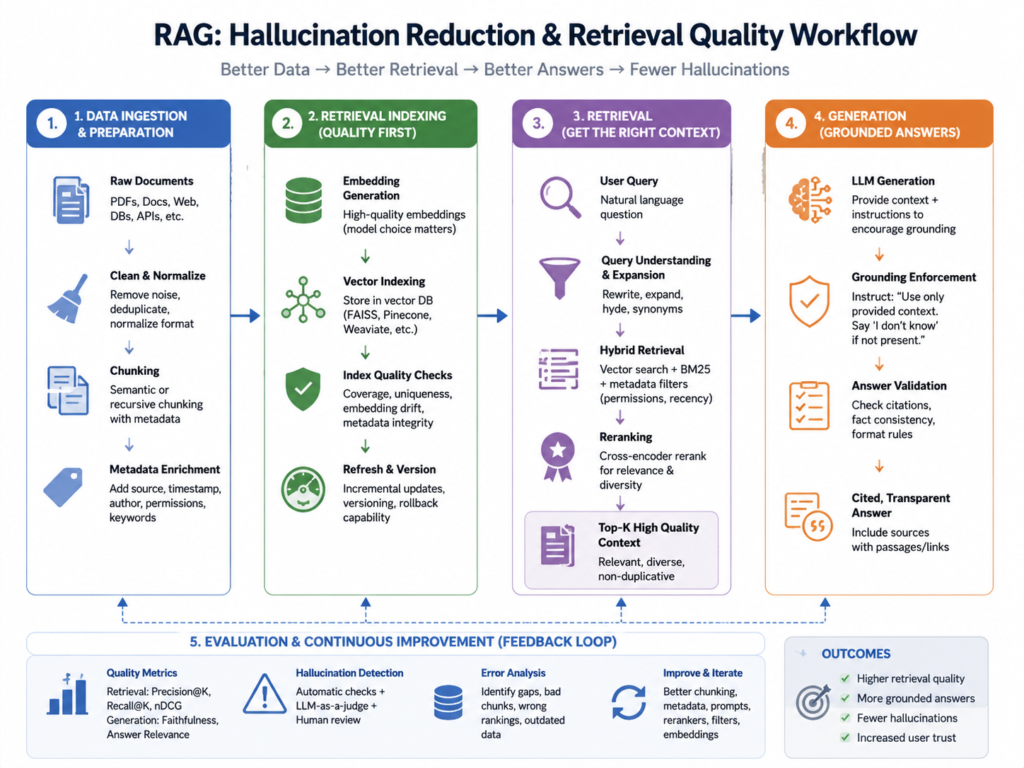
RAG Hallucination Reduction and Retrieval Quality
Retrieval-augmented generation, or RAG, helps reduce hallucinations by giving the model external context before it answers. Instead of relying only on training data, the model can respond from retrieved passages.
RAG is especially useful for fast-changing enterprise content such as policies, pricing, product terms, regulations, tickets, and internal procedures.
But RAG is not magic.
RAG can still hallucinate when the retriever fetches irrelevant documents, misses the right source, ranks stale content too high, or gives the model too much noisy context. A Manchester NHS supplier, for example, may need UK-GDPR-aware retrieval, version controls, and source freshness checks before summarizing patient-facing guidance.
For architecture decisions, teams can compare RAG, domain models, and fine-tuning using Mak It Solutions’ Domain LLM vs RAG guide.
Metrics to Track in RAG Systems
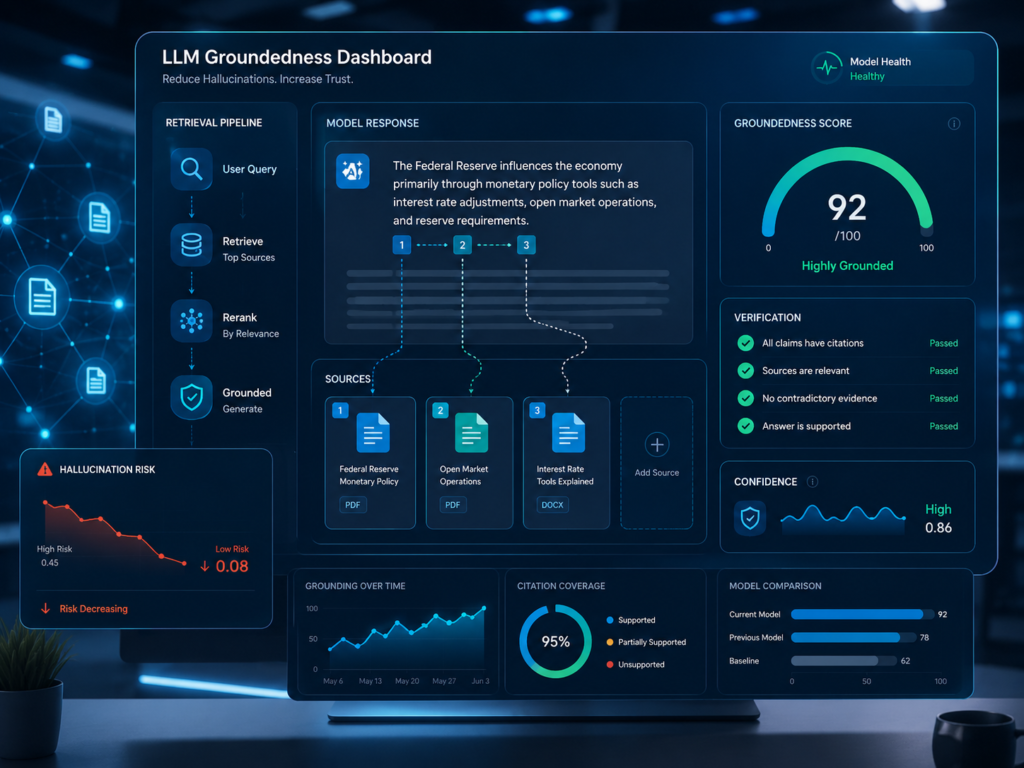
The strongest RAG systems measure more than answer quality. They track whether the answer is supported by the retrieved context.
Useful metrics include.
Grounded Ness
Context relevance
Faithfulness
Citation accuracy
Unsupported-claim rate
Refusal quality
Answer accuracy
Human reviewer agreement
Private investment in generative AI reached USD 33.9 billion globally in 2024, up 18.7% from 2023, according to Stanford HAI. That level of investment makes evaluation discipline even more important.
Citation Verification AI for Source-Grounded Answers
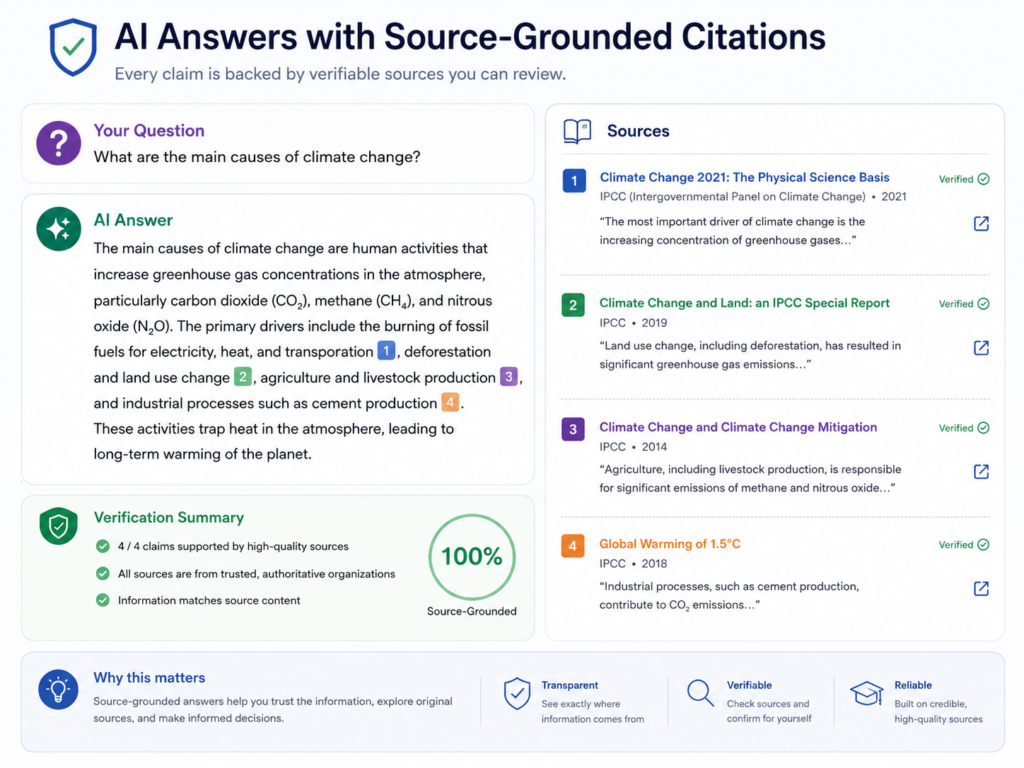
Citation verification AI checks whether each answer, paragraph, or claim is actually supported by trusted source material.
This matters because citations can look convincing even when they are wrong. A model may cite the right document but the wrong section. It may cite a source that is related but does not support the exact claim. It may even invent a reference if the system does not prevent it.
A strong citation verification layer checks.
Retrieved passages
Generated claims
Citation spans
Source permissions
Source freshness
Confidence scores
Whether unsupported claims should be removed, rewritten, or escalated
This is especially important in legal, healthcare, finance, insurance, and public-sector AI. A London law firm needs source-grounded research. A Munich bank needs traceable risk-policy answers. A US healthcare provider needs documented controls for billing, privacy, and patient-facing workflows.
Hallucination Detection Tools and Evaluation Platforms
Hallucination detection tools help teams evaluate whether LLM outputs are factual, consistent, grounded, and safe enough for production.
Good tools should support both pre-launch testing and live monitoring. Look for features such as.
Context relevance scoring
Factual consistency checks
Citation validation
Prompt and version tracking
Regression testing
Drift monitoring
Human feedback loops
Dashboards for production review
Teams often compare Galileo, LangSmith, Arize Phoenix, TruLens, Vectara, and Patronus AI depending on their stack, budget, and evaluation maturity. For engineering-heavy teams, integration with CI/CD, logs, vector stores, and dashboards may matter more than one neat score.
Related AI engineering programs may connect with AI vulnerability detection workflows and AI pair programming ROI measurement.
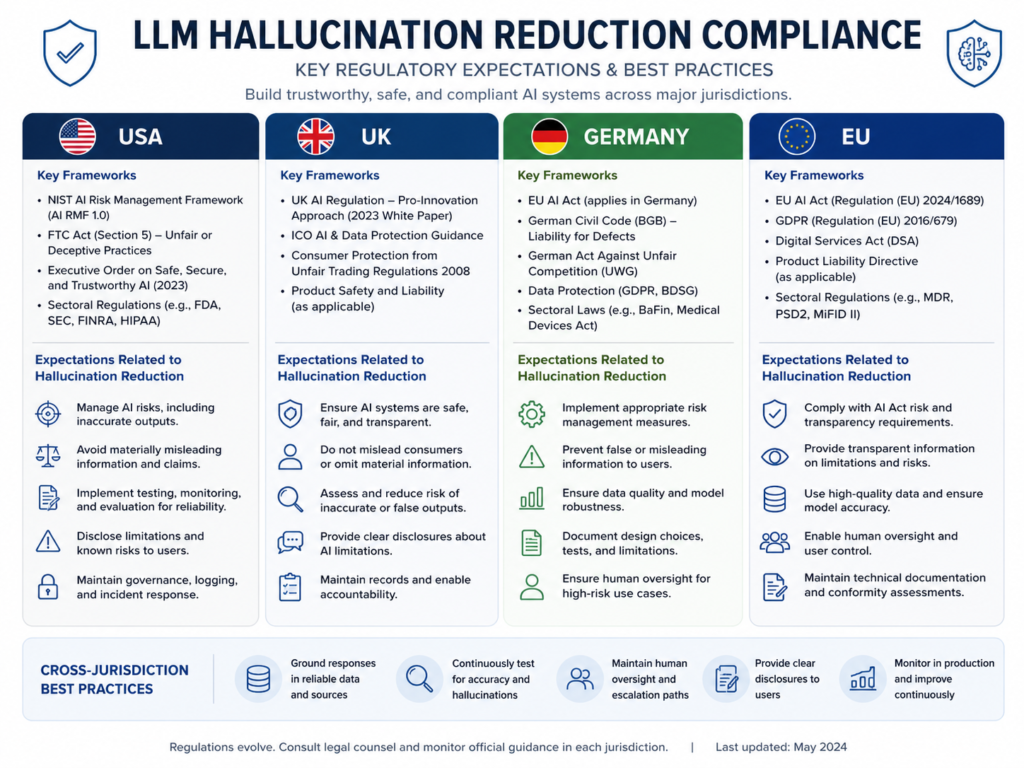
Compliance Considerations for USA, UK, Germany, and EU Teams
Regulated organizations need hallucination reduction systems that provide source traceability, evidence freshness, audit logs, and human escalation paths.
The right controls vary by geography, industry, and whether the AI system affects customers, employees, patients, or regulated decisions.
USA.
In the USA, hallucination controls matter for HIPAA-regulated healthcare, SOC 2 customer commitments, PCI DSS payment environments, FINRA/SEC financial supervision, and enterprise AI governance.
A Seattle SaaS company may need audit logs and access controls. A New York fintech may need citations tied to approved disclosures and compliance policies.
The NIST AI Risk Management Framework helps organizations manage risks to individuals, organizations, and society associated with AI.
UK.
In the UK, AI systems used by NHS suppliers, FCA-regulated firms, Open Banking providers, and legal-tech companies should prioritize traceability, data minimization, and human escalation.
A London wealth platform should not let a chatbot invent suitability guidance. A Manchester health-tech provider should avoid unsupported patient-facing summaries.
Germany and EU.
In Germany and the wider EU, hallucination reduction should account for GDPR/DSGVO, BaFin expectations, EU AI Act risk classifications, eIDAS identity workflows, PSD2 payments, data residency, and multilingual German-English grounding.
Berlin, Munich, Frankfurt, and Hamburg teams often need evidence freshness, source attribution, and clear model governance.
The European Commission describes the AI Act as risk-based rules for AI developers and deployers regarding specific AI uses.
Implementation Checklist for Enterprise LLM Hallucination Reduction
A strong roadmap starts with risk, then adds retrieval controls, citation verification, automated evaluation, observability, and compliance reporting.
Score Each AI Use Case by Risk
Start by classifying each AI workflow by.
Audience
Data sensitivity
Regulatory exposure
Decision impact
Geography
Required freshness
Escalation need
A public FAQ bot is usually lower risk than an assistant that summarizes clinical notes, credit policies, legal clauses, or insurance claims.
Build the Hallucination Reduction Stack
A practical enterprise stack includes.
Approved data sources
RAG pipelines
Access controls
Citation verification
LLM evaluation
AI observability
Audit logs
Human review
Secure workloads may also benefit from confidential computing patterns and custom delivery through mobile app development services.
Measure Success Before Scaling
Do not scale an AI system just because the demo looks good.
Measure hallucination rate, unsupported-claim rate, citation accuracy, groundedness, user trust, escalation volume, reviewer agreement, and business outcomes.
In production, the real question is not whether the model is impressive. It is whether the system is safe, measurable, and trusted.
To Sum Up
LLM hallucination reduction is not about chasing perfect AI. It is about building enterprise systems where answers can be checked, trusted, audited, and improved.
Planning an enterprise AI assistant, RAG system, or compliance-sensitive automation workflow? Mak It Solutions can help scope the architecture, evaluate hallucination risk, design verification layers, and build dashboards your business can trust.
Request a scoped consultation through the Mak It Solutions contact page to turn your AI pilot into a safer production system.
Key Takeaways
LLM hallucination reduction combines retrieval, grounding, verification, evaluation, monitoring, and governance.
RAG helps, but it does not remove hallucinations unless retrieval quality, source freshness, and ranking are controlled.
Citation verification is essential for legal, healthcare, finance, insurance, and public-sector AI workflows.
US, UK, Germany, and EU teams should design for audit logs, data residency, human escalation, and regulator-ready evidence.
Success should be measured with grounded Ness, faithfulness, citation accuracy, hallucination rate, and user trust.
FAQs
Q : How do hallucination detection tools know when an AI answer is unsupported?
A : They compare the generated answer against retrieved context, approved documents, test data, or known reference answers. Stronger systems score grounded Ness, faithfulness, factual consistency, and citation accuracy.
Q : Can citation verification AI prevent false legal or medical references?
A : Citation verification AI can reduce false legal or medical references, but it should not replace professional review. For high-risk legal, clinical, or regulatory outputs, organizations should still use qualified human review and clear escalation rules.
Q : Is RAG enough for LLM hallucination reduction?
A : RAG is helpful, but it is not enough by itself. It still needs source governance, retrieval testing, citation verification, monitoring, fallback behavior, and human review for sensitive workflows.
Q : What metrics should enterprises use to measure LLM factual accuracy?
A : Enterprises should track grounded Ness, faithfulness, answer accuracy, citation accuracy, unsupported-claim rate, refusal quality, and human reviewer agreement. Customer-facing systems should also monitor complaints, escalations, and user trust.
Q : How should regulated companies audit AI-generated answers?
A : They should log prompts, retrieved sources, generated answers, citations, model versions, reviewer decisions, and user-facing outputs. They should also track source freshness, access permissions, evaluation scores, and escalation decisions.