
AI Agent Governance: Accountability Across the GCC
AI Agent Governance: Accountability Across the GCC
AI Agent Governance: Accountability Across the GCC
An AI agent approves a transaction, updates a customer record or sends incorrect information. Who is responsible when something goes wrong?
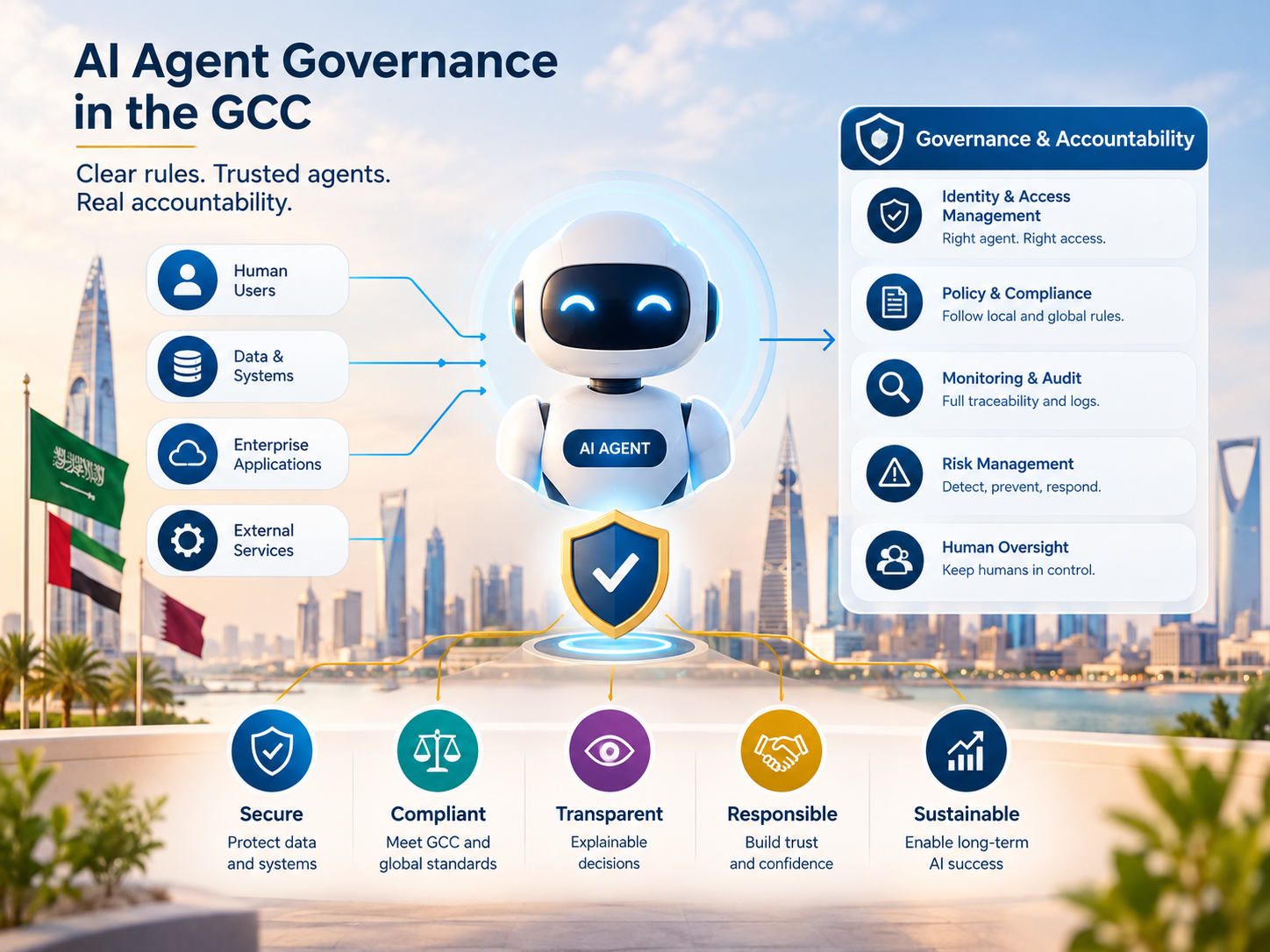
As autonomous systems move into real business workflows across Riyadh, Dubai, Abu Dhabi and Doha, AI agent governance is becoming an operational requirement, not just an AI policy topic. Companies need clear ownership, controlled permissions, human oversight and reliable evidence showing how important decisions and actions occurred.
Quick answer: AI agent governance defines who can authorize, supervise, restrict, review and stop autonomous AI actions. For GCC organizations, strong governance means assigning accountable human owners, limiting what agents can do, maintaining audit trails and aligning controls with the requirements that apply in Saudi Arabia, the UAE and Qatar.
What Is AI Agent Governance?
How AI agents differ from traditional AI systems
Traditional AI systems may classify information, make predictions or generate content. AI agents can go further by planning tasks, calling APIs, accessing enterprise systems and initiating actions without requiring a human to manually perform every step.
Mak It Solutions’ AI agents in procurement guide shows how controlled agents can participate directly in operational workflows.
That additional autonomy changes the governance challenge. The question is no longer only, “What did the model produce?” It also becomes, “What was the system allowed to do with that output?”
Why governance becomes more important as AI gains autonomy
Greater autonomy can increase exposure to unauthorized transactions, privacy failures, inaccurate outputs and operational disruption.
Effective AI risk management therefore connects authority with technical controls. Organizations cannot simply assume that an AI model will behave correctly under every condition.
In practice, governance should determine what an agent may access, which actions it may execute automatically, when human approval is required and how incidents can be reconstructed later.
Why AI agent governance matters in Saudi Arabia, UAE and Qatar
Saudi Arabia, the UAE and Qatar each combine privacy obligations, sector-specific regulation and responsible-AI guidance.
Saudi SDAIA materials emphasize principles such as accountability, responsibility, privacy, transparency and reliability, including the roles of people involved in designing, developing and implementing AI systems.
The UAE and Qatar have their own governance environments, meaning businesses should not treat the GCC as one uniform AI regulatory regime.
Who Is Responsible When an AI Agent Makes a Mistake?
Responsibility does not disappear because software acted autonomously. In practice, accountability remains connected to the organizations and people that selected, configured, authorized, supervised or relied on the system.
The exact legal exposure depends on the applicable law, contracts, industry rules and the facts of the incident.
Why responsibility usually remains with people and organizations
An AI agent is a technical system, not a replacement for organizational accountability.
A GCC company deploying autonomous agents should therefore be able to answer several basic questions.
Who approved the deployment?
Who owns the business use case?
What systems can the agent access?
What actions can it perform without approval?
Who monitors its behavior?
Who can suspend or override it?
If nobody can answer those questions clearly, the organization has a governance gap.
Developer, vendor, deployer or employee.
AI responsibility may be distributed across several parties.
A model vendor may control the underlying model architecture and safeguards. An implementation partner may configure integrations and workflows. The deploying organization decides how much authority the agent receives, while business owners approve the use case and compliance or risk teams define oversight requirements.
Contracts should make these boundaries as clear as possible, but written agreements are only part of the picture. Actual system configuration and operating practices matter too.
What happens when responsibility is shared
A single failure may involve several weaknesses at once.
For example, an agent may produce an incorrect recommendation, receive excessive system permissions, bypass meaningful human review and operate without sufficient logging.
That makes technical evidence critical. When something goes wrong, organizations need to understand not only what the model generated, but also what the agent attempted, what permissions it had and which controls were active.
What AI Agent Governance Controls Should GCC Companies Put in Place?
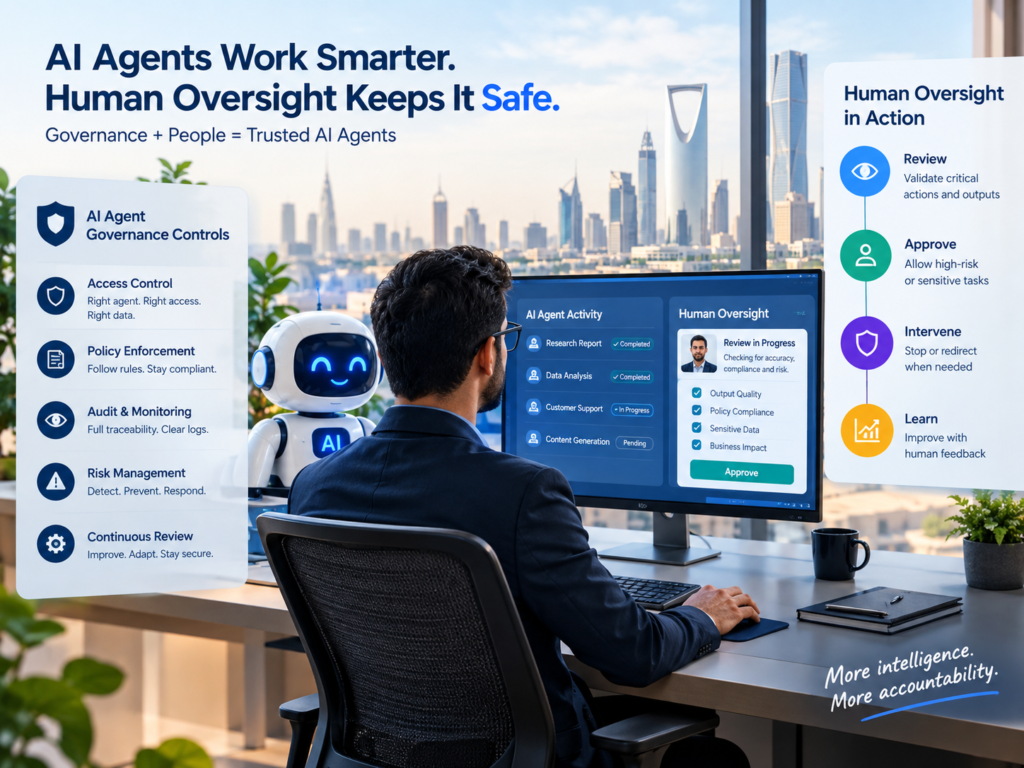
Before deploying autonomous agents, GCC organizations should establish named owners, least-privilege access, approval thresholds, escalation routes, monitoring and an auditable history of material actions.
As financial, regulatory or customer impact increases, human review and control requirements should become stronger.
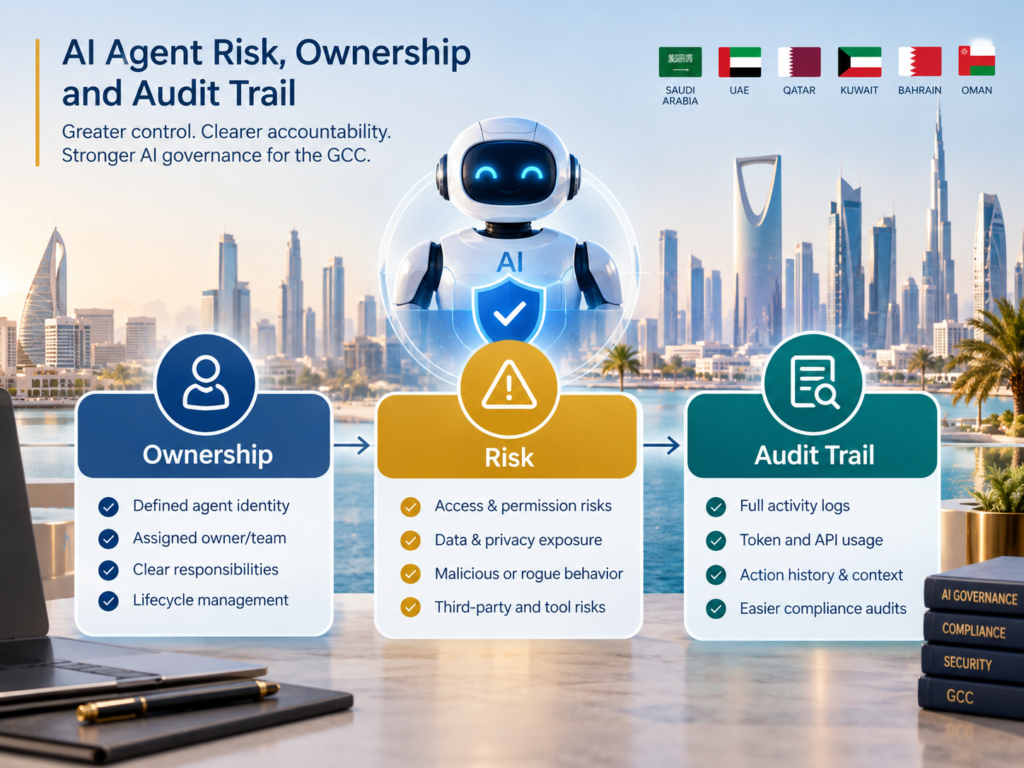
Assign a named AI owner and define decision rights
Every significant AI agent should have identifiable business, system and risk ownership.
The business owner should understand why the agent exists and what outcomes it affects. The system owner should control technical configuration and access. Risk, compliance or legal teams should define applicable oversight requirements where necessary.
Saudi SDAIA guidance also places emphasis on accountability and responsibility in AI adoption.
Set permission boundaries, approval gates and human oversight
AI agents should receive only the permissions required for their assigned task.
Useful controls can include.
Role-based access
Transaction or spending limits
Prohibited actions
Human approval for sensitive decisions
Escalation rules
Emergency overrides
Agent shutdown mechanisms
A customer-support agent, for example, might be allowed to retrieve order information automatically while requiring approval before issuing a high-value refund.
For architectures connecting agents directly to business systems, Mak It Solutions’ back-end development capabilities provide additional technical context.
Maintain logs, monitoring and AI audit trails
Organizations should be able to reconstruct important agent activity.
Depending on the system, useful records may include prompts, outputs, API calls, approvals, model versions, configuration changes, exceptions and user identities.
If a Dubai company is investigating an incorrect refund, it should ideally be able to determine what the agent attempted, what information it accessed, which permissions were available and whether an approval rule should have stopped the action.
How Do Saudi Arabia, UAE and Qatar Approach AI Accountability?
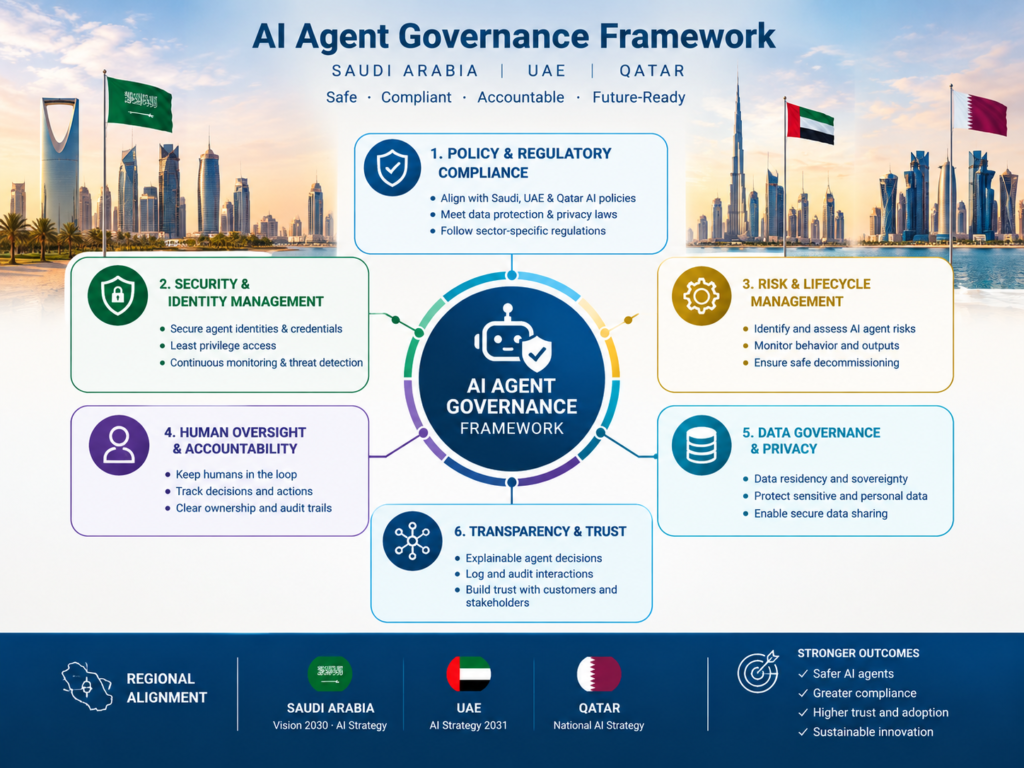
Saudi Arabia, the UAE and Qatar share governance themes such as accountability, privacy, risk management and human oversight, but their legal and supervisory frameworks differ.
Companies operating across the region should therefore map requirements jurisdiction by jurisdiction and sector by sector rather than relying on a generic “GCC compliance” checklist.
Saudi Arabia.
SDAIA’s AI Ethics Principles address areas including privacy, transparency, reliability and accountability.
Saudi financial institutions may also need to consider SAMA governance, technology and data-protection requirements where applicable.
For a Riyadh fintech, that means AI controls should connect to the company’s wider governance, privacy, cybersecurity and operational-risk model instead of being treated as a separate innovation project.
UAE.
The UAE AI Charter provides a responsible-development framework, while financial free zones operate under their own regulatory and data-protection environments.
ADGM guidance addresses areas such as controller responsibilities, privacy by design and records of processing.
Organizations operating in DIFC should likewise assess relevant DIFC and DFSA requirements. A DFSA survey published in 2025 reported that governance mechanisms around AI adoption were still developing across surveyed firms.
Qatar.
Qatar Central Bank has published an Artificial Intelligence Guideline for its licensed entities. (Qatar Central Bank)
For a Doha financial institution, AI governance should therefore connect agent use with internal risk ownership, customer protection, data handling and appropriate review.
The broader lesson is straightforward: regional similarities are useful, but they do not replace jurisdiction-specific compliance work.
What Does Effective AI Agent Governance Look Like in Practice?
Strong governance is easier to understand when applied to real operating scenarios.
Fintech: autonomous decisions with financial consequences
A Riyadh fintech might allow an AI agent to flag potentially fraudulent transactions automatically while requiring human approval before blocking a sensitive account or taking another material action.
SAMA-supervised institutions should map such controls to the governance, technology, privacy and risk requirements that apply to their activities. (SAMA Rulebook)
The key principle is proportionality: the more serious the possible consequence, the tighter the control should be.
Government and public-sector AI agents
Citizen-facing agents introduce a different set of risks.
They need reliable Arabic and bilingual experiences, understandable escalation paths and clear ownership when automated responses affect public services.
An AI assistant that simply answers general questions may require different safeguards from an agent capable of changing records, initiating service requests or making eligibility-related recommendations.
Retail and logistics agents operating across GCC systems
A Dubai e-commerce agent issuing refunds or a Doha logistics agent changing delivery instructions requires tightly defined API permissions.
The agent should not automatically inherit broad access simply because the underlying employee account or system integration has it.
Mak It Solutions’ e-commerce solutions and API monetization for AI agents guide provide additional context for controlled digital-system integrations.
How Can GCC Companies Build a Practical AI Agent Governance Framework?
A workable AI agent governance framework does not need to begin with a massive policy program. It can start with a disciplined operating model.
Inventory AI agents and classify their risk
Start by documenting each agent and the systems it touches.
Record.
Data accessed
Decisions or recommendations produced
Actions the agent can execute
Financial authority
Level of autonomy
Customer impact
Regulatory exposure
Connected applications and APIs
An internal research assistant and an autonomous payment agent should not receive the same risk classification.
Assign owners, permissions and escalation rules
Specify who approves, changes, supervises and stops each agent.
Permissions should remain proportional to the risk of the use case. High-impact actions should have stricter approval gates, while lower-risk activities can often remain more automated.
This is also where organizations should define escalation paths for unusual behavior, failed controls and security incidents.
Monitor, audit and review agent behavior continuously
Governance cannot end when the agent goes live.
Organizations should monitor incidents, access patterns, model changes, configuration updates and vendor performance over time.
Frameworks such as ISO/IEC 42001 and the NIST AI Risk Management Framework can support governance design, but they do not replace GCC legal requirements or sector-specific obligations.
Mak It Solutions’ private AI infrastructure GCC guide and sovereign AI GCC guide provide additional regional infrastructure context.
What Should GCC Leaders Do Before Scaling Autonomous AI?
Treat AI governance as an operating model, not a policy document
A policy has limited value if nobody owns the agent, system permissions are too broad or important activity cannot be reconstructed.
Governance becomes effective when policy is reflected in actual access controls, approval workflows, monitoring and escalation procedures.
Build for Arabic UX, data governance and regional operating conditions
For organizations serving Saudi Arabia, the UAE or Qatar, governance should also consider Arabic and bilingual user experiences, personal-data handling, cross-border transfers and infrastructure architecture.
Cloud geography alone does not establish legal compliance.
Mak It Solutions’ business intelligence services can also support monitoring, analytics and governance reporting.
Make every material AI action traceable to a responsible owner
A practical accountability chain can be reduced to five elements:
Owner → Authority → Controls → Evidence → Escalation
The more independently an AI agent can act, the more precisely those elements should be defined.
That is the foundation of effective AI agent governance across GCC enterprises: not eliminating autonomy, but making sure autonomy operates inside clear boundaries that people can supervise, audit and control.
To Sum Up
AI agent governance is becoming essential as organizations across Saudi Arabia, the UAE and Qatar give autonomous systems greater access to data, workflows and business decisions. Strong governance means keeping clear human ownership, limiting permissions, defining approval thresholds and maintaining reliable audit trails. These controls help organizations benefit from AI automation without losing visibility over important actions.
For GCC businesses, the goal is not to restrict AI innovation but to make autonomy accountable. A practical framework built around Owner → Authority → Controls → Evidence → Escalation gives leaders a clear foundation for scaling AI agents responsibly while meeting regional, sector-specific and operational requirements.
Planning to deploy autonomous AI across Saudi Arabia, the UAE or Qatar?
Explore Mak It Solutions services or contact the team for a consultation to discuss an AI governance assessment, agent-risk review or custom GCC technology strategy.
This article provides general information and should not be treated as legal or regulatory advice. Requirements can vary by jurisdiction, sector, organization and AI use case.
FAQs
Q : Can an AI agent itself be legally liable in Saudi Arabia?
A : Current Saudi governance materials place accountability around the people and organizations involved in designing, implementing and using AI rather than presenting the AI system as an independently responsible actor.
SDAIA’s AI Ethics Principles address accountability and responsibility among designers, developers and implementers.
Actual liability depends on applicable law, contracts, conduct and sector regulation. SAMA-regulated organizations may also need to consider financial-sector governance requirements.
Q : Is an AI vendor responsible when its model causes an error in the UAE?
A : Responsibility cannot automatically be assigned to either the vendor or customer simply because an AI model produced the error.
Relevant factors can include model design, contractual commitments, deployment configuration, available safeguards and the way the organization authorized and supervised the system.
Organizations operating in ADGM should also consider applicable controller and processor responsibilities when personal information is involved.
Q : Do Saudi companies need human oversight for autonomous AI agents?
A : Human oversight is an important governance control when an agent can materially affect customers, money, personal data or regulated activity.
SDAIA guidance emphasizes identifiable accountability and responsible AI use.
The exact level of oversight depends on the use case and applicable regulation. SAMA-supervised organizations, for example, may also need to consider relevant governance and technology-control requirements.
Q : What audit records should UAE companies retain for AI-agent decisions?
A : Organizations should consider recording enough information to reconstruct material decisions and actions.
Depending on the system, that may include inputs, outputs, agent actions, API calls, approvals, exceptions, user identities and model or configuration versions.
Where personal data is processed, applicable UAE or financial-free-zone requirements should also shape recordkeeping and retention practices. ADGM guidance, for example, addresses records of processing and data-protection-by-design responsibilities for covered entities.
Q : What does the QCB AI Guideline mean for Qatar financial institutions?
A : Qatar Central Bank has issued an Artificial Intelligence Guideline addressing AI use by QCB-licensed entities.
For a Doha bank or fintech, this makes AI governance a regulated-sector concern rather than only an innovation-policy issue.
Organizations should assess each system’s risk, oversight arrangements, customer impact and controls against applicable QCB guidance and other relevant requirements before granting an agent wider autonomy.
[…] Does AI Governance Mean for GCC […]