
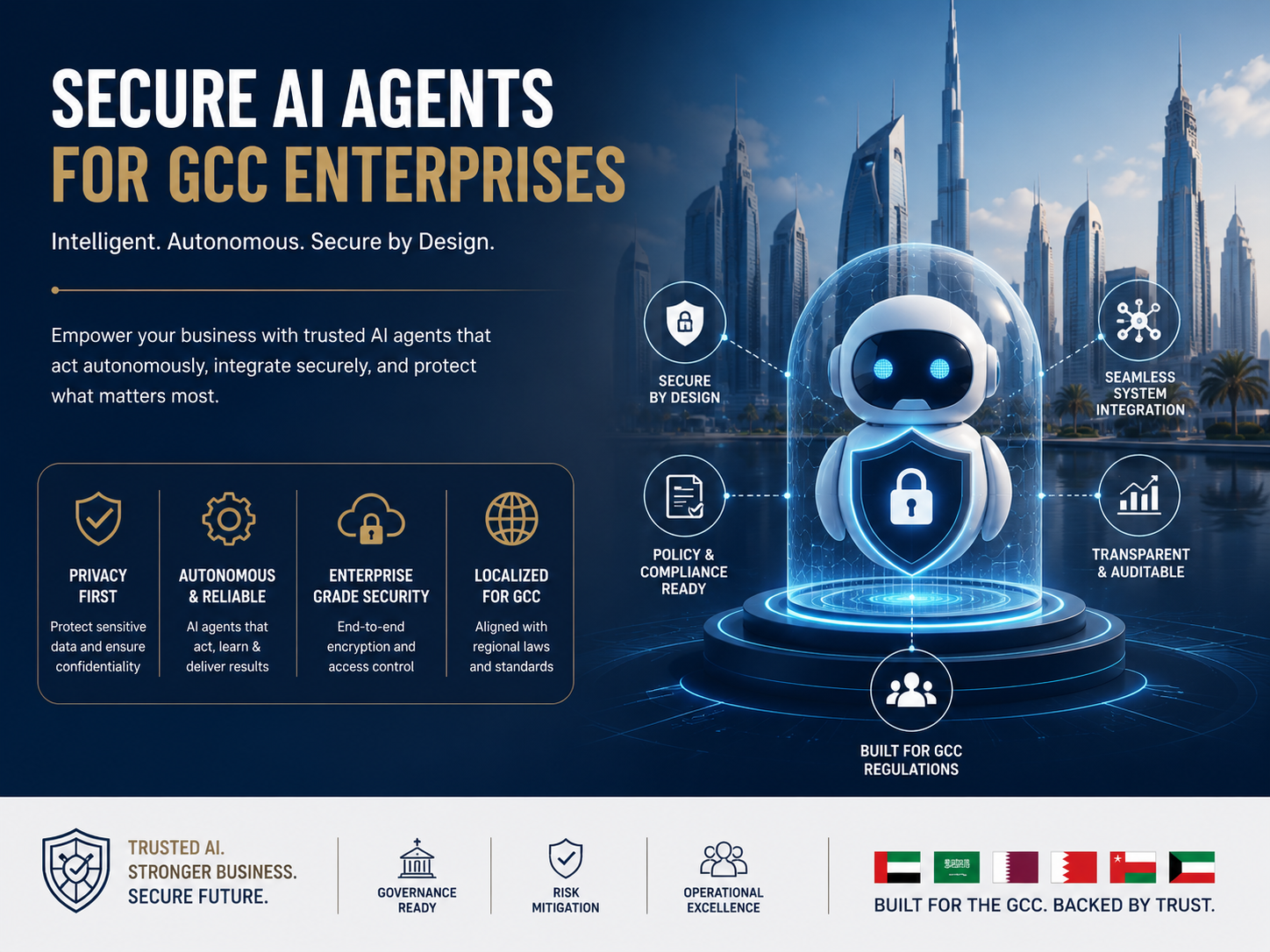
Secure AI Agents for GCC Enterprises
Secure AI agents can help GCC enterprises automate real business work without giving up control. For companies in Saudi Arabia, the UAE, and Qatar, the priority is not just using AI faster it is using AI safely, with clear permissions, audit logs, human approval, data protection, Arabic-English UX, and regulator-aware governance.
A secure AI agent is an AI system that can complete approved tasks through controlled tools, defined access, and monitored workflows. In practice, that means the agent can help with CRM updates, support replies, document summaries, or internal reporting, but it should never act beyond the limits your business has approved.
Why Secure AI Agents Matter in the GCC
AI agents are moving from innovation labs into daily workflows across Riyadh, Dubai, Abu Dhabi, Doha, and Jeddah. They can update CRM records, draft emails, analyze documents, trigger support workflows, and help teams move faster.
But secure AI agents are not just “smarter chatbots.” Once an agent can browse a website, access a CRM, send an email, or touch customer data, the risk becomes serious.
GCC enterprises need automation, but they also need regulator-aware controls, bilingual Arabic-English user experience, and a practical plan for identity, permissions, and data leakage prevention.
For Mak It Solutions clients exploring custom automation and AI-ready development, the goal is simple: design AI agents like enterprise systems, not casual experiments.
What Are Secure AI Agents for GCC Enterprises?
Secure AI agents are software assistants that understand goals, use tools, and complete approved tasks while staying inside defined security limits.
A chatbot answers questions.
A basic automation tool follows fixed rules.
An AI agent can plan, choose the next step, call tools, summarize information, and ask for approval before sensitive actions.
For example, a chatbot may tell a Dubai customer how to return an item. A secure AI agent can check the order, confirm the policy, prepare the reply in Arabic or English, and route refund approval to a human.
That difference is powerful but it also creates risk.
Why GCC Companies Are Moving Toward Agentic Workflows
Saudi Vision 2030, UAE digital government programs, and Qatar’s fintech growth are pushing businesses to reduce manual work and improve service speed.
Companies across the GCC want.
Faster onboarding
Smarter customer support
Better internal reporting
Bilingual Arabic-English automation
Safer document handling
More efficient compliance workflows
In Riyadh, fintech teams may use agents for compliance summaries. In Dubai, e-commerce brands can automate bilingual customer support. In Doha, SMEs can connect agents with cloud dashboards and CRM systems while keeping QCB expectations in mind.
The Biggest AI Agent Security Risks in Saudi, UAE, and Qatar
Secure AI agents can create value quickly, but only when the risks are understood early.
Browser Automation Risks
Browser agents can click the wrong button, submit a form too early, or expose sensitive information on a webpage.
A safer setup should.
Restrict allowed domains
Block risky actions
Log every browser session
Prevent form submission without approval
Separate test and production environments
For GCC companies handling customer data, browser automation should never be treated as a free-for-all workflow.
Email and CRM Risks
Email and CRM agents can accidentally send private details, update the wrong lead, or trigger a customer-facing message without approval.
Teams building AI workflow automation security should connect agents through scoped APIs, not shared admin accounts. For secure backend integrations, Mak It Solutions’ Node.js development services can support permission-based workflows.
A good rule: if the action affects a customer, account, payment, identity, or official record, the agent should either be restricted or require human review.
Prompt Injection and Tool Misuse
Prompt injection happens when malicious instructions hidden in a webpage, email, or document try to manipulate the agent.
For example, a document might tell the agent to ignore previous rules, reveal private data, or send information to an unauthorized destination.
The safest approach is least privilege: give the agent only the tools, files, and actions it truly needs.
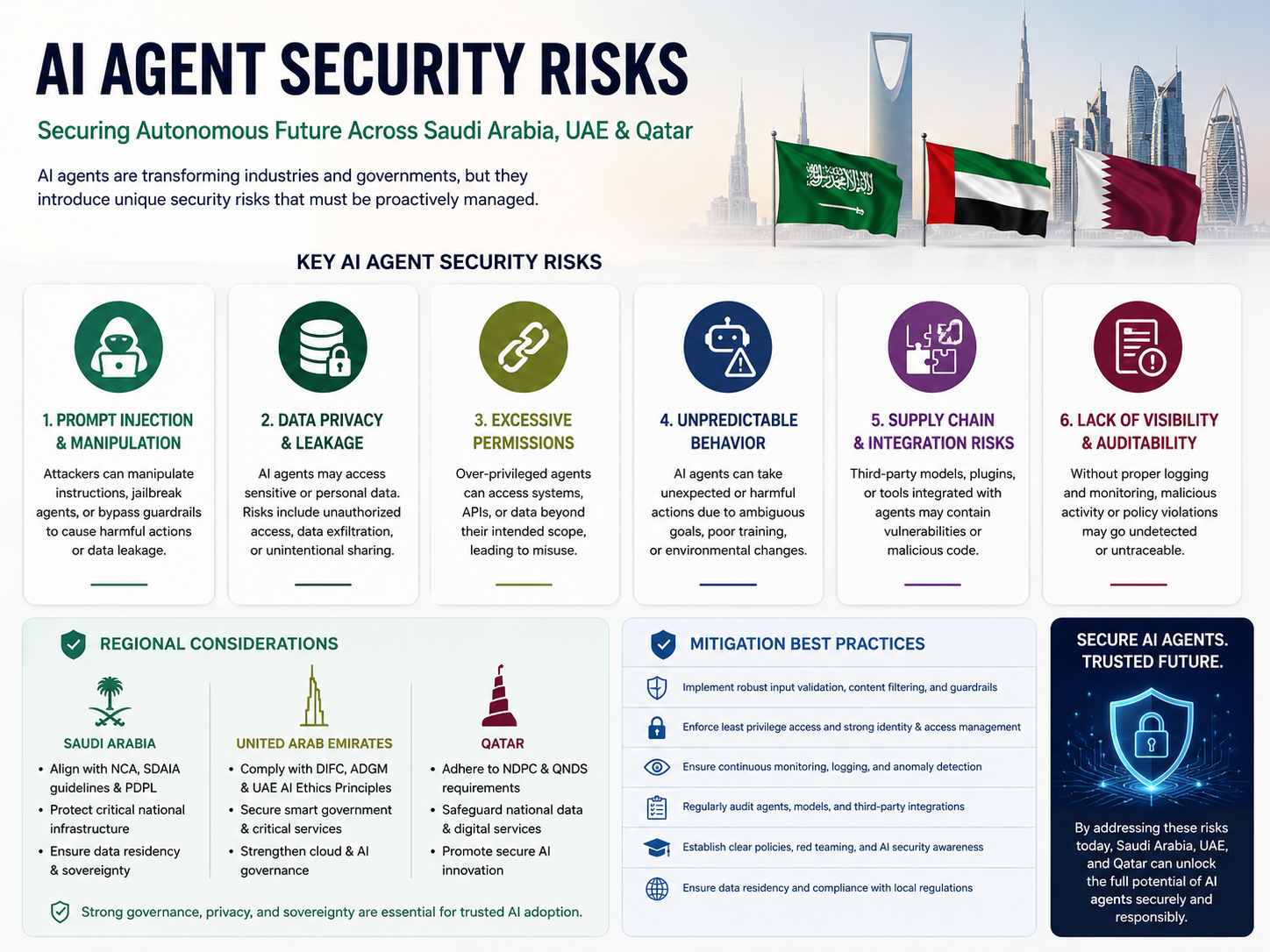
GCC Compliance Requirements for Secure AI Agents
Compliance should be part of the design from the start, especially for fintech, banking, healthcare, government, logistics, and customer-data-heavy businesses.
This section is general guidance, not legal or regulatory advice. Regulated firms should always review requirements with qualified compliance and legal teams.
Saudi Arabia.
Saudi fintech and banking workflows should consider SAMA’s cybersecurity expectations, especially around risk assessment, maturity, and control implementation.
SAMA’s Cyber Security Framework states that banks operating in Saudi Arabia must comply with the framework and assess their cybersecurity maturity.
For secure AI agents, this means Saudi enterprises should pay close attention to.
Identity and access control
Data classification
Audit logs
Risk assessment
Incident response
Vendor governance
Human approval for sensitive decisions
A Riyadh fintech startup, for example, may use an AI agent to summarize onboarding documents, but final customer-facing financial communication should stay with authorized staff.
UAE.
In the UAE, secure AI agents should align with digital identity and access governance.
TDRA describes UAE PASS as the first secure national digital identity for UAE citizens, residents, and visitors, with support for online services and digital signatures.
For Dubai and Abu Dhabi businesses, the practical lesson is clear: every AI agent action should be tied to a verified user, permission level, and audit trail.
This is especially important when agents interact with.
Customer accounts
Government portals
Identity workflows
Financial records
Regulated documentation
Internal approval systems
Qatar.
Qatar businesses, especially fintech firms, should watch QCB guidance closely.
Qatar Central Bank lists Artificial Intelligence Guidelines under its fintech resources, and QNA reported that QCB issued AI guidelines to regulate AI use in the financial sector.
For Doha-based companies, secure AI agents should be designed with governance, human oversight, data protection, and operational transparency in mind.
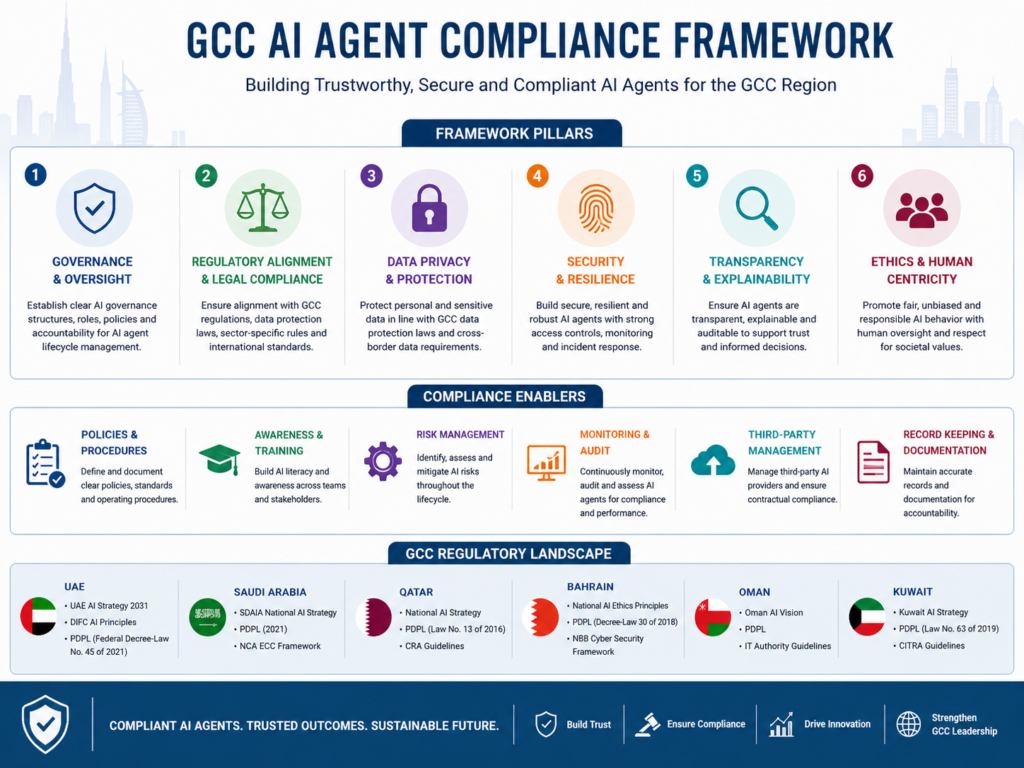
How to Build a GCC AI Agent Risk Model
A secure AI agent strategy starts with risk mapping. Before connecting an agent to email, CRM, ERP, cloud storage, or customer systems, define what it can and cannot do.
Map Every Agent Action by Risk Level
Classify agent actions into three basic risk levels.
| Risk Level | Example Action | Recommended Control |
|---|---|---|
| Low | Reading a public FAQ | Basic logging |
| Medium | Updating a CRM note | Role-based permission |
| High | Sending refunds, changing customer identity details, or issuing financial communication | Human approval required |
This makes the workflow easier for security, compliance, and business teams to understand.
Add Human Approval for Sensitive Workflows
Human-in-the-loop approval should be mandatory for regulated, financial, legal, health, and customer-impacting actions.
An AI agent can prepare the work.
A human should approve the decision.
This is especially important in SAMA-aware, TDRA-aware, ADGM-aware, and QCB-aware environments where accountability cannot simply be delegated to software.
Require Audit Logs, Identity Controls, and Access Reviews
Every AI agent action should leave a clear trail.
At minimum, logs should show.
Timestamp
User owner
Agent identity
Tool used
Data accessed
Action taken
Approval status
Final outcome
For code and security teams, Mak It Solutions’ AI-generated code security guide and AI vulnerability detection workflow guide can support safer development practices.
Secure AI Agent Use Cases Across GCC Industries
The strongest use cases are usually narrow, measurable, and easy to monitor.
Fintech and Banking
A Saudi fintech can use secure AI agents to summarize onboarding documents, flag missing KYC fields, and prepare internal compliance notes.
A Doha fintech can use QCB-aware automation for customer ticket triage while keeping final financial decisions with humans.
Good fintech use cases include.
KYC document summarization
Compliance note preparation
Internal policy search
Customer ticket classification
Risk flag explanations
Report drafting
The agent should support the team, not replace regulated decision-making.
Retail and CRM
A Dubai e-commerce brand can use secure AI agents to answer product questions, update CRM notes, and support Arabic-English conversations.
For mobile-first GCC customers, Mak It Solutions’ React Native development services can help build secure bilingual app experiences.
Useful retail workflows include.
Arabic-English support replies
Product recommendation drafts
CRM note updates
Return request triage
Order status summaries
Customer sentiment tagging
The key is to keep payment, refund, and account-change actions under tighter control.
Logistics and Government Workflows
A logistics company in Jeddah can automate shipment exception reporting. A public-sector vendor in Abu Dhabi can use agents for internal document search, provided identity and data leakage prevention are built in.
Strong governance matters most when workflows involve official documents, citizen data, regulated vendors, or cross-department approvals.
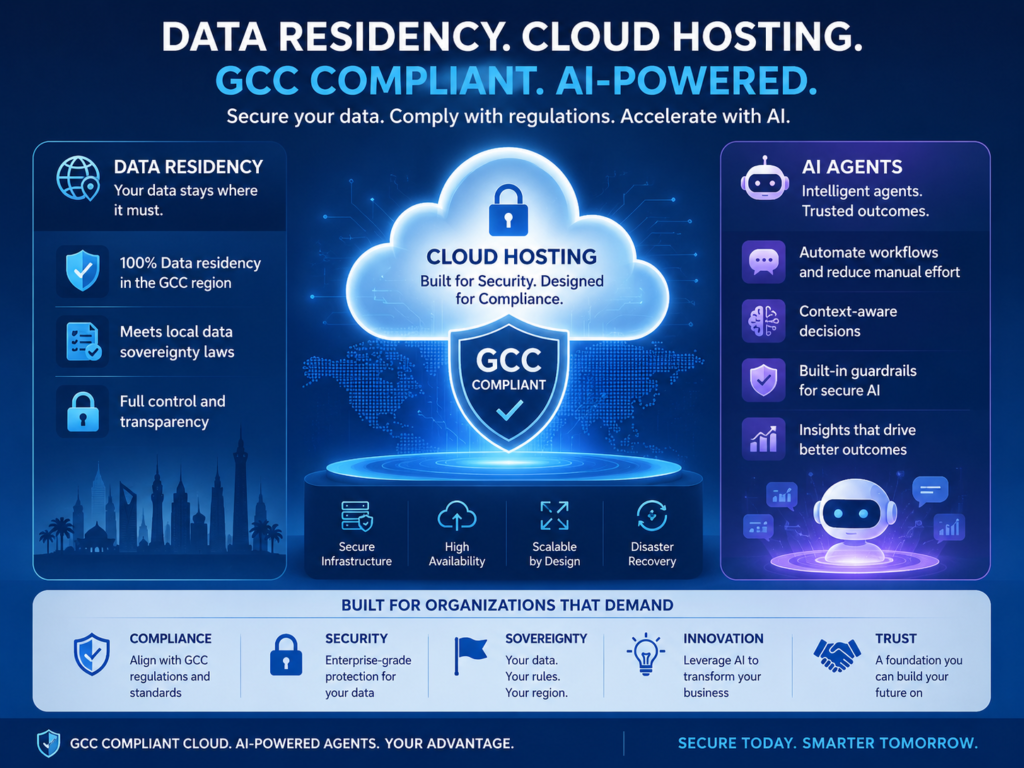
Data Residency, Cloud Hosting, and Arabic UX for GCC AI Agents
Data residency and hosting decisions should be discussed before production deployment, not after the agent is already connected to sensitive systems.
Saudi Data Residency and Regional Cloud Planning
For Saudi workloads, teams should evaluate data classification, residency obligations, and approved hosting options.
AWS launched its Middle East Bahrain Region in 2019 as its first Middle East region, with three Availability Zones. This is relevant for GCC enterprises comparing regional cloud options, although each Saudi workload still needs its own data residency and compliance review.
UAE Cloud Governance
UAE enterprises often consider local and regional cloud deployment options for latency, governance, and internal policy reasons.
When choosing a hosting model, ask.
Where is customer data stored?
Where are audit logs stored?
Can sensitive data be masked?
Can the agent run in a private environment?
Can different roles have different tool access?
Can data leave the region through third-party APIs?
These questions matter more than the cloud logo.
Qatar Cloud Options and Arabic UX
Google Cloud opened a Doha region with three zones and services such as Compute Engine, Cloud Run, Cloud SQL, GKE, and Spanner.
For Qatar-based businesses, this creates more options for regional architecture planning. Still, regulated firms should review hosting, data flows, third-party processing, and QCB expectations before deploying AI agents in production.
Arabic UX also matters. Agents should understand formal Arabic, Gulf Arabic tone, English switching, and local customer expectations.
Mak It Solutions’ Arabic RAG for company documents in GCC is a useful related resource for businesses building Arabic-first knowledge workflows.
How to Choose a Secure AI Agent Partner in the GCC
A secure AI agent partner should understand engineering, security, workflow design, and GCC business context.
Security Checklist for AI Agent Vendors
Ask whether the vendor supports.
Role-based access control
Data masking
Audit logs
Prompt injection defense
Human approval workflows
Environment separation
Secure API integrations
Arabic-English testing
Incident response planning
Permission reviews
The partner should also understand GCC industries such as fintech, government, logistics, health, and e-commerce.
Questions to Ask Before Deployment
Before signing off on an AI agent project, ask.
Can the agent act without approval?
Which tools can the agent access?
Where are logs stored?
Can we restrict tools by role?
Can we host in Bahrain, UAE, Doha, or another approved region?
Can Arabic and English workflows be tested separately?
What happens if the agent makes a mistake?
Can actions be rolled back?
How are sensitive prompts and outputs protected?
The answers should be clear, technical, and practical.
Red Flags to Avoid
Avoid vendors who cannot explain.
Permissions
Data storage
Audit trails
Rollback
Incident response
Prompt injection protection
GCC compliance expectations
Human approval design
A serious partner should connect strategy, engineering, and governance through a clear delivery plan, such as Mak It Solutions’ services hub.
Final Takeaway
Secure AI agents can help GCC enterprises move faster without losing control. The safest approach is to start with one high-value workflow, define the risk level, limit permissions, add human approval, and monitor every action through audit logs.
For Saudi, UAE, and Qatar businesses, success depends on more than automation. It depends on trust, compliance awareness, Arabic-English usability, secure integrations, and a partner who understands regional business realities.
Contact Mak It Solutions to review your workflows, map AI agent risks, and build a custom Saudi, UAE, or Qatar-ready automation strategy.
FAQs
Q : Are secure AI agents allowed for Saudi fintech companies?
A : Yes, Saudi fintech companies can explore secure AI agents, but they should treat them as controlled enterprise systems rather than open-ended tools. For SAMA-regulated or finance-adjacent workflows, agents should have limited permissions, audit logs, human approval, and clear data governance.
Q : Do UAE companies need TDRA or UAE PASS considerations for AI agents?
A : Yes, especially when AI agents interact with identity, digital services, government portals, or customer accounts. UAE PASS is central to digital identity in the UAE, so Dubai and Abu Dhabi companies should think carefully about authentication, consent, and access control.
Q : Can Qatar businesses use AI agents for CRM and customer support?
A : Yes, Qatar businesses can use AI agents for CRM, support tickets, bilingual responses, and internal workflow automation. Doha-based companies in fintech or regulated sectors should consider QCB guidance, data protection expectations, and human oversight.
Q : What data should GCC companies avoid giving to AI agents?
A : GCC companies should avoid giving AI agents unrestricted access to national IDs, payment data, health records, passwords, confidential contracts, private emails, and full customer databases. If an agent needs sensitive data, use masking, role-based access, and logging.
Q : How much control should humans keep over AI agents in regulated GCC industries?
A : Humans should keep control over high-risk actions, especially in banking, fintech, health, government, and legal workflows. AI agents can collect information, summarize records, suggest next steps, and prepare drafts, but humans should approve actions that affect money, identity, eligibility, compliance, or customer rights.